Introduction to Quantum Computing
Introduction to Quantum Mechanics
The World on a Smaller Scale
The world we see every day follows a predictable set of rules. If you roll a ball, you can track its path. If you flip a light switch, you know the light will turn on. But when we zoom way down to the level of atoms and the particles inside them, the rules change completely. This is the realm of quantum mechanics, and it's where things get weird, wonderful, and counterintuitive.
Wave or Particle?
In our world, things are either particles (like a grain of sand) or waves (like a ripple in a pond). They are distinct categories. In the quantum world, this isn't true. Particles like electrons and photons can act like both.
This concept is called wave-particle duality. Depending on how you observe it, a quantum object can behave like a localized, distinct particle or a spread-out, interfering wave.
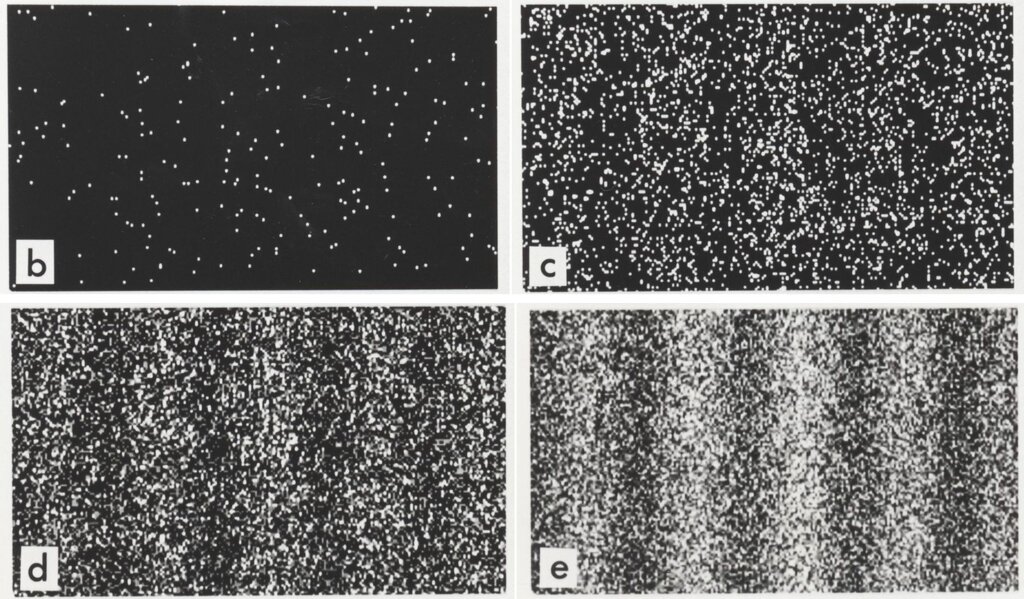
The famous double-slit experiment shows this perfectly. If you fire a stream of electrons at a screen with two narrow slits, you might expect two bands to appear behind the slits, like you were firing tiny pellets. Instead, you get a complex interference pattern of many bands, which is exactly what happens when waves pass through two slits and interfere with each other.
The strangest part? If you place a detector to see which slit each electron goes through, the wave pattern disappears. The very act of observing forces the electron to behave like a particle, and the two bands appear as expected. The quantum world seems to know when it's being watched.
At the quantum level, an object isn't just one thing or the other. It's a combination of possibilities, a particle and a wave, all at once.
The Uncertainty Principle
Another core idea of quantum mechanics is that there's a fundamental limit to what we can know about a particle at any given moment. This is known as Heisenberg's Uncertainty Principle.
Imagine trying to measure the exact position of a moving billiard ball by hitting it with another ball. The moment of collision tells you where the first ball was, but the impact changes its speed and direction. Measuring a quantum particle is similar, but the disturbance is an unavoidable part of the process.
The principle states that you cannot simultaneously know both the precise position and the precise momentum (which is its mass times its velocity) of a particle. The more accurately you measure one, the less accurately you can know the other.
In this formula, represents the uncertainty in position, and represents the uncertainty in momentum. The symbol (h-bar) is the reduced Planck constant, which is just an extremely small, fixed number. This isn't a limitation of our tools; it's a fundamental property of nature. There's an inherent fuzziness to reality at the quantum scale.
States of Possibility
Since we can't know a particle's exact properties, how do we describe it? We use something called a quantum state. A quantum state doesn't tell you what a particle is doing, but rather what it could be doing. It's a mathematical description of all the possibilities and their likelihoods.
Think of a spinning coin. Before it lands, it's not definitively heads or tails. It's in a state that encompasses both possibilities. When it lands (when we make a measurement), it
A quantum state is the complete description of a quantum system. It encapsulates all the probabilities for the outcomes of any measurement that could be performed on it.
This idea leads to a concept called superposition, where a particle can exist in multiple states at the same time. An electron, for example, can have a spin that is simultaneously "up" and "down." It's only when we measure the spin that it settles into one definite state. Before the measurement, it exists in a haze of probabilities, described perfectly by its quantum state.