Introduction to Quantum Computing
Introduction to Quantum Computing
Beyond Bits and Bytes
Classical computers, from your smartphone to the most powerful supercomputers, work with bits. A bit is a simple switch that can be in one of two states: on or off, represented by a 1 or a 0. All the amazing things classical computers do boil down to manipulating billions of these tiny switches.
Quantum computers operate on a completely different principle. Their fundamental unit of information is the quantum bit, or qubit. Unlike a classical bit, a qubit isn't limited to just 0 or 1. It can be a 0, a 1, or a combination of both at the same time.
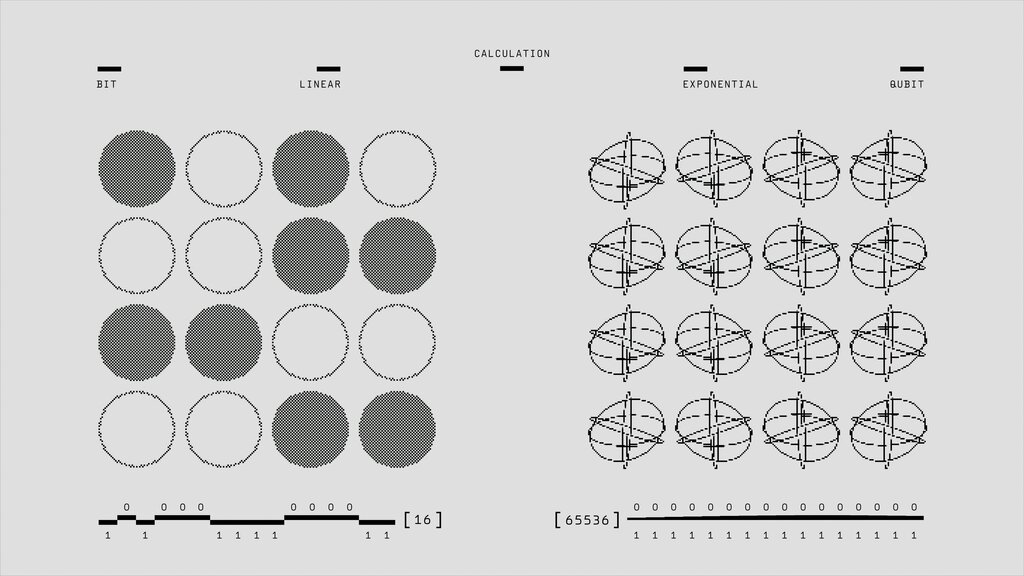
This ability to hold multiple values simultaneously is a core feature of quantum mechanics, and it opens up a new world of computational possibilities.
The Power of Superposition
The idea that a qubit can be both 0 and 1 at the same time is called superposition. Think of it like a spinning coin. While it's in the air, it's neither heads nor tails—it's a blur of both possibilities. Only when it lands (or when we measure it) does it settle into a definite state.
A qubit exists in a superposition of states until it is measured. When measured, it collapses to either a 0 or a 1. Mathematically, we can describe the state of a qubit, often represented as (pronounced "ket psi"), like this:
Here, and are probability amplitudes. The probability of measuring the qubit as a 0 is , and the probability of measuring it as a 1 is . The sum of these probabilities must equal 1.
This property is what makes quantum computers so powerful. A classical 3-bit register can store only one of eight possible combinations (000, 001, 010, etc.) at any given time. A 3-qubit system, however, can hold all eight of those combinations in superposition at once.
Each time you add a qubit, the computational power doubles. With just a few hundred qubits, you could represent more numbers than there are atoms in the known universe.
Entanglement's Spooky Connection
Another strange but powerful quantum property is entanglement. This happens when two or more qubits become linked in such a way that their fates are intertwined, no matter how far apart they are.
Imagine you have two "entangled" coins. You give one to a friend who travels to the other side of the world. When you flip your coin and it lands on heads, you instantly know that your friend's coin must have landed on tails. This connection is immediate and independent of distance. Albert Einstein famously called this phenomenon "spooky action at a distance."
In a quantum computer, entanglement allows qubits to correlate their states in ways that have no classical equivalent. This deep connection is a crucial resource that quantum algorithms use to solve complex problems that are intractable for even the fastest classical supercomputers.
A New Kind of Machine
The principles of superposition and entanglement mean that quantum computers are built and operated very differently from the computers we use every day. Qubits are incredibly fragile. Any disturbance from the outside world, like a tiny change in temperature or a stray magnetic field, can destroy their quantum state in a process called decoherence.
To protect the qubits, quantum computers are often housed in large, complex machines called dilution refrigerators that cool them to temperatures colder than deep space, just a fraction of a degree above absolute zero.
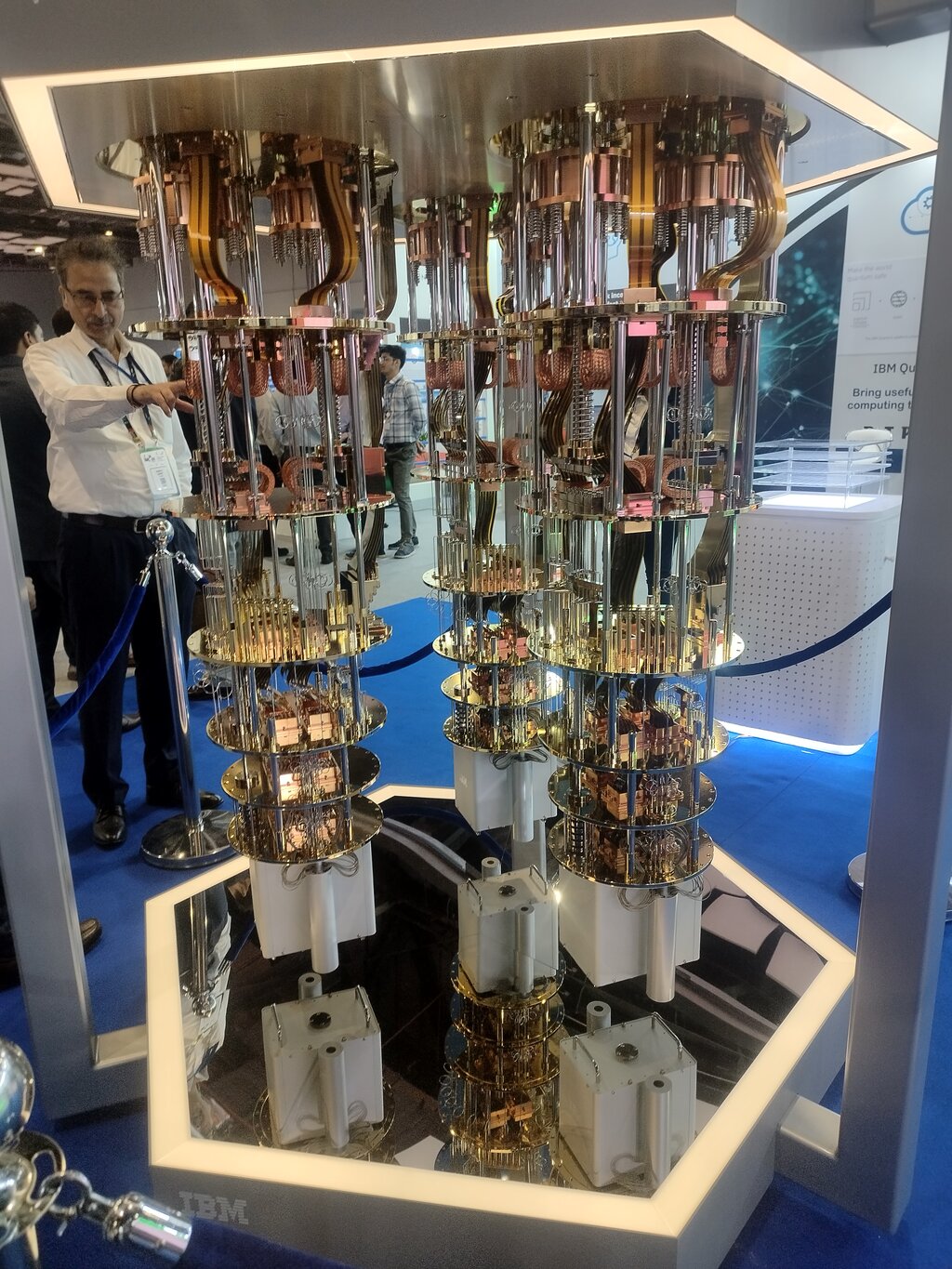
Here’s a quick comparison:
| Feature | Classical Computer | Quantum Computer |
|---|---|---|
| Basic Unit | Bit | Qubit |
| State | 0 or 1 | 0, 1, or both (superposition) |
| Processing | Processes data sequentially | Processes many possibilities at once |
| Connections | Bits are independent | Qubits can be entangled |
| Environment | Room temperature | Near absolute zero, shielded |
Now let's review these key ideas.
Ready to check your understanding?
What is the fundamental unit of information in a quantum computer?
The principle that allows a qubit to represent both 0 and 1 at the same time is known as:
By harnessing these quantum phenomena, scientists and engineers are building a new type of computer that promises to revolutionize fields like medicine, materials science, and artificial intelligence.