Introduction to Quantum Computing
Introduction to Quantum Computing
Beyond Bits and Bytes
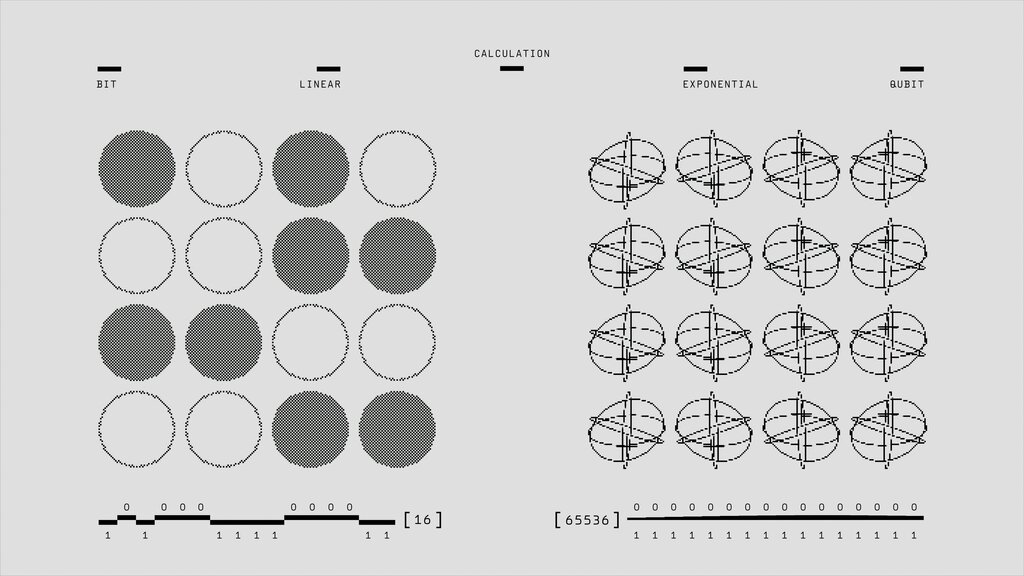
For centuries, our idea of computation has been built on a simple concept: the bit. A bit is the smallest unit of data in a computer, and it can only be in one of two states, a 0 or a 1. Think of it like a light switch. It's either on or off. Every app on your phone, every website you visit, and every video you stream is built from billions of these simple on-or-off switches working together.
This binary system is incredibly powerful and has taken us from room-sized calculators to supercomputers in our pockets. But some problems are so complex that even the fastest supercomputers would take billions of years to solve them. These are problems like designing new medicines by simulating molecules, creating new materials with specific properties, or breaking the complex encryption that protects our data.
To tackle these challenges, we need a new kind of computation. We need to go beyond the simple on-or-off world of classical bits and into the strange and fascinating realm of quantum mechanics.
The Quantum Advantage
Quantum computing isn't just a faster version of what we have now. It's a completely different way of processing information. It operates on the principles of quantum mechanics, the physics that governs how matter behaves at the atomic and subatomic levels. At this tiny scale, the rules of our everyday world don't apply. Particles can be in multiple places at once and can be mysteriously linked over vast distances.
By harnessing these properties, quantum computers can perform calculations in a way that classical computers simply cannot.
qubit
noun
The basic unit of quantum information. It can represent a 0, a 1, or a superposition of both states simultaneously.
The magic of the qubit comes from a property called superposition. While a classical bit must be either a 0 or a 1, a qubit can be in a combination of both states at the same time. It's like a spinning coin before it lands. It's not heads and it's not tails; it's a mix of both possibilities. Only when we measure it, or force it to land, does it settle into a definite state of either 0 or 1.
This ability to exist in multiple states at once allows quantum computers to explore a vast number of possibilities simultaneously. While a classical computer checks each path one by one, a quantum computer can check many paths at the same time.
Entanglement
The other key quantum concept is entanglement. This is a special connection between a pair or a group of qubits. When qubits are entangled, their fates are linked, no matter how far apart they are. If you measure the state of one qubit, you instantly know the state of the other.
Albert Einstein famously called this "spooky action at a distance." This interconnectedness allows for powerful information processing. By entangling qubits, a quantum computer can perform complex calculations where the result depends on the relationship between many different variables. It's like having a team of workers who are all perfectly in sync, even without communicating directly.
Superposition lets a qubit explore many possibilities at once. Entanglement links qubits together so they can work in concert to solve complex problems.
Because of these properties, adding more qubits to a quantum computer increases its power exponentially. A computer with just 300 qubits could, in theory, explore more states than there are atoms in the known universe. This is the promise of quantum computing: to solve problems that are currently beyond our reach.

Before you get started on your quantum journey, let's review the key concepts we've covered.
Now, let's test your knowledge.
What is the fundamental unit of data in a classical computer, which can only be in one of two states: 0 or 1?
The quantum principle that allows a qubit to be in a combination of both 0 and 1 states at the same time is known as:
Building a stable, large-scale quantum computer is a massive scientific and engineering challenge, but the field is advancing rapidly. Understanding these fundamental concepts is the first step toward appreciating the computational revolution that's on the horizon.