Introduction to Quantum Computing
Introduction to Quantum Computing
A Different Kind of Computing
For decades, computers have worked on a simple principle. Information is stored as bits, which are like tiny light switches that can be either on or off. We represent these two states as 1 and 0. Every app you use, every photo you take, and every website you visit is built on this binary foundation. It’s a powerful system that has taken us from room-sized calculators to smartphones in our pockets.
But some problems are just too complex for this approach. Simulating new molecules for medicine, designing revolutionary materials, or breaking sophisticated encryption can involve a staggering number of variables. A classical computer would have to check every possibility one by one, a process that could take thousands of years. Quantum computing offers a completely new way to process information, built on the strange and fascinating rules of quantum mechanics.
The Quantum Bit
The foundation of quantum computing isn't the bit, but the qubit. While a classical bit is definitively a 0 or a 1, a qubit is far more flexible. It can be a 0, a 1, or a combination of both at the same time. This “both-at-once” property is called superposition.
Qubit
noun
The basic unit of quantum information. It is the quantum analogue of the classical bit.
Think of a spinning coin. While it's in the air, it's neither heads nor tails, but a blur of both possibilities. Only when it lands and you measure it does it settle into a single, definite state. A qubit is like that spinning coin. It exists in a spectrum of possibilities until it is measured.
Superposition and Entanglement
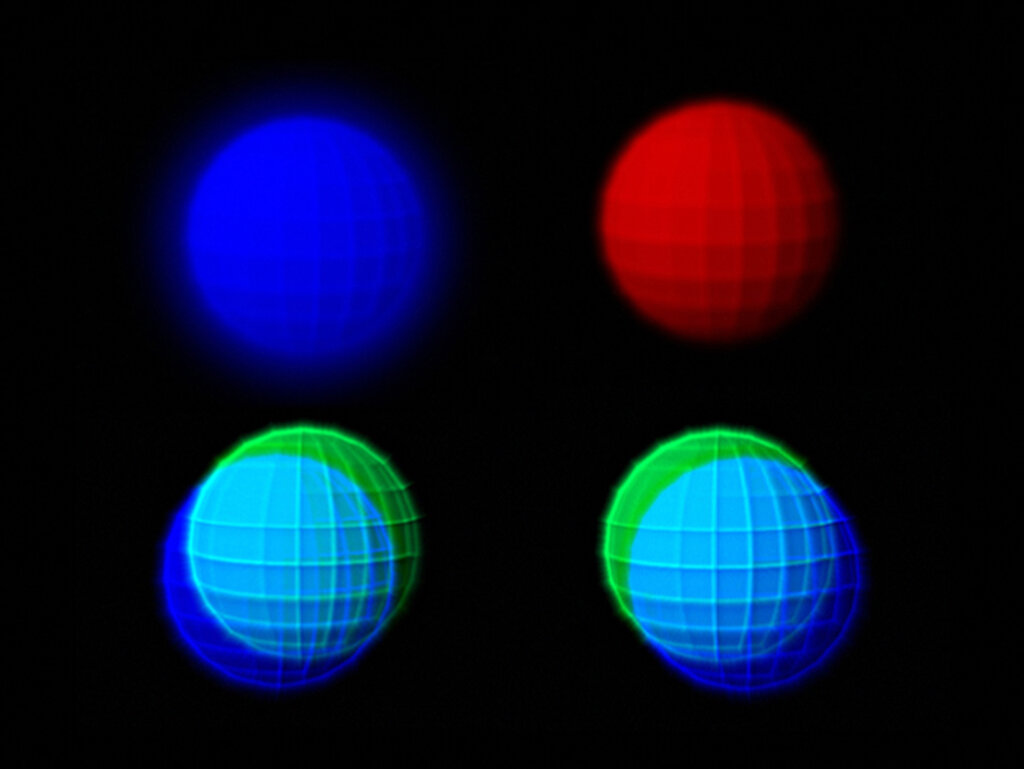
Superposition is what allows a qubit to hold more information than a classical bit. We can describe the state of a qubit mathematically.
The other key principle is entanglement. This is a special connection that can exist between two or more qubits. If two qubits are entangled, their fates are linked, no matter how far apart they are. If you measure one and find it's a 0, you instantly know the other is a 1, and vice versa. Albert Einstein famously called this "spooky action at a distance."
This connection isn't just a curiosity; it's a powerful resource. Entanglement allows qubits to correlate their information in ways that have no classical equivalent, which is essential for many quantum algorithms.
Quantum vs. Classical
The differences between classical and quantum computing are fundamental. Superposition and entanglement give quantum computers an enormous advantage for certain types of problems.
| Feature | Classical Computing | Quantum Computing |
|---|---|---|
| Basic Unit | Bit | Qubit |
| State | 0 or 1 | 0, 1, or a superposition of both |
| Power | Scales linearly. Adding a bit adds one bit of information. | Scales exponentially. Adding a qubit doubles the computational space. |
Because a qubit can represent both 0 and 1 at the same time, a quantum computer with just a few qubits can explore a massive number of possibilities simultaneously. Two qubits can represent four states at once (00, 01, 10, 11). Three qubits can represent eight states. With 300 qubits, a quantum computer could represent more states than there are atoms in the observable universe.
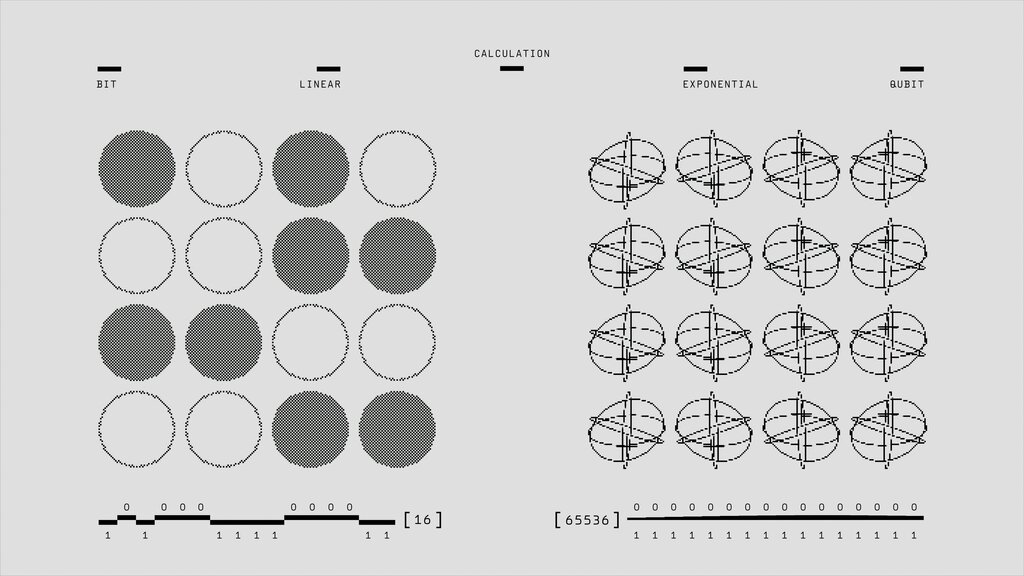
This exponential power makes quantum computers uniquely suited for solving certain problems. Potential applications include:
- Drug Discovery: Simulating molecules with perfect accuracy to design new medicines.
- Materials Science: Creating new materials with desired properties, like more efficient solar cells or better batteries.
- Financial Modeling: Optimizing investment strategies by analyzing complex market dynamics.
- Cryptography: Breaking current encryption standards and creating new, unhackable ones.
Let's review the key terms we've just covered.
Now, let's test your understanding of these foundational ideas.
What is the fundamental unit of information in a quantum computer?
The principle that allows a qubit to be a 0 and a 1 at the same time is called:
Quantum computing is still in its early days, much like classical computing was in the 1950s. But by harnessing the principles of quantum mechanics, it promises to reshape technology and solve problems we once thought were impossible.