Introduction to Quantum Computing
Introduction to Quantum Computing
Beyond Bits and Bytes
Classical computers, from your smartphone to the most powerful supercomputers, work with bits. A bit is the smallest unit of data, and it can only be in one of two states: a 0 or a 1. Think of it like a light switch. It's either on or it's off. There's no in-between.
Quantum computing throws that rule out the window. It's a completely different way of processing information, built on the strange and fascinating rules of quantum mechanics.
From this class, I came to understand that quantum computing is a new way of building computers that uses the laws of quantum physics rather than classical electronics.
Instead of relying on simple on-or-off switches, quantum computers use something far more flexible to store and manipulate information.
The Quantum Bit, or Qubit
The basic unit of quantum information is the quantum bit, or qubit. It's the quantum equivalent of the classical bit, but with a crucial difference.
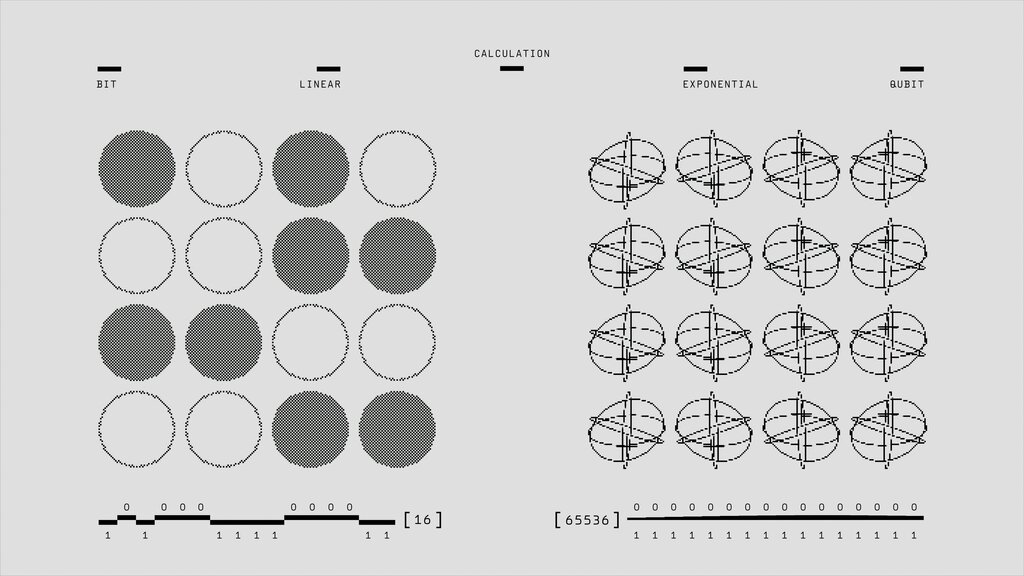
A qubit can be a 0, a 1, or a blend of both at the same time. This “both-at-once” property is called superposition. Imagine spinning a coin. While it's in the air, it's not quite heads and not quite tails. It's in a combination of both states. Only when it lands and you measure it does it settle into a definite outcome.
A qubit is like that spinning coin. It exists in a superposition of 0 and 1 until the moment you measure it, at which point it “collapses” into one of the two classical states.
Superposition and Entanglement
Superposition is what gives quantum computers their immense potential. Because a qubit can hold multiple values simultaneously, a quantum computer with just a few qubits can explore a vast number of possibilities at once.
Mathematically, we can describe the state of a qubit, written as , as a combination of the basis states and .
Here, and are complex numbers called amplitudes. The probability of measuring the qubit as a 0 is , and the probability of measuring it as a 1 is . The sum of these probabilities must always equal 1, because the qubit has to be in one of the two states upon measurement.
Quantum mechanics has another strange property called entanglement. When two or more qubits become entangled, their fates are linked. No matter how far apart they are, the state of one qubit instantly affects the state of the other. If you measure one entangled qubit and find it's a 0, you instantly know the state of its partner. Albert Einstein famously called this “spooky action at a distance.”
Quantum entanglement is a fundamental resource for quantum computing as it involves the distribution of information in a fundamentally non-classical way.
This deep connection between qubits allows for powerful computational tricks that are impossible on classical computers.
Quantum Gates
So how do we perform calculations with these qubits? In classical computing, we use logic gates like AND, OR, and NOT to manipulate bits. Quantum computing has its own version: quantum gates.
Quantum gates are operations that change the state of one or more qubits. For example, a gate might rotate the state of a qubit, changing its probabilities of being a 0 or a 1. The Hadamard gate, or H gate, is one of the most fundamental. It takes a qubit that is definitely a 0 or a 1 and puts it into a perfect superposition, with an equal chance of being measured as either.
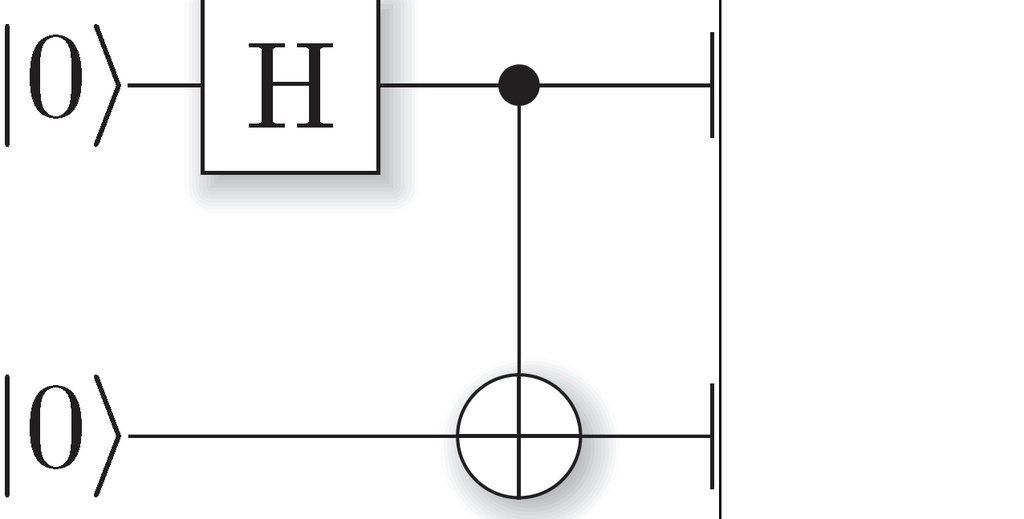
Other gates can entangle qubits or perform other complex transformations. By stringing these gates together into a sequence called a quantum circuit, programmers can build algorithms that harness the power of superposition and entanglement to solve specific problems.
These principles are the building blocks of quantum computing. They allow these machines to tackle certain types of problems, like factoring large numbers or simulating molecules, far more efficiently than any classical computer ever could.
Let's check your understanding of these foundational ideas.
What is the primary difference between a classical bit and a quantum bit (qubit)?
The state of a qubit is described by the equation . What is the relationship between the amplitudes and ?
By moving beyond simple on/off states, quantum computing opens up a new frontier of computational possibilities.