Introduction to Quantum Computing
Introduction to Quantum Computing
The Quantum Bit
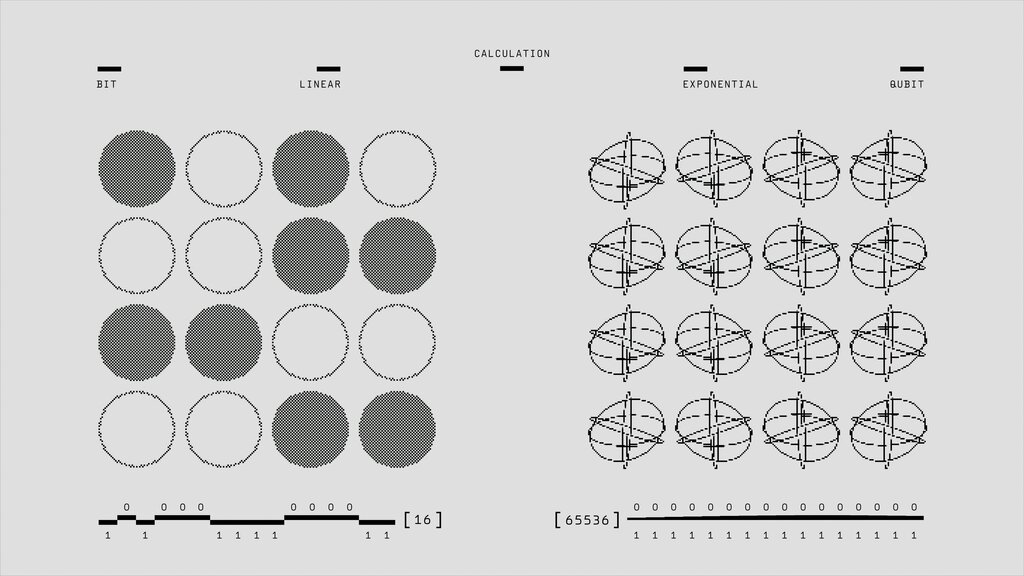
Classical computers operate on bits, which are like tiny light switches. A bit can be either on (represented by 1) or off (represented by 0). All the complex tasks your computer performs boil down to manipulating these simple binary states.
Quantum computing starts by reimagining this fundamental unit. Instead of a bit, it uses a qubit. A qubit can also be in a state of 0 or 1. In quantum mechanics, these are written using a special notation called Dirac notation, as and . But unlike a classical bit, a qubit isn't limited to just these two states.
The state of a qubit can be visualized as a point on the surface of a sphere, known as the Bloch sphere. The North Pole represents , the South Pole represents , and every other point on the surface represents a unique combination of the two.
Beyond On and Off
This ability to exist in a combination of states is called superposition. Think of a spinning coin. While it's in the air, it's neither heads nor tails. It's in a fuzzy, probabilistic state that's a blend of both possibilities. Only when it lands (when we measure it) does it collapse into a definite outcome.
A qubit in superposition is similar. It exists as a weighted combination of both and simultaneously. We can write the state of a qubit, , mathematically.
The key constraint is that the probabilities must add up to 100%. This is expressed as:
By holding information in superposition, a quantum computer with just a few hundred qubits could explore a vast number of possibilities at once, a feat that would be impossible for even the most powerful classical supercomputers.
A Spooky Connection
The final core concept is entanglement. This is a uniquely quantum phenomenon where the fates of two or more qubits become intertwined. If two qubits are entangled, they form a single quantum system, even if they are physically separated by vast distances.
Imagine you have two coins that are magically linked. You give one to a friend who travels to the other side of the world. The instant you look at your coin and see that it's heads, you know with absolute certainty that your friend's coin is tails. You don't know the outcome beforehand, but you know their results are perfectly correlated.
Measuring one entangled qubit instantly influences the state of the other, a property Albert Einstein famously called “spooky action at a distance.”
This connection isn't about sending a signal faster than light. Rather, the measurement outcome was never determined for either qubit until one of them was measured. The moment one is measured, the uncertainty for both collapses instantly.
One of the simplest entangled states, called a Bell state, is written as:
Entanglement is a crucial resource in quantum computing. It allows for the creation of complex quantum states and is the backbone of many quantum algorithms and quantum communication protocols.
Now, let's check your understanding of these foundational concepts.
What is the fundamental difference between a classical bit and a quantum qubit?
The state of a qubit in superposition is often described mathematically as . What is the essential relationship between the coefficients α and β?
Qubits, superposition, and entanglement are the building blocks that give quantum computers their power. By manipulating these quantum properties, we can approach problems in entirely new ways.