Introduction to Quantum Computing
Introduction to Quantum Computing
Beyond Zeros and Ones
Classical computers, from your smartphone to the most powerful supercomputers, think in a very straightforward way. They use bits, which are like tiny light switches that can be either on or off. We represent these states as 1 and 0. Every app you use, every photo you take, is ultimately just a vast sequence of these ones and zeros.
Quantum computing operates on a completely different principle. It uses a new kind of bit, one that's not limited to just two states.
Qubit
noun
The basic unit of quantum information. A qubit can represent a zero, a one, or a combination of both states simultaneously.
This ability to exist in multiple states at once is a core concept in quantum mechanics called superposition.
The Power of Superposition
Imagine spinning a coin. While it's in the air, spinning rapidly, it’s not definitively heads or tails. It's in a fuzzy, probabilistic state—a combination of both possibilities. Only when it lands (when we measure it) does it settle into a single, definite outcome: either heads or tails.
A qubit is like that spinning coin. It can be in a superposition of both and states at the same time. We can write this state as:
Here, and are numbers called probability amplitudes. When we measure the qubit, the probability of finding it in state is , and the probability of finding it in state is . These probabilities must add up to 1.
This single property dramatically expands the amount of information a single unit can hold. Instead of just 0 or 1, a qubit represents a continuous range of possibilities.
While one qubit is powerful, the true potential of quantum computing emerges when we link them together.
Quantum Entanglement
Entanglement is one of the strangest and most powerful aspects of quantum mechanics. When two or more qubits are entangled, their fates become intertwined. The state of one qubit instantly influences the others, no matter how far apart they are.
Think of it like having two magic coins. You flip them, send one to a friend on the other side of the world, and keep one for yourself. The moment you look at your coin and see it's heads, you instantly know your friend's coin is tails. Before you looked, both coins were in an uncertain state, but measuring one immediately determined the state of the other.
This connection is what Albert Einstein famously called "spooky action at a distance." It doesn't allow for faster-than-light communication, but it does allow for incredibly powerful computations by creating complex, correlated states across many qubits.
The exponential growth in computing power is a key advantage. With just 300 entangled qubits, a quantum computer could represent more states than there are atoms in the known universe.
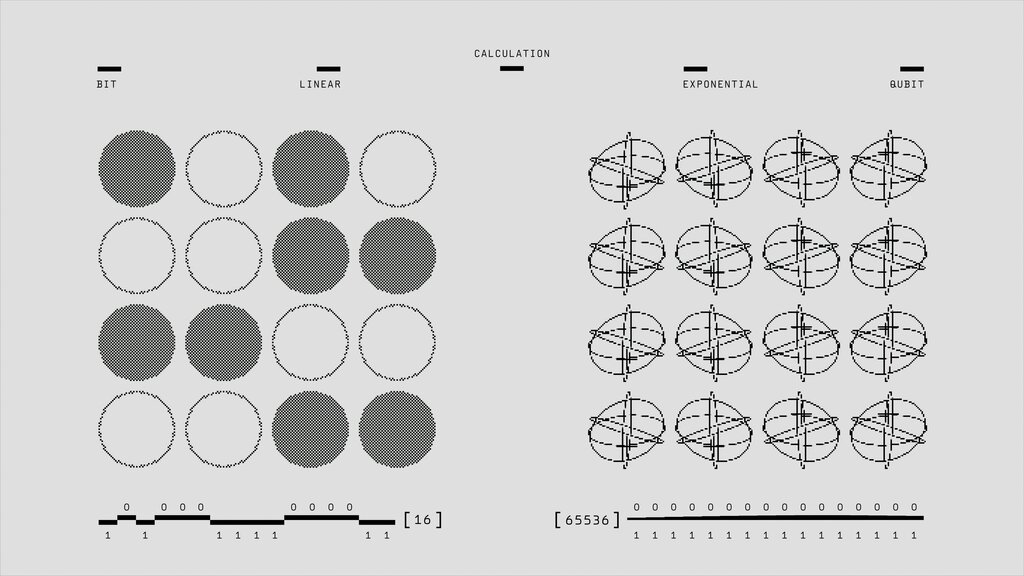
Solving Problems Differently
Quantum computers aren't just faster versions of classical computers. They don't run Windows or browse the internet. Instead, they are specialized machines designed to solve specific types of problems that are impossible for even the most powerful classical supercomputers.
This is achieved through quantum algorithms. These are special procedures that manipulate qubits in superposition and entanglement to find solutions. Instead of checking possibilities one by one, a quantum algorithm can explore a vast number of potential solutions simultaneously.
Quantum computers approach solving problems in a fundamentally new way.
Famous examples include:
- Shor's Algorithm: Can find the prime factors of very large numbers, a task that would take a classical computer billions of years. This has huge implications for cryptography.
- Grover's Algorithm: Can search an unsorted database much faster than any classical algorithm.
These algorithms leverage quantum principles to tackle problems in fields like materials science, drug discovery, and financial modeling. They open up new possibilities for solving some of humanity's most complex challenges.
Now, let's test your understanding of these fundamental concepts.
What is the fundamental difference between a classical bit and a quantum bit (qubit)?
The state of a qubit is described by the equation . What does represent?
This is just the beginning of the quantum journey. By harnessing the unique properties of the quantum world, we are building a new generation of computers with the potential to reshape our world.