Introduction to Quantum Computing
Introduction to Quantum Computing
A New Kind of Computer
Your phone, your laptop, every computer you've ever used works on a simple principle. Information is broken down into bits, which are like tiny light switches. A bit can be either ON or OFF, represented by a 1 or a 0. That's it. All the amazing things classical computers do, from streaming movies to sending messages, are built on billions of these simple 1s and 0s.
Quantum computing doesn't just improve on this idea; it throws out the rulebook and starts fresh, using the strange and wonderful laws of quantum mechanics to process information in a completely new way.
Meet the Qubit
Instead of bits, quantum computers use qubits. A qubit can be a 0, and it can be a 1. But thanks to a principle called superposition, it can also be in a combination of both states at the same time.
qubit
noun
The basic unit of quantum information. It is the quantum analogue of the classical bit.
Think of a spinning coin. While it's in the air, it's not quite heads and not quite tails. It's in a fuzzy, probabilistic state of both. Only when it lands (when we measure it) does it settle on a definite outcome, heads or tails. A qubit is like that spinning coin. This ability to exist in multiple states at once allows quantum computers to explore many possibilities simultaneously, giving them a massive computational advantage for certain problems.
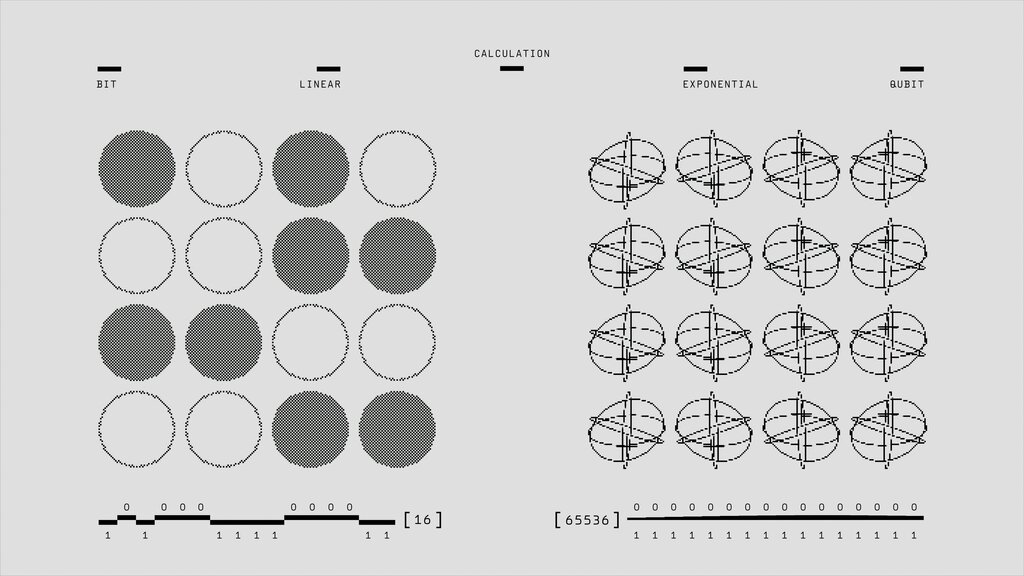
Superposition is only half the story. The other key principle that gives quantum computers their power is entanglement.
Spooky Connections
Quantum entanglement is a phenomenon where two or more qubits become linked in a special way. Their fates are intertwined, no matter how far apart they are. If you measure one entangled qubit and find it's a 0, you instantly know its partner must be a 1, and vice versa. Albert Einstein famously called this "spooky action at a distance."
This connection is like having a pair of magic gloves. Imagine you put one in a box and your friend takes the other box to the other side of the world. The moment you open your box and see a left-handed glove, you know, without a doubt, that your friend has the right-handed one. Entanglement creates these perfect correlations between qubits, allowing for complex information processing that isn't possible in the classical world.
Why Bother?
Quantum computers aren't here to replace your laptop for browsing the web or writing emails. Classical computers are excellent at those tasks. Instead, quantum computers are designed to tackle problems that are currently impossible for even the most powerful supercomputers to solve.
Potential applications are vast and transformative. They include:
- Drug Discovery and Materials Science: Simulating molecules and materials at the quantum level to design new drugs and invent novel materials with desired properties.
- Optimization Problems: Solving complex logistical challenges, like optimizing shipping routes or financial modeling, which involve a staggering number of variables.
- Cryptography: Breaking current encryption codes, but also enabling new, ultra-secure methods of communication.
| Feature | Classical Computing | Quantum Computing |
|---|---|---|
| Basic Unit | Bit | Qubit |
| State | 0 or 1 | 0, 1, or a superposition of both |
| Key Principles | Logic gates | Superposition & Entanglement |
This new computing paradigm is still in its early days, much like classical computing was in the 1950s. But its potential to reshape science, medicine, and technology is enormous. Let's check your understanding of these core ideas.
What is the fundamental unit of information in a quantum computer?
The principle that allows a qubit to exist in a combination of both 0 and 1 states at the same time is called:
Understanding qubits, superposition, and entanglement is the first step into the fascinating world of quantum computing.