Introduction to Quantum Computing
Introduction to Quantum Mechanics
A World of Uncertainty
In the world we see every day, things are predictable. If you kick a soccer ball, you can know its position and how fast it's moving. But when we zoom way down to the level of atoms and electrons, the rules change completely. Welcome to quantum mechanics.
One of the first strange rules you encounter is the Heisenberg Uncertainty Principle. It states that there's a fundamental limit to how well you can know certain pairs of properties of a particle at the same time. The most famous pair is position and momentum (which is mass times velocity).
The more precisely you know a particle's position, the less precisely you know its momentum. And the more precisely you know its momentum, the fuzzier its position becomes. It's not about having better measuring tools; it's a fundamental property of the universe. Imagine trying to find the exact location of a single ripple in a pond. The ripple is spread out, so it doesn't have a single, precise location.
You can know where a particle is, or you can know where it's going, but you can't know both with perfect accuracy.
This trade-off is described by a simple inequality:
Here, is the uncertainty in position, is the uncertainty in momentum, and is a tiny constant number. The formula shows that as the uncertainty in one value () gets smaller, the uncertainty in the other () must get larger to keep the product above that constant value.
Is It a Wave or a Particle?
Another core concept of quantum mechanics is wave-particle duality. At our scale, things are either particles (like a grain of sand) or waves (like a sound wave). In the quantum realm, things like electrons and photons can act like both, depending on how you observe them.
The most famous demonstration of this is the double-slit experiment. Imagine a wall with two thin, parallel slits in it. If you shoot tiny particles, like paintballs, at the wall, you'd expect to see two lines of paint build up on a screen behind it, corresponding to the two slits.
If you send waves, like water waves, through the slits, they interfere with each other. Where crest meets crest, the wave is amplified. Where crest meets trough, they cancel out. This creates a distinctive interference pattern of many bands on the screen, not just two.
Here’s the weird part. When scientists fired electrons one by one at the double slits, they didn't get two simple lines. Over time, the individual electron impacts built up to form an interference pattern, just like a wave. It's as if each single electron passed through both slits at once and interfered with itself.
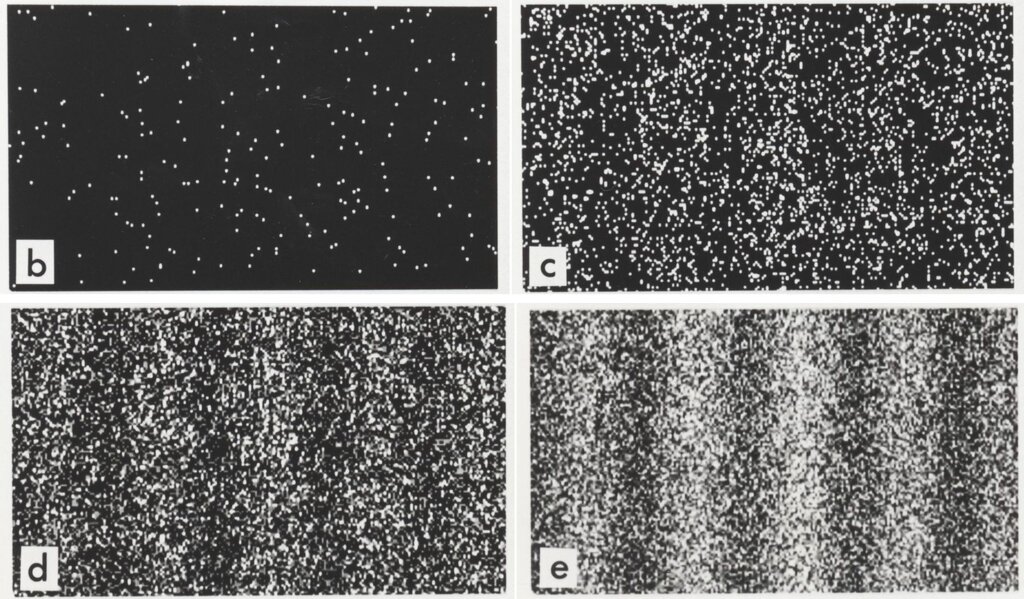
But it gets stranger. If you place a detector at the slits to see which one the electron goes through, the interference pattern vanishes. The electrons start behaving like normal particles again, forming just two lines on the screen. The very act of observing forces the electron to “choose” a state, behaving like a particle instead of a wave.
Describing the Quantum World
So how do we describe something that is so uncertain and can be two things at once? We can't use the simple positions and velocities of classical physics. Instead, we use a mathematical object called a quantum state.
A quantum state contains all the information we can possibly know about a quantum system. It doesn't tell us, "the electron is here." Instead, it describes a combination of all the possible states the system could be in. This is called superposition. Before we measure it, the electron in the double-slit experiment is in a superposition of having gone through the left slit AND the right slit.
Think of a spinning coin. Before it lands, it's not heads or tails. It's in a superposition of both states. When it lands (our measurement), it settles into one definite outcome.
The quantum state doesn't give us definite outcomes, but probabilities. For each possible outcome of a measurement, there's a number associated with it called a probability amplitude. To find the actual probability of that outcome, you take the square of the magnitude of this amplitude.
For example, a quantum state might tell us that the probability amplitude of finding an electron at position A is 0.5 and at position B is 0.866. To get the probabilities, we square these values. The probability of finding it at A is , or 25%. The probability of finding it at B is , or 75%. Notice that the probabilities (0.25 + 0.75) add up to 1, or 100%.
This is the essence of quantum mechanics. It's a world built on probability, not certainty. The quantum state tells us the odds for every possibility, but only a measurement can reveal which one becomes our reality.
According to the Heisenberg Uncertainty Principle, if you know the exact momentum of a quantum particle, what can you know about its position?
In the double-slit experiment, firing electrons one by one without any detectors at the slits results in an interference pattern, as if each electron passed through both slits at once. True or False?