Introduction to Quantum Computing
Introduction to Quantum Mechanics
The Strange Rules of the Quantum World
In our everyday world, things are predictable. A thrown baseball follows a clear path. Ripples in a pond spread out in a regular pattern. Objects are either particles, like the baseball, or waves, like the ripples. But when we zoom way down to the level of atoms and electrons, these familiar rules break down. Welcome to the world of quantum mechanics, where particles can act like waves, and there's a fundamental limit to what we can know.
Everything is a Wave and a Particle
One of the most mind-bending ideas in quantum physics is wave-particle duality. It says that tiny objects like electrons can behave like solid particles and spread-out waves, depending on how you look at them.
The classic experiment that shows this is the double-slit experiment. Imagine a barrier with two thin, parallel slits in it. If you shoot tiny particles, like paintballs, at the barrier, you'd expect to see two lines of paint on the wall behind it, one for each slit. Simple enough.
Now, let's do this with electrons. If we fire them one by one, we expect the same result. But that's not what happens. Instead of two lines, a pattern of many stripes appears on the detector screen. This is an interference pattern, something you only get when waves pass through two slits and interfere with each other, creating peaks and troughs.
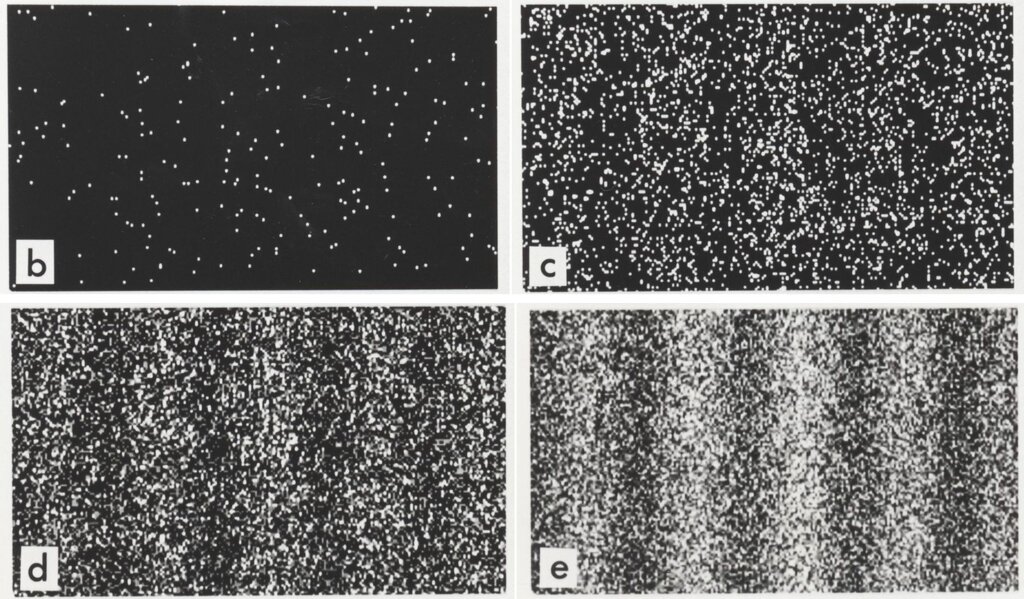
It seems each electron, traveling alone, somehow passes through both slits at once, like a wave, and interferes with itself. Even stranger, if we place a detector at the slits to see which one the electron goes through, the interference pattern vanishes. The very act of observing forces the electron to “choose” a path and act like a particle, leaving just two lines on the screen. The wave behavior is gone.
This isn't just a clever trick. It reveals a fundamental truth: quantum objects exist in a haze of possibilities until they are measured.
A Limit on What We Can Know
This leads us to another core concept: the uncertainty principle, formulated by Werner Heisenberg. It states that there's a fundamental trade-off in how precisely we can know certain pairs of properties of a particle at the same time. The most famous pair is position and momentum (which is mass times velocity).
The more precisely you measure a particle's position, the less precisely you can know its momentum. And the more accurately you pin down its momentum, the fuzzier its position becomes. It’s not about having clumsy measurement tools; it's a built-in feature of the universe.
Think of it like trying to take a picture of a moving car. A fast shutter speed will give you a sharp, clear image of the car's position, but you'll have no idea how fast it's going. A slow shutter speed will create a blur, giving you a good sense of its speed and direction, but its exact location at any instant is unclear.
This isn't just an analogy; the act of measurement at the quantum level inherently disturbs the system. To find an electron's position, you have to interact with it, perhaps by bouncing a photon of light off it. This interaction inevitably kicks the electron, changing its momentum in an unpredictable way. This cosmic trade-off is expressed mathematically.
Describing the Quantum World
So if particles don't have definite positions or momenta, how do we describe them? Physicists use the concept of a quantum state. The state of a quantum system is captured by a mathematical object called a wave function, usually represented by the Greek letter psi ($ \Psi $).
The wave function doesn't tell you where the particle is. Instead, it tells you the probability of finding the particle at any given point if you were to measure it. Where the wave function has a large amplitude (a high peak), there's a high probability of finding the particle. Where the amplitude is low, the probability is small.
Before measurement, the particle exists in a superposition of all these possible states at once, described by its wave function. When you make a measurement, the wave function is said to “collapse,” and the particle snaps into one single, definite state. This is why the electron in the double-slit experiment can act like a spread-out wave before you look, but becomes a localized particle the moment you do.
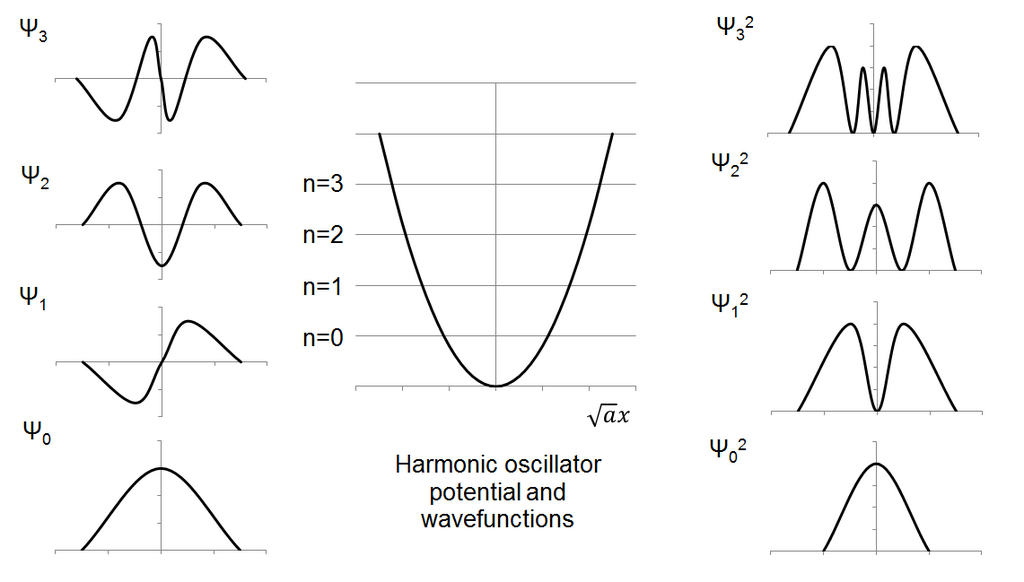
These three ideas, wave-particle duality, the uncertainty principle, and the concept of quantum states, form the bedrock of quantum mechanics. They paint a picture of a reality that is fundamentally probabilistic, where the act of observation plays a crucial role in what we see.
Let's check your understanding of these strange new rules.
In the double-slit experiment, when electrons are fired one at a time, they create an interference pattern on the screen behind the slits. What does this pattern suggest about the nature of an individual electron?
What happens in the double-slit experiment if a detector is placed at the slits to determine which one each electron passes through?
These principles may seem counterintuitive, but they have been confirmed by countless experiments and are the foundation for technologies like lasers, transistors, and the quantum computers of the future.