Introduction to Qigong
Introduction to Qigong
What is Qigong?
At its heart, Qigong is the art of working with your body's vital energy. The practice combines slow, gentle movements, specific breathing techniques, and focused intention to improve the flow of this energy. Think of it as a moving meditation that connects your mind, body, and breath.
The word itself tells you a lot. It’s made of two Chinese characters:
Qigong
Qi
noun
Often translated as 'life force' or 'vital energy,' Qi is the intrinsic energy that flows through all living things. In traditional Chinese thought, it's the fundamental building block of the universe.
The second character, Gong (功), means 'work' or 'skill.' So, Qigong literally translates to 'energy work' or 'skill in cultivating energy.' It’s a practice developed over thousands of years to master the flow of your own life force.
Qigong is not about learning complex forms, but about feeling and guiding the energy within you.
A Practice Through Time
Qigong’s roots run deep into Chinese history, intertwining with ancient medicine, philosophy, and spirituality. Its earliest forms likely began with shamanic dances imitating animal movements, intended to harmonize with nature. Over centuries, these practices were refined and absorbed into various traditions, most notably Daoism.
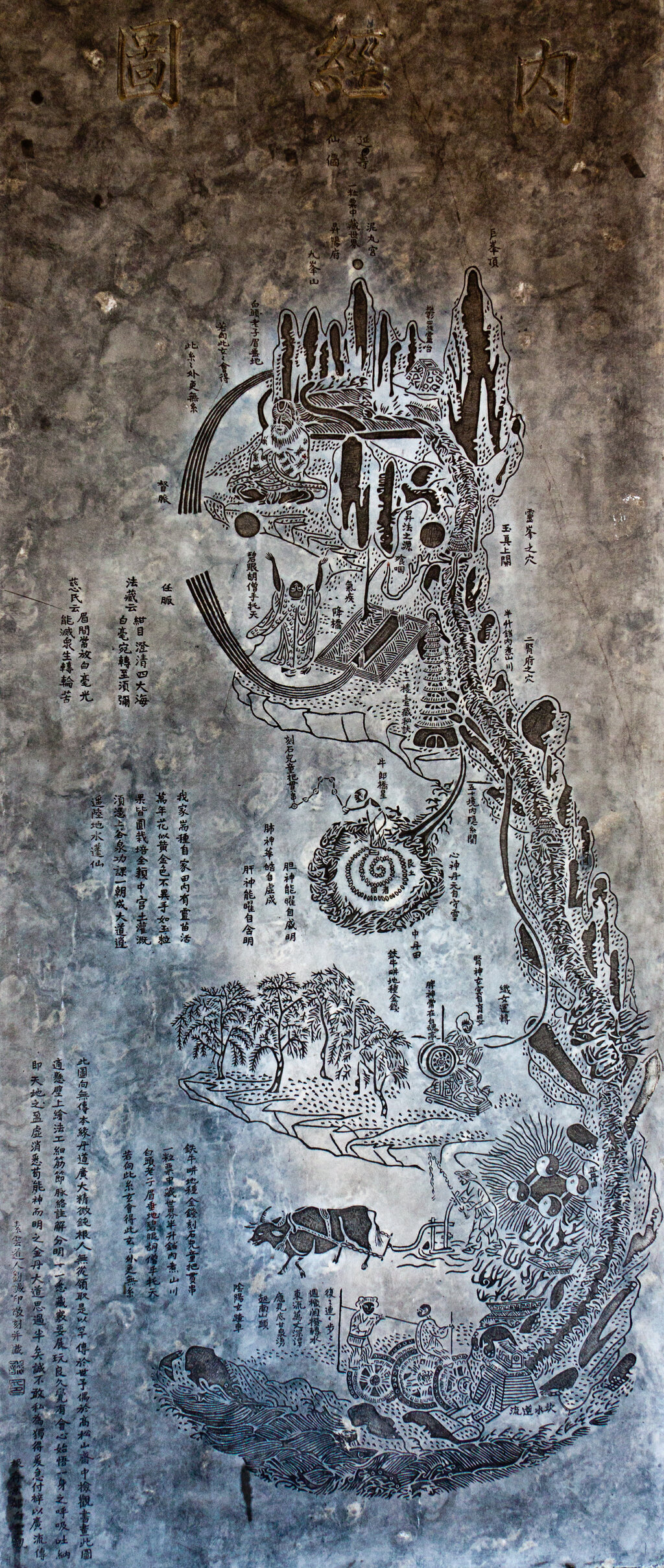
Daoist scholars and monks practiced Qigong to achieve longevity and spiritual alignment. They documented their insights into how energy flows in the body, creating a foundation for what would later become Traditional Chinese Medicine (TCM). Foundational texts, like the Huangdi Neijing (The Yellow Emperor's Inner Classic), described the network of energy pathways, or meridians, that Qigong works with.
From these ancient roots, Qigong evolved into thousands of different styles, each with its own focus. But they all share the same core principles for understanding the body's energy.
The Building Blocks
To understand Qigong, you need to grasp a few key ideas from Chinese philosophy. These concepts form the theoretical foundation for the practice. They aren't just abstract ideas; they're seen as observable patterns in nature and within our own bodies.
The basic theory and principles are the roots of the entire qigong practice.
First is the concept of Yin and Yang. This is the principle of duality, the idea that the universe is composed of opposing but complementary forces. Think of darkness and light, stillness and movement, or cool and warm. One cannot exist without the other. In Qigong, the goal is to balance the Yin and Yang energies within the body to achieve harmony and health.
Next is the Five Elements theory, also known as Wuxing. This theory builds on Yin and Yang, describing five fundamental phases or types of energy that cycle through nature and our bodies. The five elements are:
- Wood (木, mù): Represents growth, expansion, and springtime.
- Fire (火, huǒ): Represents peak energy, passion, and summertime.
- Earth (土, tǔ): Represents stability, nourishment, and late summer.
- Metal (金, jīn): Represents contraction, refinement, and autumn.
- Water (水, shuǐ): Represents stillness, storage, and winter.
These elements are not static. They interact in continuous cycles, generating and overcoming one another to maintain a dynamic balance.
These principles—Qi, Yin and Yang, and the Five Elements—are the map that Qigong practitioners use to navigate the inner landscape of the body. By understanding them, you can begin to see how simple movements and breaths can create profound balance.
What does the term 'Qigong' (气功) literally translate to?
Which of the following are the three core components combined in Qigong practice?
With these foundational concepts in mind, you have the essential framework for exploring the practice of Qigong.