Introduction to Python Programming
Introduction to Python
What Is Python?
Python is one of the world's most popular programming languages. It’s known for being powerful, versatile, and surprisingly easy to read. This readability makes it a favorite for beginners and experts alike.
It was created in the late 1980s by Guido van Rossum. He wanted to design a language that was both powerful and simple, bridging the gap between complex languages like C++ and simple shell scripts. As for the name, it has nothing to do with snakes. Van Rossum was a big fan of the British comedy troupe Monty Python.
Since its release, Python has grown enormously. A large, active community contributes to its vast collection of libraries, which are bundles of pre-written code that programmers can use to perform common tasks without starting from scratch.
The Zen of Python
Every programming language has a certain style or philosophy. Python's is famously captured in a collection of 19 guiding principles known as "The Zen of Python." These principles emphasize simplicity, readability, and clarity above all else.
Beautiful is better than ugly. Explicit is better than implicit. Simple is better than complex.
This philosophy means that writing Python code feels a lot like writing structured English. The goal is to make code that is easy for other people to understand, not just a computer. This focus on human readability is a major reason why Python is so widely used in collaborative projects in science, finance, and web development.
You can actually read all 19 principles by running a simple command within Python itself.
import this
This command prints the full text, which serves as a constant reminder of the language's core values.
Key Features
Python's design philosophy gives rise to several key features that set it apart.
| Feature | Description |
|---|---|
| Simple and Readable | The syntax is clean and uncluttered, making it easy to learn and read. |
| Interpreted | Code is executed line-by-line, which simplifies the process of finding and fixing errors. |
| Dynamically Typed | You don't have to declare a variable's type. Python figures it out automatically when the program runs. |
| Multi-Paradigm | It supports different programming styles, including procedural, object-oriented, and functional programming. |
| Extensive Libraries | Python has a massive collection of libraries for tasks ranging from web development to machine learning. |
Let's look closer at one of its most important features: dynamic typing.
Dynamic Typing
noun
A feature where the type of a variable is checked during runtime, not beforehand. This means you don't have to explicitly declare a variable's type (like integer or string).
Where Is Python Used?
Python's versatility means you'll find it almost everywhere. Its simple syntax and powerful libraries make it a top choice for a wide range of applications.
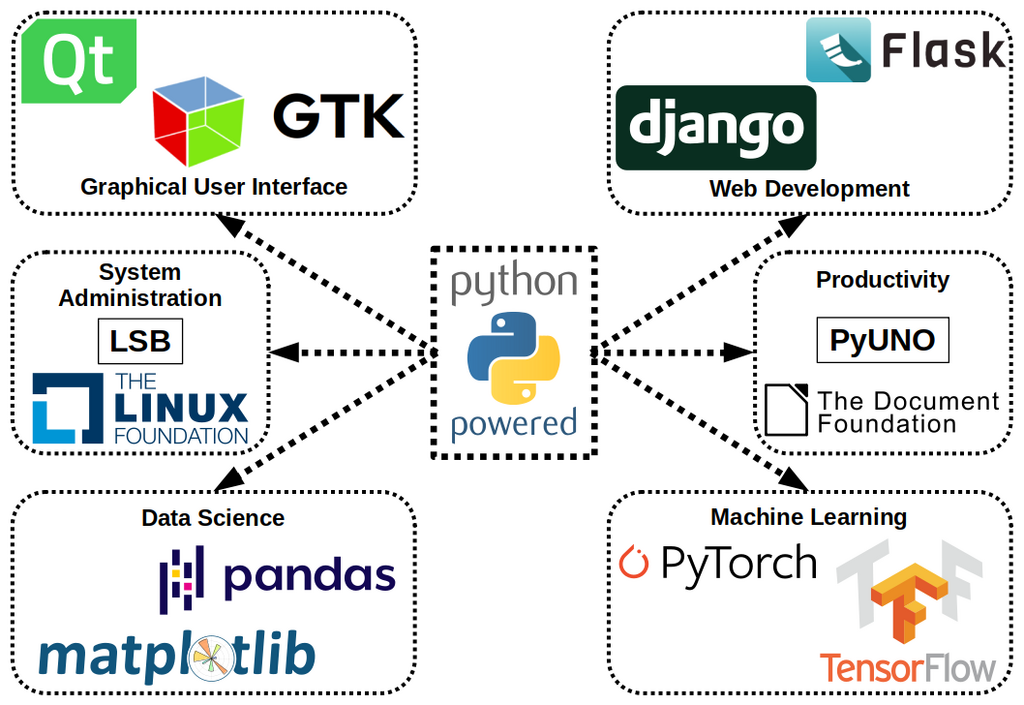
Some of the most common fields include:
- Web Development: Frameworks like Django and Flask allow developers to build robust websites and web applications quickly.
- Data Science & Machine Learning: Libraries like NumPy, pandas, and TensorFlow have made Python the leading language for data analysis, visualization, and artificial intelligence.
- Automation and Scripting: Python is excellent for writing small scripts to automate repetitive tasks, like organizing files or sending emails.
- Software Testing and Prototyping: Its readability makes it ideal for building quick prototypes and writing tests for larger software projects.
Because it's easy to learn but powerful enough for complex tasks, Python provides a great foundation for anyone looking to get started with programming.
Who is the creator of the Python programming language?
What is the primary emphasis of Python's design philosophy, as captured in 'The Zen of Python'?