Introduction to Python Programming
Introduction to Python
What is Python?
Python is a high-level, general-purpose programming language. Think of it as a versatile tool, like a Swiss Army knife for coders. You can use it to build websites, analyze data, automate tasks, and even create artificial intelligence. It was created by Guido van Rossum and first released in 1991. The name doesn't come from a snake, but from the British comedy group Monty Python. Van Rossum wanted a name that was short, unique, and a little mysterious.
What makes Python so popular, especially for beginners, is its focus on simplicity and readability. The code often looks a lot like plain English, which makes it easier to learn and understand than many other languages.
The Zen of Python
Python has a clear design philosophy that guides its development. This philosophy is captured in a set of 20 principles known as "The Zen of Python." You can actually see them by typing import this into a Python interpreter. The core idea is that code should be beautiful, simple, and explicit.
Beautiful is better than ugly. Explicit is better than implicit. Simple is better than complex. Readability counts.
These aren't just suggestions; they are the principles that make Python code clean and maintainable. When you write Python, you're encouraged to solve problems in the most straightforward way possible.
Core Features
Beyond its philosophy, Python has several features that make it powerful and flexible. Two of the most important are its dynamic typing and automatic memory management.
Dynamic Typing
noun
A system where the type of a variable is checked during runtime, not before. This means you don't have to declare the variable's type beforehand.
With dynamic typing, you can assign a number to a variable and later assign a piece of text to the same variable. Python figures out the type on the fly. This makes the code more concise and flexible, as you don't need to specify types for everything.
Python also handles memory for you. In some languages, you have to manually allocate and free up memory, which can be a common source of bugs. Python's automatic memory management, often called "garbage collection," keeps track of objects that are no longer in use and cleans them up, freeing you to focus on solving the actual problem.
Where is Python Used?
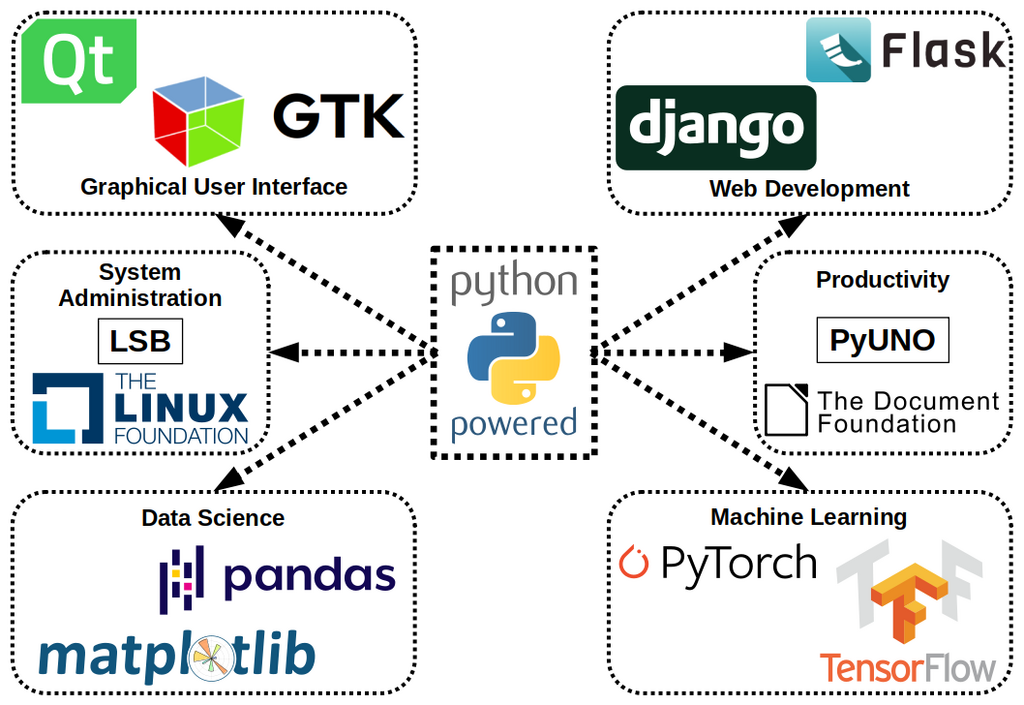
Python's versatility means it's used almost everywhere. Its simple syntax and powerful libraries have made it a favorite in many fields.
Here are just a few examples:
- Web Development: Frameworks like Django and Flask allow developers to build powerful web applications quickly.
- Data Science & Machine Learning: Libraries such as pandas, NumPy, and TensorFlow have made Python the go-to language for data analysis, visualization, and artificial intelligence.
- Automation: Python is excellent for writing scripts that automate repetitive tasks, from organizing files to managing systems.
- Software Prototyping: Because you can write and test ideas quickly in Python, it's often used to build initial versions of software before moving to other languages.
Ready to check your understanding?
Who is the creator of Python, and what was the inspiration for its name?
Which feature of Python handles the allocation and freeing up of memory, preventing common bugs?
This foundation gives you a sense of what Python is and why it's such a widely used language. Its focus on readability and simplicity makes it an excellent starting point for anyone new to programming.