Introduction to Python Programming
Introduction to Python
Meet Python
Python is a high-level programming language known for its clear, readable syntax. Created by Guido van Rossum and first released in 1991, it was designed to be easy to learn and use, allowing developers to write programs with fewer lines of code than many other languages.
Think of it as a tool that can build almost anything. Programmers use Python for web development, data analysis, artificial intelligence, scientific computing, and automating everyday tasks. Its versatility is a big reason why it's one of the world's most popular programming languages, used by companies like Google, Netflix, and NASA.
The Zen of Python
Python's core philosophy is a set of guiding principles known as "The Zen of Python." These principles emphasize simplicity, readability, and explicitness. The goal is to make code that is not only powerful but also easy for humans to understand.
Beautiful is better than ugly. Explicit is better than implicit. Simple is better than complex.
This focus on clarity means that when you write Python code, you're encouraged to solve problems in a straightforward way. The language avoids cryptic symbols and complex rules, which makes it an excellent choice for beginners and a productive tool for experts. This philosophy is so central that it's baked into the language itself. You can see all 19 aphorisms by running a simple command.
import this
Core Features
Several key features make Python powerful and flexible. It's not just about simple syntax; the language is designed to handle a wide range of problems and programming styles.
Dynamic Typing
other
A feature where you don't have to declare the type of a variable (like a number or text) when you create it. Python figures it out automatically at runtime.
Imagine you have a set of boxes. In some languages, you have to label each box for what it can hold: "apples only" or "books only." In Python, the boxes are unlabeled. You can put an apple in a box, and later, you can take it out and put a book in instead. This is dynamic typing. It offers flexibility and can make writing code faster.
Python also handles memory for you automatically. You create objects and variables, and when you're done with them, Python's "garbage collector" cleans them up behind the scenes. This frees you from the complex task of managing memory manually, which can be a common source of bugs in other languages.
| Feature | Description |
|---|---|
| Multi-Paradigm | Supports different ways of programming, like procedural, object-oriented, and functional styles. |
| Interpreted | Code is run line by line, which makes debugging easier. |
| Extensive Libraries | Comes with a vast collection of pre-written code for common tasks. |
| Cross-Platform | Python code written on one operating system (like Windows) runs on others (like macOS or Linux) without changes. |
Batteries Included
Python follows a "batteries included" philosophy. This means its Standard Library is packed with useful modules and functions right out of the box. Need to work with dates and times, read a compressed file, or fetch data from a website? There’s likely a module for that already included with Python.
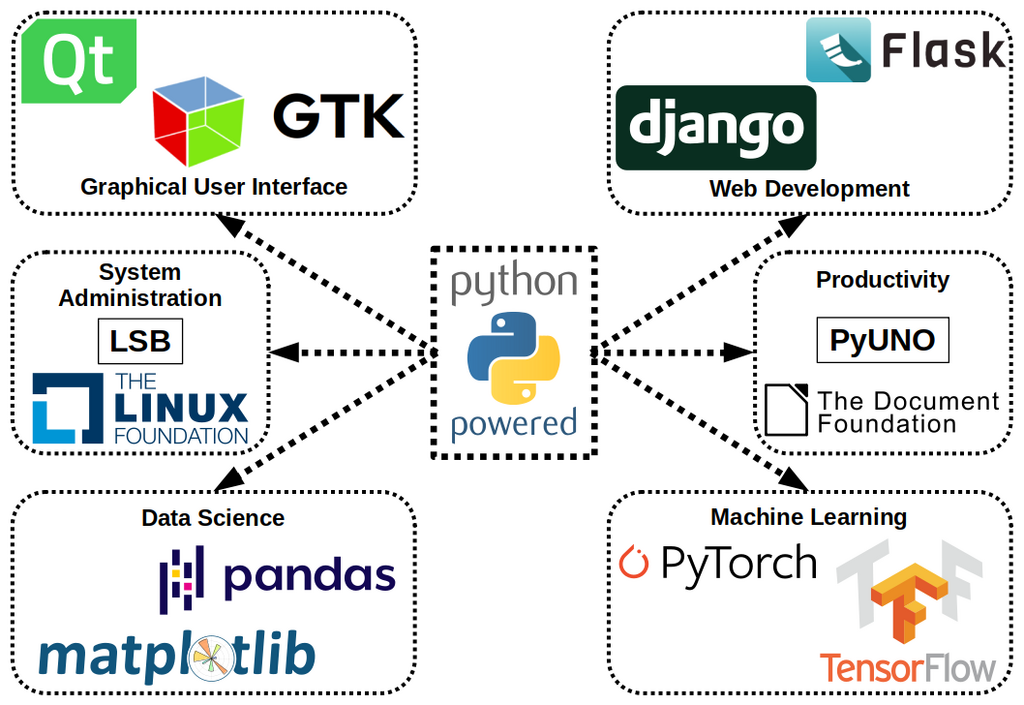
This vast library saves you from having to write code for common tasks from scratch. It’s like having a well-stocked workshop. Instead of building every tool yourself, you can just grab the one you need and get to work on your project. This approach accelerates development and helps programmers build robust applications quickly.
Time to check your understanding of these core concepts.
Who is the creator of the Python programming language?
Which concept is described by the analogy of being able to put an apple in a box, then later replace it with a book?
Understanding Python's history and philosophy provides a strong foundation. Now you're ready to explore how to actually write the code.