Introduction to Python Programming
Introduction to Python
Meet Python
Python is a popular programming language known for its clear, readable syntax. It was created in the late 1980s by Guido van Rossum, who wanted to design a language that was easy to read and write. Think of it as a set of instructions a computer can understand, but written in a way that’s closer to plain English than many other languages.
This simplicity makes it a great choice for beginners. But don't let that fool you; it's also incredibly powerful. Professionals use Python for a huge range of tasks, from building websites and apps to analyzing data and powering artificial intelligence.
Python's main strengths are its readability, its versatility for many different tasks, and its large, supportive community that creates helpful resources.
Your Programming Toolkit
To start writing Python, you need two things: the Python interpreter and a code editor. The interpreter is the program that reads your Python code and carries out its instructions. You can download it for free from the official website, python.org.
A code editor is where you'll write and save your code. While you could use a basic text editor, most programmers use an Integrated Development Environment (IDE). An IDE is a specialized editor that includes helpful tools like syntax highlighting (coloring your code to make it easier to read) and debugging tools to help you find errors.
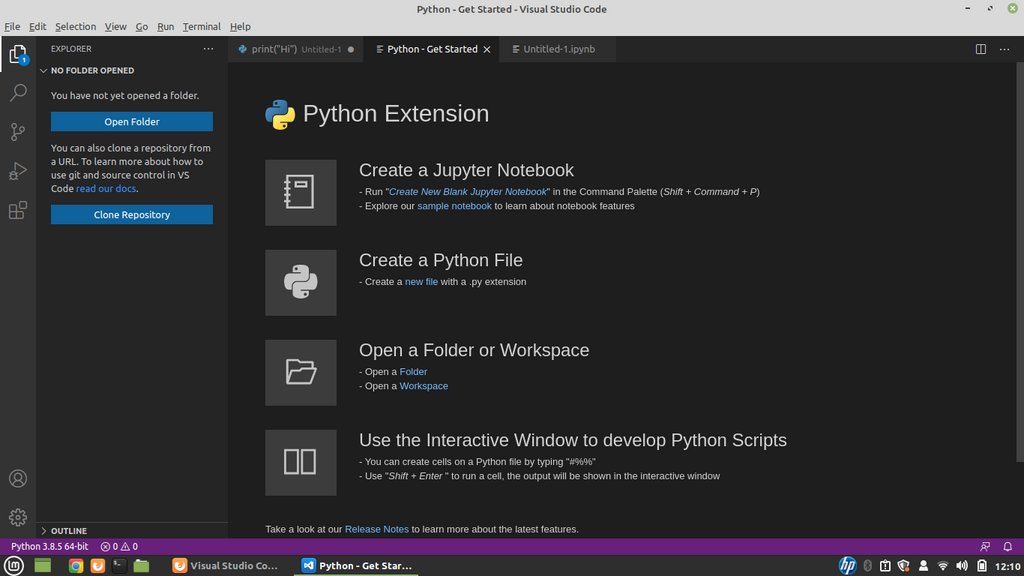
For beginners, popular choices include Visual Studio Code (VS Code) and PyCharm. Both have free versions and offer a great experience for learning Python. Go ahead and install both Python and an IDE of your choice on your computer.
Your First Program
It's a tradition in programming to start by making the computer say "Hello, World!". Let's do that. Open your IDE and create a new file. Save it with a .py extension, which tells the computer it's a Python file. For example, you could name it hello.py.
Now, type the following line of code into your file:
print("Hello, World!")
Let's break this down:
print()is a function. It's a built-in Python command that tells the computer to display something on the screen.- The text inside the parentheses
()is what you want the function to use. In this case, it's the text you want to print. - The quotation marks
""tell Python that the text inside them is a string, which is just a sequence of characters.
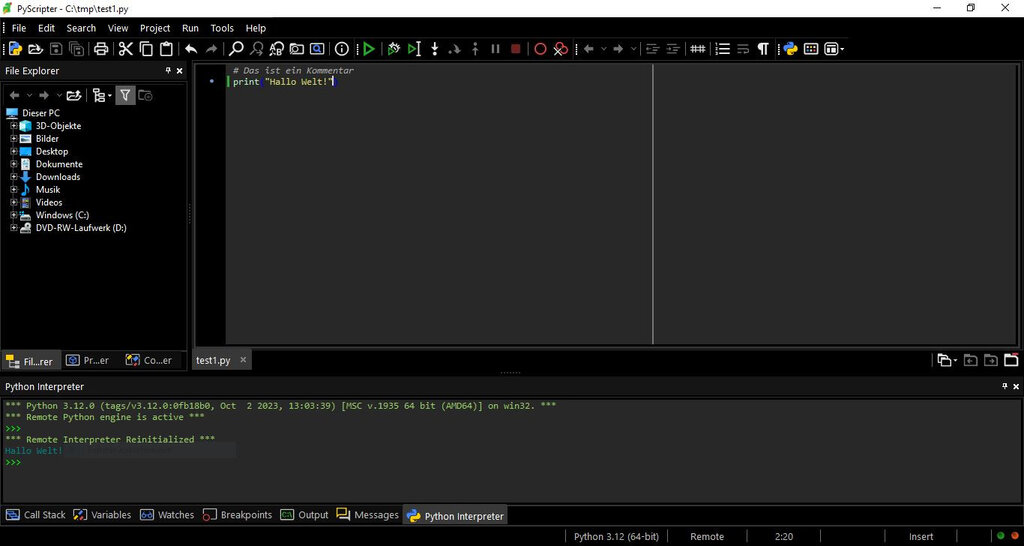
Save the file, and then run it. Most IDEs have a "Run" button (often a green triangle) that will execute your code. When you do, you should see Hello, World! appear in an output window or terminal. You've just written and run your first Python program!
Now that you've got the basics down, let's test your knowledge.
Who is the creator of the Python programming language?
What is the primary function of the Python interpreter?