Introduction to Python Development
Introduction to Python
What Is Python?
Python is a programming language, which is a way for humans to give instructions to computers. Think of it like a recipe. A recipe gives a chef a series of steps to follow to create a dish. A programming language gives a computer a series of steps to follow to complete a task.
What makes Python special is its design. It was created in the late 1980s by Guido van Rossum, who wanted a language that was easy to read and write. The core idea is that code should be as clear as plain English. This focus on simplicity and readability makes Python a great language for beginners.
Python is a high-level, interpreted language. Let's break that down.
High-level means it's closer to human language than machine language. You don't have to worry about the complex, low-level details of the computer's hardware, like managing memory. Python handles that for you behind the scenes.
Interpreted means that you can run Python code line by line. An interpreter program reads your code and executes it directly. This is different from compiled languages, where the entire program must be translated into machine code before it can run. This makes testing small pieces of code quick and easy.
Python's design philosophy is often summarized as "The Zen of Python," a collection of 20 guiding principles. The first is "Beautiful is better than ugly."
Where Is Python Used?
Because of its flexibility and ease of use, Python is used almost everywhere. It’s like a multi-tool for programmers. Some of the most common applications include:
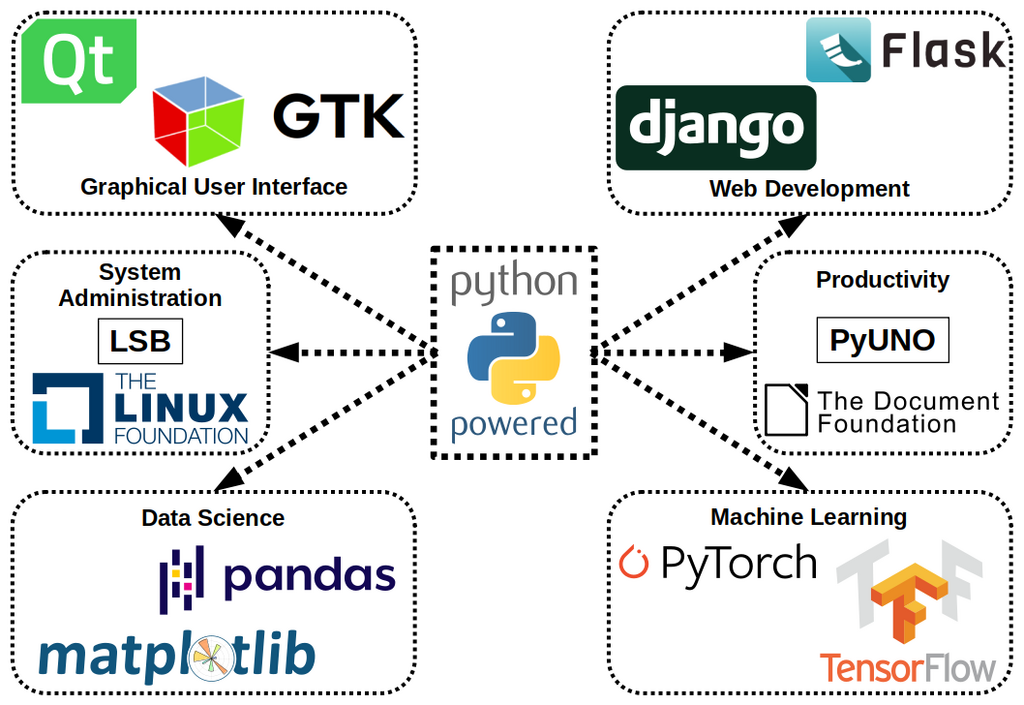
- Web Development: Building the server-side logic of websites and web applications. Frameworks like Django and Flask make it simple to create powerful web services.
- Data Science and Machine Learning: Analyzing large datasets, creating visualizations, and building artificial intelligence models. Libraries like pandas, NumPy, and TensorFlow are industry standards.
- Automation and Scripting: Writing small programs (scripts) to automate repetitive tasks, like renaming files, sending emails, or scraping data from websites.
- Software Development: Creating desktop applications, games, and other software tools.
Companies like Google, Netflix, and Instagram use Python extensively in their operations, which shows just how powerful and scalable it is.
Getting Started
To start writing Python, you first need to install it on your computer. The official source for Python is the Python Software Foundation's website, python.org. You can download the latest version for Windows, macOS, or Linux for free.
The installer will guide you through the setup process. On Windows, it's a good idea to check the box that says "Add Python to PATH." This makes it easier to run Python from your computer's command line or terminal.
Python's syntax is meant to be simple and readable, reflecting the structure of natural language, making it a better option for novices.
Once installed, you'll have access to the Python interpreter. This is a program that lets you interact with Python directly. It’s a bit like a calculator that understands programming commands. When you run the interpreter, you'll see a prompt, usually >>>, where you can type code.
# In your computer's terminal or command prompt, type:
python

# Or, on some systems:
python3

# This will start the Python interpreter, which looks like this:
# Python 3.9.6 (default, Jun 29 2021, 05:25:02)
# [Clang 12.0.5 (clang-1205.0.22.9)] on darwin
# Type "help", "copyright", "credits" or "license" for more information.
# >>>
This interactive environment is often called a REPL, which stands for Read-Eval-Print Loop. It reads the code you type, evaluates it (runs it), prints the result, and loops back to wait for your next command. It’s a fantastic tool for experimenting and learning.
For example, you can use the interpreter to do simple math.
>>> 2 + 2
4

>>> 10 * 5
50
The interpreter immediately gives you the answer. This instant feedback is one of the reasons Python is so friendly for beginners.
Ready to test your knowledge? Let's see what you've learned so far.
What is the primary design philosophy behind the Python programming language?
What does it mean that Python is an "interpreted" language?
You've taken the first step into the world of Python. You know what it is, why it's popular, and how to get it running. Now you're ready to start writing your own instructions for the computer to follow.