Introduction to Programming Fundamentals
Introduction to Programming
What Is Programming?
Think of a recipe for baking a cake. It gives you a list of ingredients and a sequence of steps to follow: mix the flour and sugar, preheat the oven, bake for 30 minutes. If you follow the instructions precisely, you get a cake. If you miss a step, you might end up with a mess.
A computer program is a lot like a recipe, but the instructions are for a computer. Programming is the art of writing these instructions. Computers are incredibly powerful, but they can't think for themselves. They need a detailed, step-by-step guide to perform any task, from displaying a button on a screen to calculating a complex equation.
Programming is the process of giving a computer a set of instructions to accomplish a specific task.
These instructions are written in a special language that the computer can understand. The collection of these instructions is called a program or code.
The Role of a Programmer
A programmer is a problem-solver and a translator. Their job is to take a human idea, like "I want an app that shows me the weather," and break it down into a series of logical steps that a computer can execute. They are the bridge between human intention and computer action.
This involves more than just typing. A programmer's day often includes:
- Planning: Thinking through the problem and designing a logical solution.
- Writing: Translating that solution into a programming language.
- Testing: Running the program to find and fix errors, which are often called bugs.
- Refining: Improving the code to make it more efficient or easier to understand.
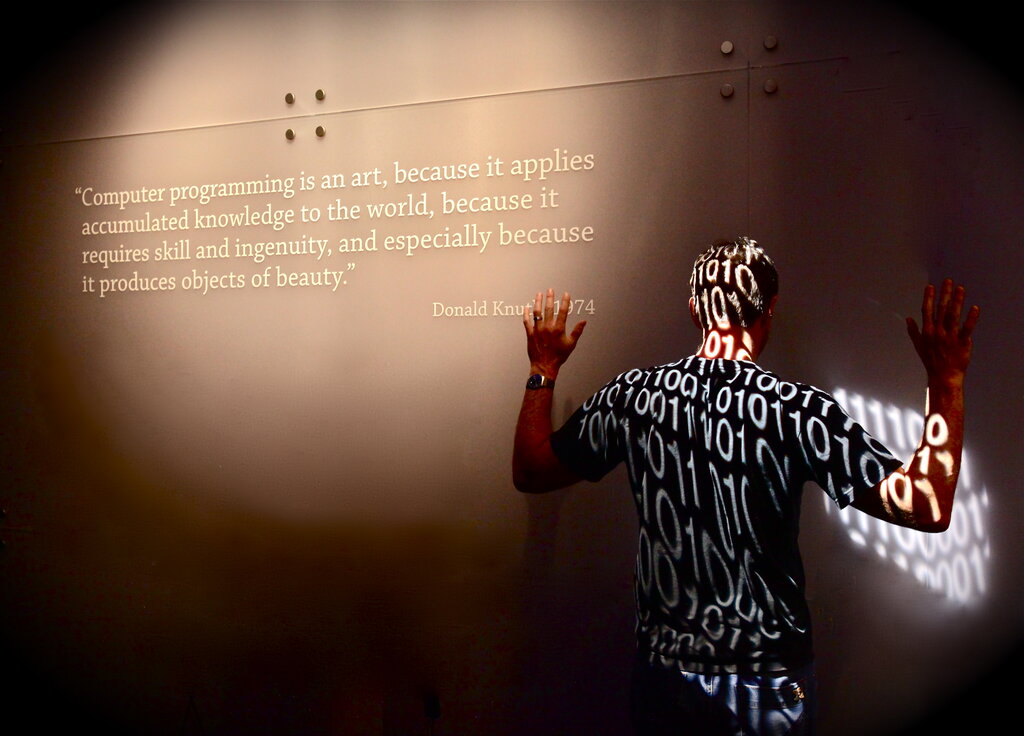
It’s a cycle of thinking, creating, and troubleshooting. At its core, programming is about using logic to build useful things.
A World of Languages
Just as humans speak many different languages, there are thousands of programming languages. Each language was designed for a specific purpose and has its own set of rules, known as syntax. A programmer chooses the best language for the job at hand.
You don't need to know them all. Most programmers specialize in a few. Here are some popular examples and what they're often used for:
| Language | Common Uses |
|---|---|
| Python | Data science, web development, automation |
| JavaScript | Making websites interactive, web applications |
| Java | Android apps, large-scale enterprise systems |
| C++ | Video games, operating systems, high-performance software |
| Swift | Apps for iPhones, iPads, and Macs |
Programming languages can be grouped into two main types. High-level languages, like Python or JavaScript, use words and syntax that are relatively easy for humans to read and write. Low-level languages are much closer to the raw 0s and 1s that a computer's processor actually understands. Most modern programming is done in high-level languages because they are faster to work with.
The Basic Structure of a Program
While every program is different, most follow a fundamental pattern. Think of it like a tiny machine that takes something in, does something with it, and produces a result.
Here's what each part does:
- Input: This is how a program receives data. It could be a user clicking a mouse, typing their name into a form, or reading information from a file.
- Processing: This is the core logic. The program takes the input and performs actions based on its instructions. This could be anything from sorting a list of names to calculating the total cost of items in a shopping cart.
- Output: After processing the data, the program shows the result. It might display a message on the screen, save a new file, or play a sound.
Even the most complex app on your phone is built from these simple building blocks, repeated millions of times.
A computer program is most similar to which of the following?
What is the primary role of a programmer?
This foundation gives you a starting point for thinking like a programmer. It's about breaking down big problems into small, logical instructions that a computer can follow.