Introduction to Programming
Introduction to Programming
What Is Programming?
Imagine trying to explain how to make a sandwich to someone who takes every word you say literally. You couldn't just say, "Make me a peanut butter and jelly sandwich." You'd have to provide exact, step-by-step instructions: pick up two slices of bread, open the jar of peanut butter, use a knife to spread it on one slice, and so on.
In a nutshell, that's programming. It's the process of giving a computer a set of precise instructions to perform a specific task. Computers are powerful, but they can't think for themselves. They need us to break down tasks into small, logical steps using a language they can understand.
Programming is simply the act of writing instructions for a computer to follow to solve a problem.
The Role of Algorithms
Before you can write any instructions, you need a plan. In the world of programming, that plan is called an algorithm. An algorithm is a step-by-step recipe for solving a problem or accomplishing a task. You use algorithms all the time in daily life, even if you don't realize it.
The recipe for baking a cake is an algorithm. The directions your GPS gives you are an algorithm. For our sandwich example, the algorithm might look something like this:
Once you have a clear algorithm, the act of programming is translating those steps into a language the computer can execute. A well-designed algorithm makes writing the actual code much easier and more organized.
An Overview of Languages
Computers don't understand English, Spanish, or Japanese. They understand machine code, which is a series of ones and zeros. Writing in machine code is incredibly tedious, so computer scientists created programming languages to act as a bridge.
Programming languages use syntax that is easier for humans to read and write. A program called a compiler or interpreter then translates this code into the machine code the computer can execute.
There are hundreds of programming languages, each with its own strengths. Think of them like tools in a toolbox. You wouldn't use a hammer to saw a piece of wood. Similarly, you choose a programming language based on the task you want to accomplish.
| Language | Common Uses |
|---|---|
| Python | Data science, web development, automation |
| JavaScript | Building interactive websites, web applications |
| Java | Android apps, large-scale enterprise systems |
| C++ | Video games, high-performance software |
Don't worry about memorizing them. The key takeaway is that different languages are suited for different problems. The fundamental concepts of problem-solving and algorithms apply to all of them.
The Basic Structure of a Program
While every language has its own rules, most programs follow a simple, fundamental structure: they take some input, process it, and produce an output.
- Input: Data that the program receives. This could be a user typing on a keyboard, a file from a hard drive, or information from a sensor.
- Processing: The program manipulates the input based on its instructions (the algorithm). This might involve performing calculations, modifying text, or making decisions.
- Output: The result of the processing. This could be text displayed on the screen, a new file being saved, or a light turning on.
A classic first program for any new programmer is called "Hello, World!" Its only job is to display the text "Hello, World!" on the screen. It's a simple way to confirm your programming setup is working correctly.
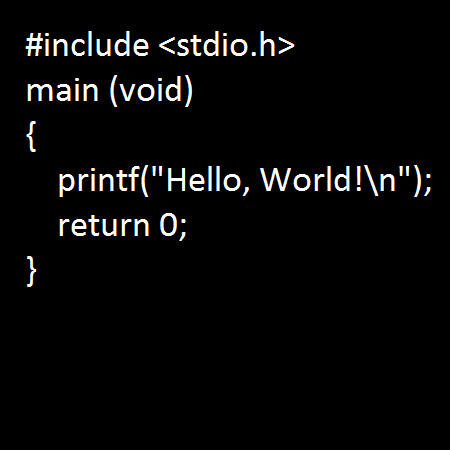
In this example, the program doesn't take any user input. The "processing" is simply the instruction to print a specific phrase, and the output is the text you see on the screen. Even this tiny program follows the basic structure.
Now, let's test your understanding of these core concepts.