Introduction to Pottery
Clay Preparation
Choosing Your Clay
Before you can shape a pot or sculpt a figure, you need to start with the right raw material. Clay isn't just mud; it's a specific type of earth with unique properties. The type of clay you choose will affect how it feels to work with, how it's fired, and the look of your final piece.
There are three main families of clay, each with its own personality.
| Clay Type | Firing Temperature | Plasticity (Workability) | Common Uses |
|---|---|---|---|
| Earthenware | Low (1745-2012°F) | High | Terra cotta pots, tiles |
| Stoneware | Medium-High (2100-2372°F) | Medium | Mugs, dinnerware, bowls |
| Porcelain | High (2300-2550°F) | Low | Fine china, sculpture |
For beginners, earthenware and stoneware are the most forgiving and versatile options. Most clay today is purchased from a ceramic supplier. It comes pre-mixed and de-aired in plastic bags, which makes getting started much easier than digging and processing your own.
Wedging and Kneading
Even if your clay comes from a bag, it needs preparation. This crucial step is called wedging or kneading. Think of it like kneading dough before baking bread. The goal is to get the clay into a perfectly uniform, workable state.
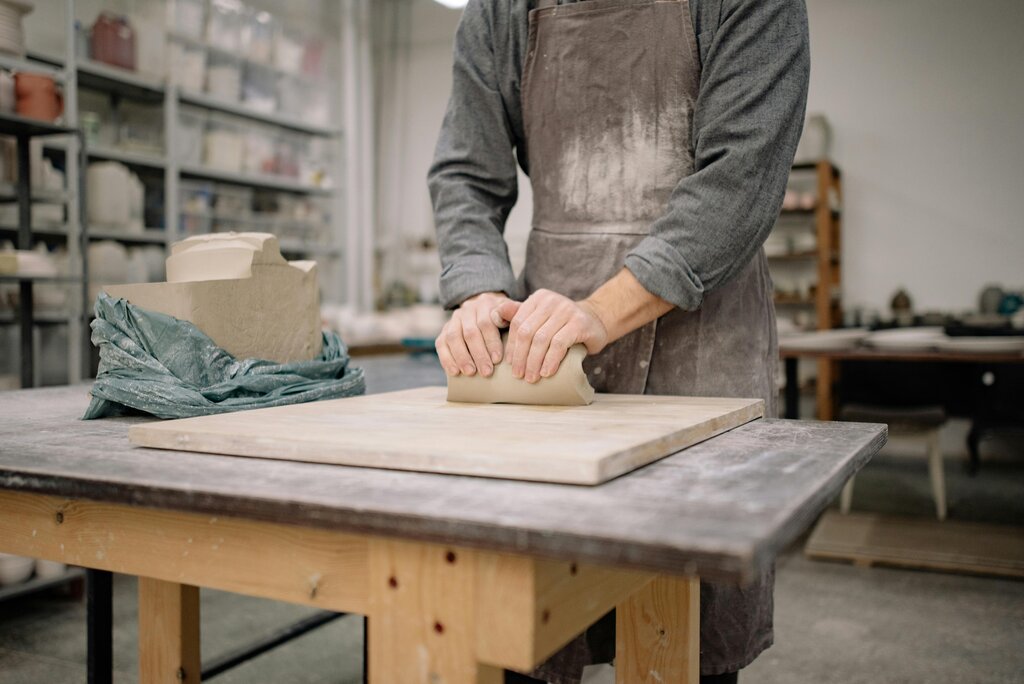
Wedging accomplishes two things. First, it ensures the moisture is evenly distributed throughout the clay, giving it a smooth, consistent texture. Second, and most importantly, it removes any trapped air bubbles.
A popular method is the "ram's head" technique. You push the lump of clay down and away from you on a sturdy surface, then rock it back, creating a shape that looks like a ram's head with curled horns. Repeating this motion dozens of times forces air out and aligns the clay particles.
An air bubble is a tiny bomb waiting to go off in the kiln.
This isn't an exaggeration. When clay is fired in a kiln, the moisture turns to steam and any trapped air expands dramatically. If that air and steam can't escape, the pressure builds until your piece cracks or even explodes. Proper wedging is your insurance against this happening.
Keeping Clay Workable
Once your clay is perfectly wedged, you need to keep it that way until you're ready to use it. Clay dries out when exposed to air, losing its plasticity. To prevent this, store it in airtight containers or heavy-duty plastic bags. A cool, dark place is best.
If you don't use all your wedged clay in one session, wrap it up tightly. If it gets a little firm, you can mist it lightly with water before storing it. Any scraps you create can be collected and recycled later by adding water and re-wedging them back into a usable state.
What are the two primary purposes of wedging clay?
If you fail to properly wedge your clay, what is the most likely catastrophic result during firing?
Proper preparation is the foundation of good pottery. By choosing the right clay and wedging it correctly, you set yourself up for success.