Introduction to Piano Playing
Piano Basics
Getting to Know the Keyboard
Look at a piano keyboard. You'll see a repeating pattern of white and black keys. The black keys are grouped in twos and threes. These groups are your landmarks for navigating the keyboard.
The white keys are named after the first seven letters of the alphabet: A, B, C, D, E, F, and G. This pattern repeats up and down the keyboard.
To find any note, start with C. The white key just to the left of any group of two black keys is always a C. The most important C to know is Middle C, which is usually located near the center of the piano, often under the brand name.
Use the groups of black keys as your guide. C is always to the left of the two-black-key group. F is always to the left of the three-black-key group.
Sitting at the Piano
How you sit at the piano affects everything about your playing. Good posture helps you play comfortably, move your hands freely, and avoid injury. It's not about being stiff and formal; it’s about being relaxed and centered.
First, adjust your bench. You should be sitting far enough away that your elbows are slightly in front of your body when your hands are on the keys. Your forearms should be parallel to the floor.
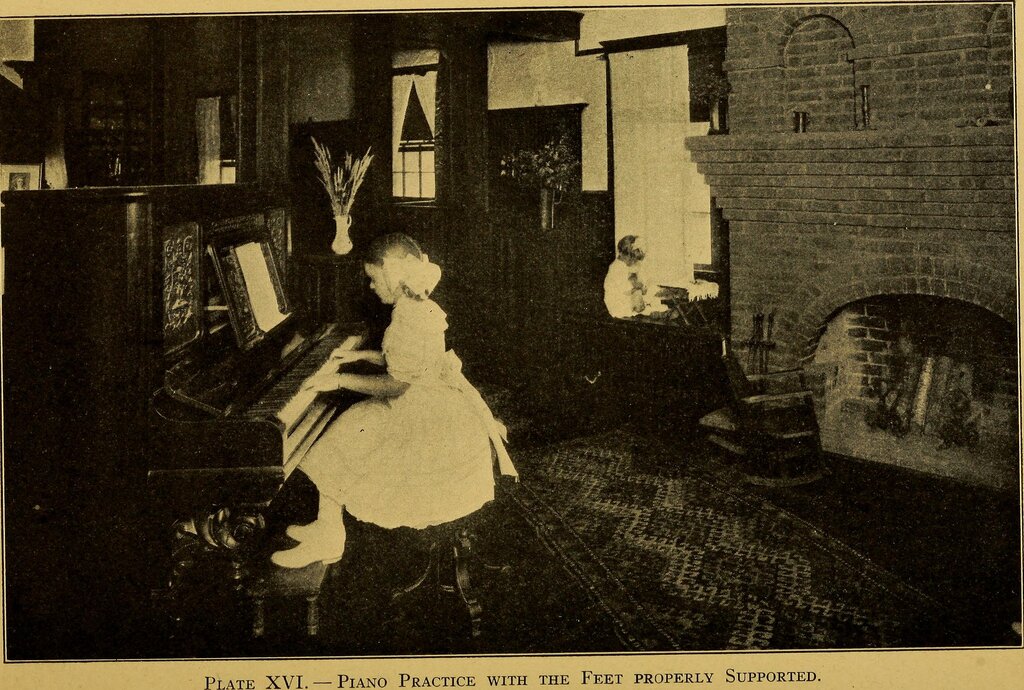
Sit on the front half of the bench with your back straight but not rigid. Your shoulders should be relaxed, not hunched up toward your ears. Plant both feet flat on the floor, about shoulder-width apart. This gives you a stable base to play from.
Hand Position and Finger Numbers
Just like your body posture, your hand position is key. You want your hands to be relaxed and natural. Let your arms hang loosely at your sides, and notice the natural curve of your fingers. That's the shape you want to maintain when you place your hands on the keys.
Imagine you're holding a small ball in your palm. Your fingers should be gently curved, and your wrist should be level, not bent up or down. Your knuckles should form a gentle arch. This position allows for strength and flexibility.
The basic hand shape for piano resembles a loose “C”:Curved fingers: Fingers should be naturally curved as if holding a small ball, not flat or claw-like.Relaxed wrist: Slightly higher than the knuckles, but not excessively raised.
To make things easier, pianists number the fingers on each hand from 1 to 5. Your thumb is always 1, your index finger is 2, middle finger is 3, ring finger is 4, and your pinky is 5. This is the same for both the left and right hands.
A common starting position is to place your right thumb (finger 1) on Middle C. The rest of your fingers will then naturally fall on the next four white keys: D, E, F, and G.
Understanding Octaves
You've learned that the musical alphabet A-G repeats. The distance between one note and the next note with the same name is called an octave.
Find a C on the keyboard. Now, count up eight white keys (including the C you started on). The eighth key will be the next C. This C is one octave higher. The same works for any note. The distance from any G to the next G is an octave, from any F to the next F is an octave, and so on.
The entire piano keyboard is made up of a little over seven octaves. This gives the instrument its incredible range, from very low, rumbling bass notes to high, sparkling treble notes.

Recognizing octaves helps you understand the layout of the keyboard as a whole. Instead of seeing 88 individual keys, you can start to see repeating patterns, which makes finding your way around much easier.
How can you reliably find the note 'C' on any piano keyboard?
Which finger is designated as finger number 5 in standard piano notation for both hands?
Getting comfortable with these fundamentals is the first step on your piano journey. Take some time to simply sit at the piano, find the different notes, and practice a relaxed posture and hand shape.