Introduction to Piano Playing
Keyboard Layout
The Keyboard Landscape
Take a look at a piano keyboard. You'll see a repeating pattern of white and black keys. The black keys are grouped into sets of two and three. This pattern is your map.

These groups of black keys are your landmarks. Once you can spot them, you can find any note. The musical alphabet uses just seven letters: A, B, C, D, E, F, and G. This sequence repeats over and over across the white keys.
Notice the pattern:
- The note C is always the white key just to the left of the two-black-key group.
- The note F is always the white key just to the left of the three-black-key group.
If you can find C and F, you can fill in the rest of the alphabet from there.
Finding Your Way
The most important landmark on the piano is Middle C. It’s the starting point for many beginner pieces and a central reference for musicians.
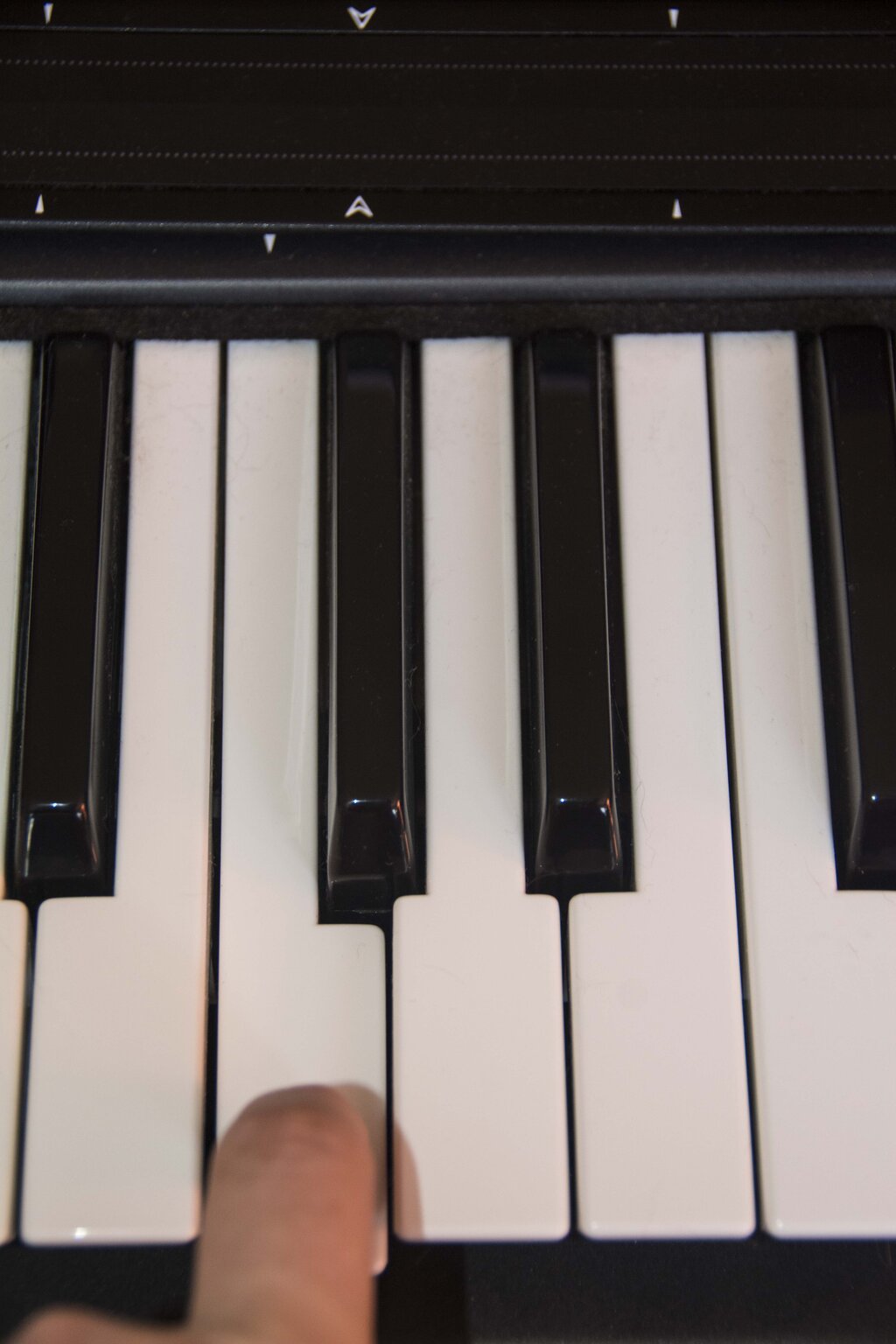
Middle C is the C that is closest to the middle of the keyboard. On a standard 88-key piano, it's the fourth C you'll find when counting up from the lowest note on the left.
This set of 12 keys, from one C to the next, is called an octave. The entire keyboard is just this same 12-key pattern repeating itself.
octave
noun
A series of twelve notes, including seven white keys and five black keys, that repeats across the keyboard. The interval between a note and the next note with the same name.
Octaves and Pitch
As you move your hands to the right on the piano, the notes get higher in pitch. Move to the left, and they get lower.
To keep track of which octave you're in, notes are often labeled with a number. Middle C is called C4. The C in the octave below it is C3, and the C above it is C5. This system helps you know exactly where on the keyboard a piece of music should be played.
For now, just get comfortable with this layout. Sit at a piano or keyboard and practice finding all the C's. Then try finding all the F's. The more you explore the keyboard's geography, the more natural it will feel.