Introduction to Physics
Introduction to Mechanics
What is Mechanics?
Mechanics is the part of physics that explains how and why things move. It’s the foundation for understanding everything from a thrown baseball to the orbit of a planet.
To keep things simple, we can split mechanics into two main areas. The first is kinematics, which is the language we use to describe motion. The second is dynamics, which explains the causes of that motion, namely forces.
Mechanics is a branch of physics that deals with the motion of objects and the forces that cause these motions.
Describing Motion
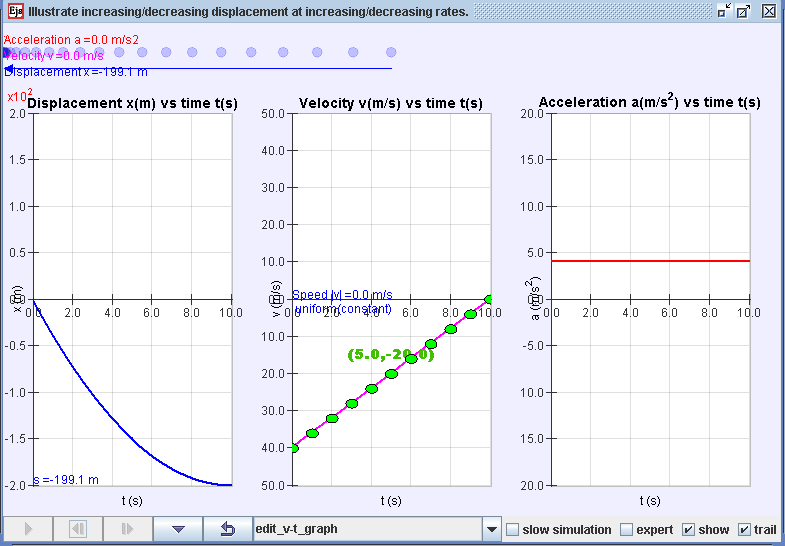
Before we can understand why things move, we need a clear way to talk about their movement. That's where kinematics comes in. It gives us the tools to describe motion precisely, using three key ideas: displacement, velocity, and acceleration.
Displacement
noun
The change in an object's position. It measures the straight-line distance and direction from the starting point to the ending point.
Displacement isn't the same as the total distance traveled. In the example above, you walked a total distance of 13 meters, but your final position is only 7 meters away from where you started.
Velocity
noun
The rate at which an object's displacement changes. It includes both speed and direction.
Because velocity includes direction, you can change your velocity without changing your speed. A car turning a corner at a constant 30 miles per hour is changing its velocity because its direction is changing.
Acceleration
noun
The rate at which an object's velocity changes. An object is accelerating if it's speeding up, slowing down, or changing direction.
Why Things Move
Now that we can describe motion, we can ask why it happens. The answer is dynamics, and the core principles were laid out by Isaac Newton over 300 years ago. These are known as Newton's Laws of Motion.
Newton's First Law: The Law of Inertia An object at rest will stay at rest, and an object in motion will stay in motion with the same velocity, unless acted upon by a net external force.
This law introduces the idea of inertia, an object's resistance to changes in its state of motion. The more mass an object has, the more inertia it has. It’s why it’s harder to push a car than a bicycle.
Newton's Second Law: Force and Acceleration The acceleration of an object is directly proportional to the net force acting on it and inversely proportional to its mass.
This is the most famous of the three laws and is often summarized by a simple equation.
In simple terms, if you push something, it will accelerate. If you push it harder, it will accelerate more. If it’s heavier (has more mass), it will accelerate less.
Newton's Third Law: Action and Reaction For every action, there is an equal and opposite reaction.
This means that forces always come in pairs. When you push on a wall, the wall pushes back on you with an equal amount of force. When a rocket expels gas downwards, the gas pushes the rocket upwards. This simple principle explains how so many things in our world work.

Energy and Momentum
Forces and motion are closely linked to two other crucial concepts in mechanics: energy and momentum. These are what we call conserved quantities, which means the total amount of them in a closed system never changes. They just move around or change form.
Work
noun
In physics, work is done when a force causes an object to have a displacement. It is the transfer of energy.
Work and energy are two sides of the same coin. The work-energy theorem states that the total work done on an object equals the change in its kinetic energy, which is the energy of motion. In other words, doing work on something changes how fast it's moving.
Another fundamental idea is the conservation of energy: energy cannot be created or destroyed, only converted from one form to another, like from potential energy (stored energy) to kinetic energy.
Momentum
noun
A measure of an object's motion, calculated as the product of its mass and velocity. It is often described as "mass in motion."
Like energy, momentum is also conserved. The law of conservation of momentum states that the total momentum of a closed system remains constant. This is the key principle behind understanding collisions. When two pool balls collide, the total momentum of both balls before the collision is the same as the total momentum after. Momentum is simply transferred from one ball to the other.
Time to check your understanding of these core concepts.
A race car is driving at a constant speed of 150 mph around a circular track. Is its velocity changing?
Which of Newton's Laws best explains why it's harder to push a heavy box than a light one?
These building blocks of kinematics, dynamics, energy, and momentum form the basis of all mechanics. Mastering them opens the door to understanding a vast range of physical phenomena.