Introduction to Phylogenetics
Introduction to Phylogenetics
The Family Tree of Life
Think of phylogenetics as building a family tree, but for all living things. It's the study of how species are related to one another through evolutionary history. Instead of tracing ancestors through birth records, scientists use evidence like DNA, anatomical features, and fossils to piece together the past.
This isn't just about drawing connections. Phylogenetics provides a framework for understanding life's incredible diversity. It helps us see how a tiny bacterium and a giant blue whale, despite their differences, share a distant common ancestor. Charles Darwin was one of the first to sketch out this idea of a great, branching tree of life.
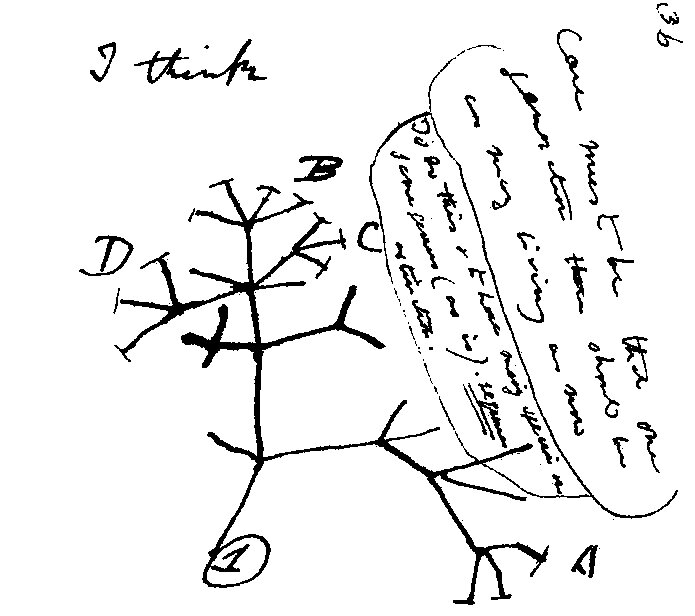
These diagrams, called phylogenetic trees, are not facts set in stone. They are hypotheses, or scientific best guesses, based on the available evidence. As we discover more, these trees can be revised and refined, giving us an ever-clearer picture of the story of evolution.
Anatomy of a Tree
To understand the story a phylogenetic tree tells, you first need to know its parts. Each component has a specific meaning.
Let's break down what you see in the diagram:
-
Leaves (or Terminal Nodes): These are at the very tips of the branches. Each leaf represents a group of organisms, which could be a species, a population, or even an individual.
-
Branches: These are the lines that connect the tree. They represent the evolutionary paths from one generation to the next. The length of a branch can sometimes represent time or the amount of genetic change, but for now, just think of them as the connections.
-
Nodes: A node is a point where a branch splits into two or more new branches. This split represents a speciation event, where one ancestral lineage split into distinct new ones. Therefore, each node represents the most recent common ancestor of all the leaves that branch off from it.
-
Root: The root is the base of the tree, the single branch at the bottom that connects to everything else. It represents the oldest, common ancestor of every organism on the tree.
The key insight is that any two species on the tree are related. To find their common ancestor, you just trace their branches back until they meet at a node.
For example, in the diagram above, species C and D are more closely related to each other than either is to species E. We know this because they share a more recent common ancestor. You only have to go back one node to connect C and D. To connect C and E, you have to go back two nodes.
Why It Matters
Phylogenetics is a foundational tool in modern biology. Its applications are broad and powerful.
In taxonomy, the science of naming and classifying organisms, phylogenetics has caused a revolution. Instead of grouping organisms by simple physical similarities, scientists now group them based on evolutionary relationships. This has led to a more accurate and natural classification system.
In ecology, phylogenetics helps explain why certain communities of species exist. By understanding the evolutionary history of organisms in an ecosystem, we can better understand how they interact and adapt to their environment.
For evolutionary biologists, these trees are essential maps of history. They allow scientists to track the evolution of specific traits, like the development of flight in birds or the loss of sight in cave-dwelling fish. They can also be used to understand how diseases evolve. During a viral outbreak, scientists rapidly sequence the virus's genetic material from different patients to build a phylogenetic tree. This tree helps them track how the virus is spreading and changing over time, which is critical for public health.
Time to check your understanding of these core concepts.
What is the primary goal of phylogenetics?
On a phylogenetic tree, the tips of the branches, which represent specific groups of organisms like a species or population, are called ______.
By understanding these trees, we learn to read the story of life written in the connections between all living things.