Introduction to Philosophy
Introduction to Philosophy
What is Philosophy?
At its core, philosophy is about asking fundamental questions. It's the study of the big ideas that shape our understanding of the world, ourselves, and each other. Why are we here? What does it mean to be a good person? What is real? These aren't questions with easy answers, and philosophy doesn't always provide them. Instead, it offers a way to think clearly and critically about them.
Western Philosophy is the study of fundamental questions about existence, knowledge, values, reason, and language, originating from ancient Greece around the 6th century BCE with thinkers like Socrates, Plato, and Aristotle.
The word philosophy comes from two Greek words: philo (love) and sophia (wisdom). A philosopher is a "lover of wisdom." The goal isn't just to have opinions, but to examine them, challenge assumptions, and build arguments based on reason. It’s a process of inquiry that touches on nearly every aspect of human life, from science and art to politics and religion.
The Main Branches
To tackle these big questions, philosophy is often broken down into several major branches. Each one focuses on a different set of fundamental problems.
| Branch | Core Question |
|---|---|
| Metaphysics | What is the nature of reality? |
| Epistemology | How do we know what we know? |
| Ethics | How should we act? |
| Logic | What is correct reasoning? |
| Aesthetics | What is beauty and art? |
Metaphysics explores the fundamental nature of existence. It asks questions like: What is time? Do we have free will? What happens after we die? It’s about the underlying structure of reality itself.
Epistemology is the theory of knowledge. It's concerned with how we acquire knowledge and what makes a belief justified. How can we be sure that what we think is true actually is? What's the difference between an opinion and a fact?
Ethics, or moral philosophy, deals with questions of right and wrong. It examines what it means to live a good life, our obligations to others, and the nature of justice. Is it always wrong to lie? What makes an action morally right?
Logic is the study of reasoning and argumentation. It provides the tools to analyze arguments, identify fallacies, and construct sound reasoning. Logic helps us think clearly and systematically, which is crucial for all other areas of philosophy.
Aesthetics focuses on the nature of beauty, art, and taste. It asks questions like: What makes something a work of art? Is beauty subjective, or are there objective standards? What is the purpose of art?
A Brief History of Thought
Western philosophy began in ancient Greece over 2,500 years ago. Thinkers like Thales, Socrates, Plato, and Aristotle laid the groundwork for almost every philosophical debate that followed. Socrates famously challenged people to "know thyself," Plato explored the nature of ideal forms, and Aristotle created systematic approaches to logic and science.
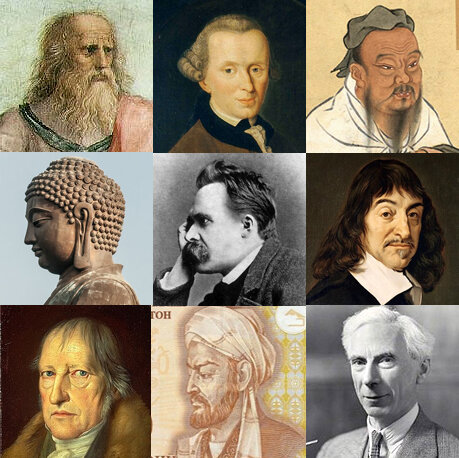
After the classical period, philosophy evolved through several key movements:
- Medieval Philosophy: Thinkers like Augustine and Thomas Aquinas worked to reconcile Greek philosophy with Christian theology, exploring the relationship between faith and reason.
- The Renaissance & Enlightenment: This period saw a renewed focus on humanism, reason, and scientific inquiry. Figures like René Descartes ("I think, therefore I am") and Immanuel Kant shifted philosophy's focus toward the nature of the self and the limits of human knowledge.
- Modern Philosophy: In the 19th and 20th centuries, philosophy branched out dramatically. Existentialism (Søren Kierkegaard, Jean-Paul Sartre) grappled with individual freedom and the meaning of life, while Analytic philosophy (Bertrand Russell, Ludwig Wittgenstein) emphasized logic, language, and precision.
This long conversation, spanning centuries and continents, continues to shape how we understand our world.
The word "philosophy" is derived from the Greek words philo and sophia. What is the literal translation?
A philosopher investigating the question, "What makes a belief justified, as opposed to just being an opinion?" is working within which branch of philosophy?
Philosophy is a journey of questioning and discovery. By exploring its branches and history, we gain the tools to think more deeply about the world and our place in it.