Introduction to Particle Physics
Introduction to Particle Physics
The Building Blocks of Everything
If you take any object, say an apple, and cut it in half, you get two smaller pieces of apple. If you could keep cutting those pieces, you'd eventually get down to apple molecules, then to the atoms that make them up, like carbon and oxygen. But it doesn't stop there. Atoms have a nucleus made of protons and neutrons, with electrons zipping around it. For a long time, we thought those were the smallest pieces.
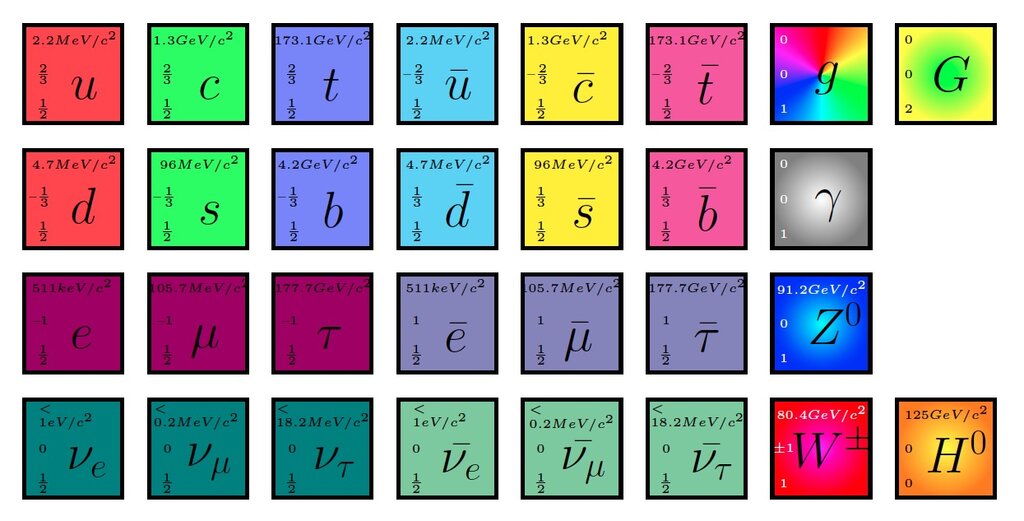
It turns out, even protons and neutrons are made of something smaller. These are the true fundamental building blocks of our universe, called elementary particles. They are, as far as we know, the end of the line. You can't cut them into smaller pieces. These particles fall into two main families: quarks and leptons.
Quarks are sociable particles. They are always found in groups, never alone. Leptons, on the other hand, are perfectly happy on their own.
The most famous lepton is the electron, the tiny particle responsible for electricity. Another type of lepton, the neutrino, is incredibly light and barely interacts with anything. Trillions of them are passing through your body every second without a trace.
Quarks combine to form the protons and neutrons inside an atom's nucleus. For instance, a proton is made of two "up" quarks and one "down" quark. A neutron is made of one "up" quark and two "down" quarks. There are other types, or "flavors," of quarks and leptons, but they are much heavier and less stable. They existed in the early universe but now are mostly just seen in particle accelerators.
A Mirror Universe
For every fundamental particle, there's a corresponding antiparticle. Think of it as a mirror image. An antiparticle has the same mass as its particle counterpart, but an opposite electric charge and other quantum properties.
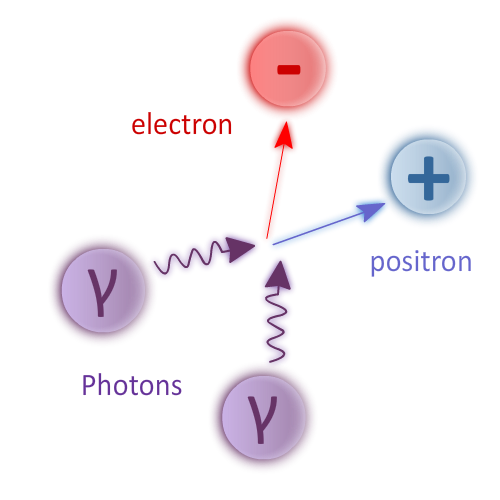
The antiparticle of the electron, which has a negative charge, is called the positron. It has a positive charge. The antiparticle of an up quark is an anti-up quark.
What happens when a particle and its antiparticle meet? They annihilate each other in a flash of pure energy. This process can also happen in reverse: a burst of energy can create a particle-antiparticle pair, as long as there's enough energy to account for their mass ().
The Forces of Nature
So we have the building blocks. But what holds them together? What makes them interact? The universe is governed by four fundamental forces. You experience two of them every day: gravity, which keeps you on the ground, and electromagnetism, which powers your lights and holds atoms together.
The other two forces operate on the tiny scale of the atomic nucleus. The strong nuclear force is what binds quarks together inside protons and neutrons. It's incredibly powerful but has a very short range. The weak nuclear force is responsible for certain types of radioactive decay, a process where one type of particle changes into another.
In particle physics, forces aren't just invisible fields. They are the result of particles exchanging other particles.
Imagine two people on ice skates. If one throws a heavy ball to the other, both will be pushed backward. The exchange of the ball created a repulsive force between them. The fundamental forces work in a similar way. The particles that carry these forces are called gauge bosons.
Each force has its own messenger particle. For electromagnetism, it's the photon. For the strong force, it's the gluon. The weak force is carried by W and Z bosons. Gravity is theorized to be carried by a particle called the graviton, but it hasn't been detected yet.
| Force | Carrier Particle(s) | What it Does |
|---|---|---|
| Strong | Gluon | Binds quarks into protons and neutrons |
| Electromagnetic | Photon | Acts on charged particles; creates light, electricity |
| Weak | W and Z bosons | Governs some types of radioactive decay |
| Gravitational | Graviton (hypothetical) | Acts on mass and energy; governs planetary orbits |
These particles and forces make up what's known as the Standard Model of particle physics. It's our best description of the subatomic world, and it has been incredibly successful at explaining how the universe works at its most fundamental level.
Now, let's test your understanding of these fundamental concepts.
What are the two main families of elementary particles, which are considered the fundamental building blocks of matter?
According to the Standard Model, what is a proton composed of?
Understanding these basic components—quarks, leptons, antiparticles, and force-carrying bosons—is the first step into the fascinating world of particle physics.