Introduction to Organic Chemistry
Introduction to Organic Chemistry
The World of Carbon
Organic chemistry is the study of compounds that contain carbon. It might sound narrow, but it's a massive field. Carbon is the backbone of all life on Earth, from the simplest bacteria to complex mammals. DNA, proteins, sugars, and fats are all organic molecules.
What makes carbon so special? It has a unique ability to form four strong, stable covalent bonds. This allows it to connect with a wide variety of other elements like hydrogen, oxygen, nitrogen, and sulfur. More importantly, carbon atoms can bond with each other to form long chains, branched structures, and complex rings. No other element does this with such stability and versatility.
This ability to form diverse and stable structures is why millions of organic compounds exist. They range from simple molecules like methane (), the main component of natural gas, to incredibly complex ones like DNA, which carries our genetic code.
Functional Groups
With so many molecules, how do chemists make sense of them all? They look for functional groups. A functional group is a specific arrangement of atoms within a molecule that is responsible for its characteristic chemical reactions.
Think of the carbon backbone of an organic molecule as its frame or chassis. The functional groups are like the engine, wheels, and steering wheel—they determine what the molecule does and how it interacts with other molecules. A molecule might have a long, complex carbon skeleton, but the action usually happens at the functional group.
By learning to recognize a few dozen functional groups, you can predict the behavior of thousands of different organic compounds.
For example, any molecule containing an -OH group (a hydroxyl group) is classified as an alcohol. All alcohols share certain properties, like the ability to form hydrogen bonds, because they all have that same functional group. The length of the carbon chain might change other properties, like boiling point, but the fundamental chemical reactivity remains similar.
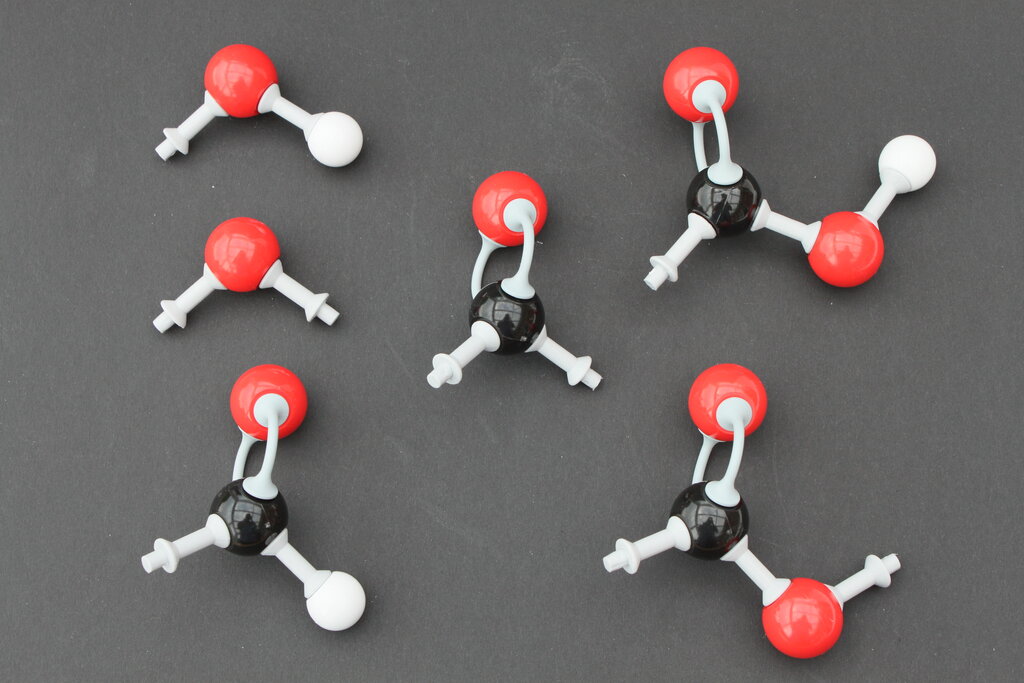
Here are a few of the most common functional groups.
| Class of Compound | Functional Group | Structure |
|---|---|---|
| Alkane | (all single bonds) | C-C |
| Alkene | Double Bond | C=C |
| Alkyne | Triple Bond | C≡C |
| Alcohol | Hydroxyl | -OH |
| Ether | Ether | -O- |
| Ketone | Carbonyl | C=O (internal) |
| Carboxylic Acid | Carboxyl | -COOH |
Naming the Molecules
A systematic method is needed to name organic compounds. The International Union of Pure and Applied Chemistry (IUPAC) developed a set of rules for this purpose. The goal is simple: every distinct organic compound should have a unique, unambiguous name.
The IUPAC system is based on a few key parts:
- Parent Chain: Find the longest continuous chain of carbon atoms.
- Prefix: The prefix indicates the number of carbon atoms in the parent chain (e.g., meth- for 1, eth- for 2, prop- for 3).
- Suffix: The suffix identifies the most important functional group (e.g., -ane for an alkane, -ol for an alcohol).
- Locants: Numbers are used to show the position of functional groups or branches on the parent chain.
Let's see this in action. A three-carbon chain is indicated by the prefix prop-. If it's an alkane (only single bonds), the suffix is -ane. So, its name is propane.
If we replace a hydrogen on the second carbon of propane with a hydroxyl (-OH) group, it becomes an alcohol. The suffix changes to -ol. We also need a number to show where the -OH group is. The name becomes propan-2-ol, commonly known as rubbing alcohol. If the -OH group were on an end carbon, it would be propan-1-ol.
Understanding these core principles—the special nature of carbon, the role of functional groups, and the logic of nomenclature—provides the foundation for exploring the entire field of organic chemistry.
Ready to check your understanding? Let's try a few questions.
What unique property of carbon allows it to form the backbone of millions of diverse organic compounds?
In an organic molecule, what is the primary role of a functional group?
With these basics, you're ready to start exploring the reactions and structures that make up the world around us.