Introduction to Organic Chemistry
Introduction to Organic Chemistry
Carbon: The Backbone of Life
Organic chemistry is, at its heart, the study of carbon compounds. But why does an entire branch of chemistry revolve around a single element? It's because carbon is unique. A carbon atom can form four stable covalent bonds with other atoms, including other carbon atoms.
This ability to link up with itself, called catenation, allows carbon to form long, stable chains, branched chains, and complex rings. No other element does this as well as carbon. These carbon backbones form the skeletons of millions of different organic molecules, from the simple methane in natural gas to the incredibly complex DNA that carries our genetic code.
Carbon doesn't just form single bonds. It can also form double and triple bonds with other atoms, adding even more variety to the structures it can create.
Hybridization and Molecular Shape
The four bonds of a carbon atom aren't just randomly placed. Their arrangement in 3D space is predictable and depends on the types of bonds involved (single, double, or triple). This geometry is explained by a concept called hybridization.
Think of it this way: a carbon atom has a set of atomic orbitals where its bonding electrons reside ( and orbitals). To form stable, strong bonds, these orbitals can mix together to form new, hybrid orbitals. The way they mix determines the final shape of the molecule.
There are three main types of hybridization for carbon: , , and .
When a carbon atom forms four single bonds, it undergoes hybridization. The four hybrid orbitals point towards the corners of a tetrahedron, creating bond angles of 109.5°. Methane () is the classic example.
If a carbon atom forms one double bond and two single bonds, it undergoes hybridization. This results in a flat, trigonal planar geometry with bond angles of 120°. The molecule ethene () contains two hybridized carbons.
Finally, when a carbon forms one triple bond and one single bond, it uses hybridization. This creates a linear molecule with a bond angle of 180°. Ethyne (), also known as acetylene, is a linear molecule with two hybridized carbons.
Functional Groups: Molecular Personalities
While carbon backbones provide the structure, the real action in organic chemistry happens at the functional groups. A functional group is a specific arrangement of atoms within a molecule that is responsible for its characteristic chemical reactions and properties.
You can think of the carbon backbone as the chassis of a car, while the functional groups are the engine, wheels, and steering. They determine how the molecule moves, interacts, and behaves. Molecules with the same functional group tend to react in similar ways, which allows chemists to organize and predict the behavior of millions of compounds.
Students simply need to apply some basic functional group chemistry and understand that these groups can be manipulated while leaving the carbon backbone intact.
Let's meet a few of the most common functional groups. You'll see these everywhere in organic chemistry.
| Functional Group | Structure | Found In |
|---|---|---|
| Alcohol | R—OH | Disinfectants, beverages |
| Carboxylic Acid | R—COOH | Vinegar, citrus fruits |
| Amine | R—NH₂ | Amino acids, medicines |
| Ketone | R—CO—R' | Solvents (acetone) |
| Ester | R—COO—R' | Fragrances, flavorings |
In the table, 'R' and 'R'' represent the rest of the carbon-based molecule. By identifying the functional groups in a molecule, you can begin to understand its personality: Is it acidic? Will it dissolve in water? How will it react with other molecules? This is the foundation of understanding organic reactions.
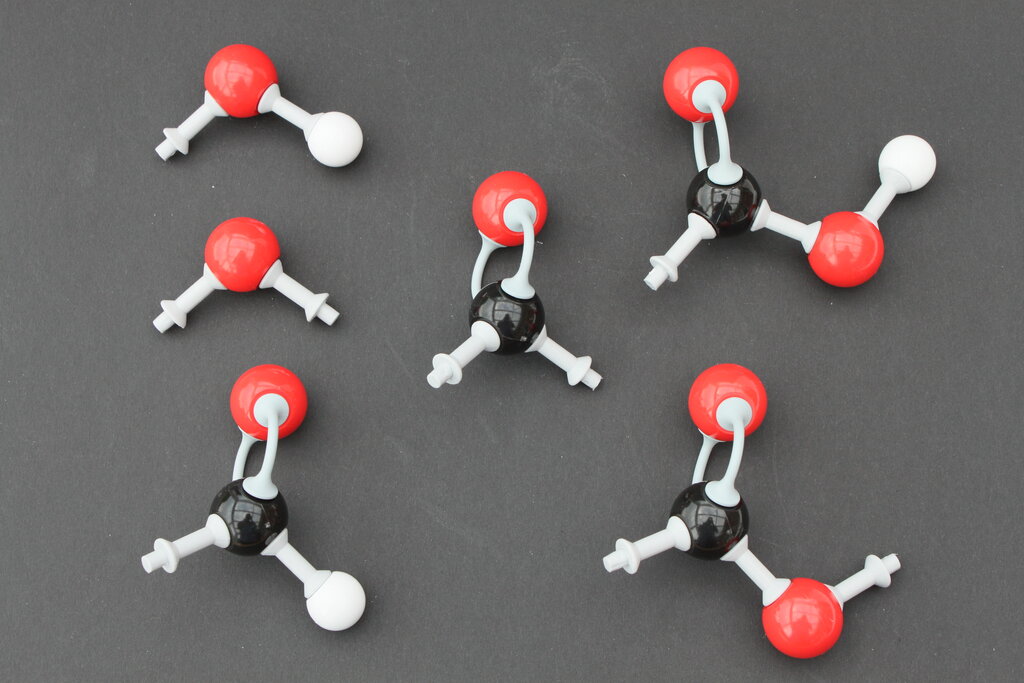
Now that you've learned about the building blocks of organic chemistry, let's test your understanding.
What is the term for carbon's unique ability to form long, stable chains by bonding with other carbon atoms?
A carbon atom that undergoes hybridization will have what characteristic bond angle?
Understanding carbon's unique bonding, its different hybridization states, and the concept of functional groups provides the essential groundwork for exploring the vast and fascinating world of organic chemistry.