Introduction to Nuclear Physics
Atomic Nucleus Structure
The Atom's Dense Core
At the heart of every atom lies the nucleus, a tiny, incredibly dense region that contains almost all of the atom's mass. If an atom were the size of a sports stadium, its nucleus would be no bigger than a marble. This central core is populated by two types of particles: protons and neutrons. Together, they are known as nucleons.
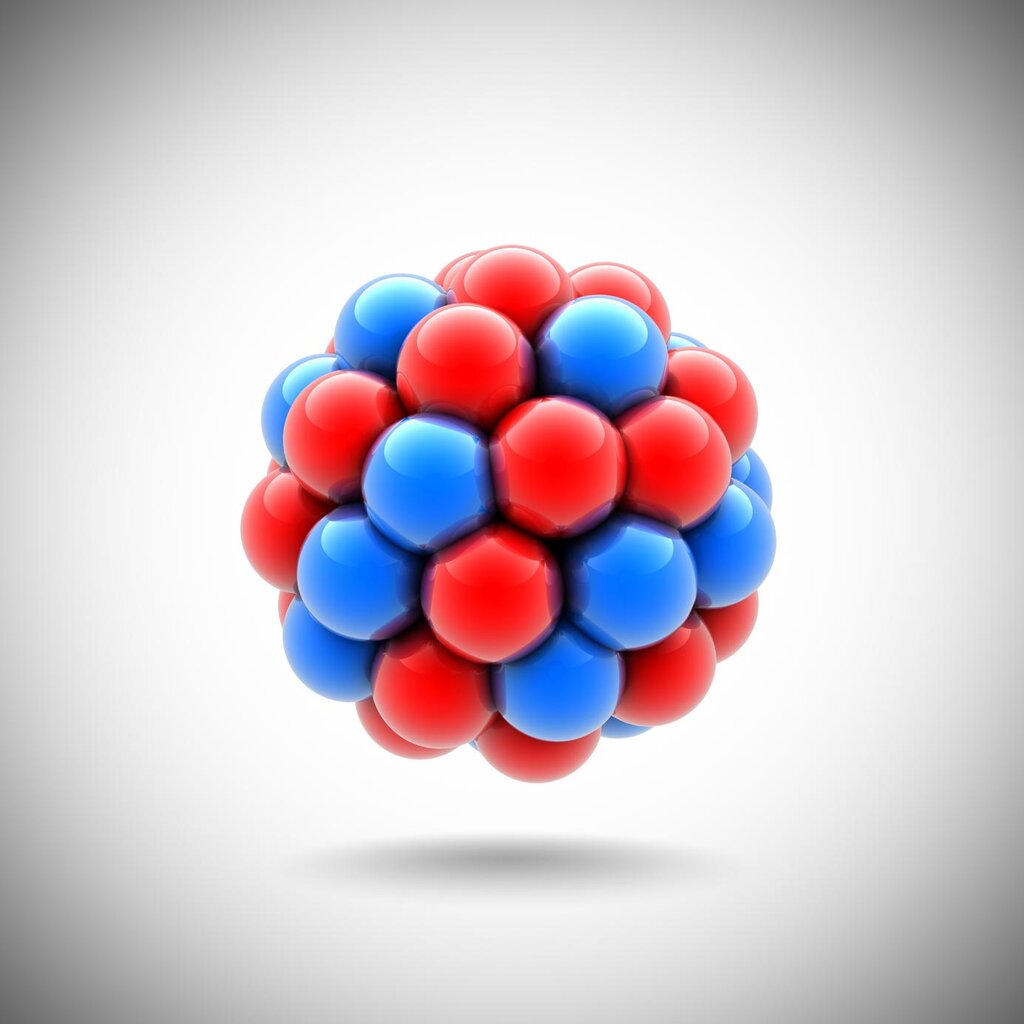
Protons carry a positive electrical charge, while neutrons, as their name suggests, are neutral and have no charge. The number of protons determines what element an atom is. An atom with one proton is always hydrogen, and an atom with six protons is always carbon. This crucial number is called the atomic number, represented by the symbol .
Atomic Number () = Number of Protons
The total number of protons and neutrons in a nucleus is its mass number, symbolized by . The number of neutrons can be found by simply subtracting the atomic number from the mass number.
Where is the mass number, is the atomic number (protons), and is the neutron number.
Holding It All Together
This raises a question. If protons are all positively charged, why don't they repel each other and fly apart? The force of electrostatic repulsion is powerful, yet atomic nuclei are remarkably stable. The answer lies in a different, even more powerful force at play.
Strong Nuclear Force
noun
The fundamental interaction that binds protons and neutrons together in atomic nuclei. It is the strongest of the four fundamental forces but acts only over extremely short distances.
The strong nuclear force is a powerful attraction that exists between nucleons. It's about 100 times stronger than the electromagnetic force that pushes protons apart, but it only works over the tiny distances within a nucleus. Think of it like incredibly strong, but very short-range, glue. Once protons are far enough apart, the strong force vanishes, and electromagnetic repulsion takes over. This delicate balance is what holds the nucleus together.
Isotopes
While the number of protons defines an element, the number of neutrons can vary. Atoms of the same element that have different numbers of neutrons are called isotopes.
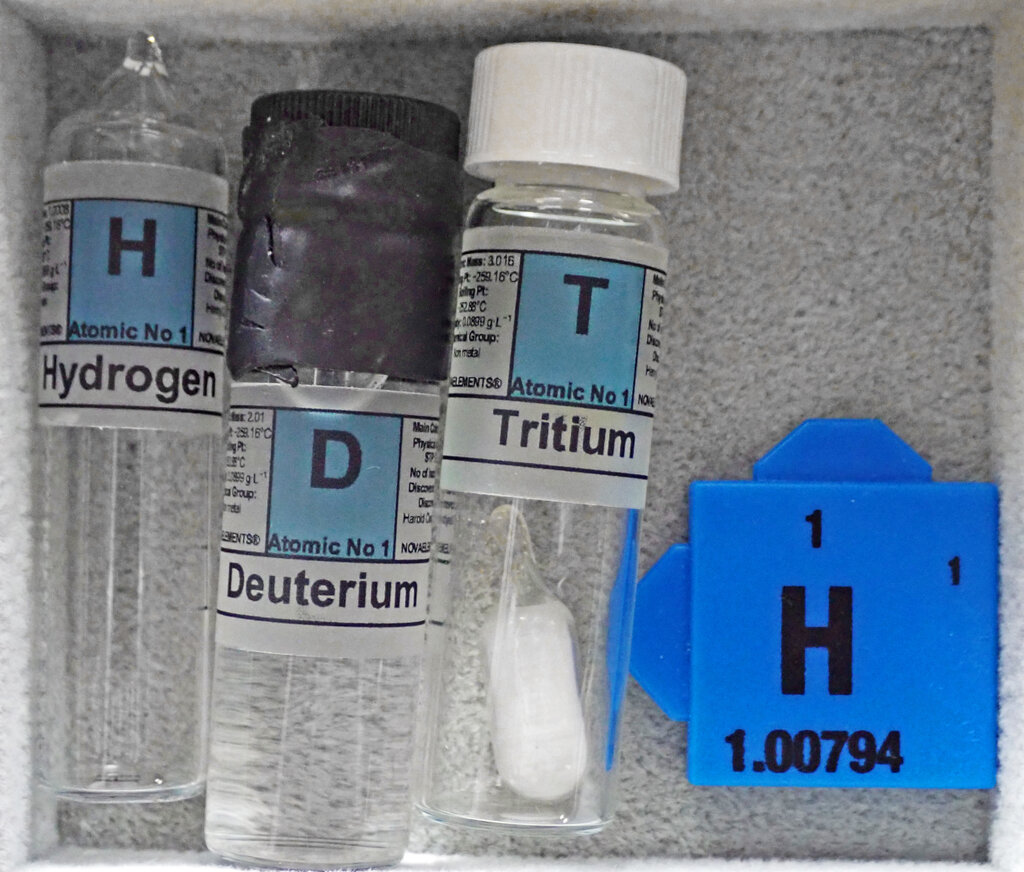
For example, all carbon atoms have six protons. The most common form of carbon has six neutrons as well, giving it a mass number of 12. This is written as Carbon-12 or . However, other isotopes exist. Carbon-13 has six protons and seven neutrons, and Carbon-14 has six protons and eight neutrons.
Since they have the same number of protons (and electrons in a neutral atom), isotopes of an element have nearly identical chemical properties. But their different masses, due to the varying number of neutrons, give them different nuclear properties.
| Isotope | Protons () | Neutrons () | Mass Number () |
|---|---|---|---|
| Carbon-12 | 6 | 6 | 12 |
| Carbon-13 | 6 | 7 | 13 |
| Carbon-14 | 6 | 8 | 14 |
The stability of a nucleus depends on its ratio of neutrons to protons. For lighter elements, a ratio of about 1-to-1 is most stable. For heavier elements, more neutrons are needed to counteract the increasing repulsion between the many protons. When this ratio is too far off, the nucleus becomes unstable. This sets the stage for other nuclear phenomena, like radioactivity.
What fundamental property of an atom determines its identity as a specific element?
The isotope Uranium-238 () has an atomic number of 92. How many neutrons are in its nucleus?