Introduction to Nuclear Physics
Atomic Structure
The Building Blocks of Matter
Everything around you, from the air you breathe to the screen you're reading this on, is made of atoms. For a long time, we thought atoms were the smallest, most fundamental things in the universe. But it turns out they have even smaller parts inside them.
Subatomic particles are protons, neutrons and electrons.
These three particles are the stars of the show. They determine an atom's properties, how it behaves, and what kind of element it is. Protons and neutrons are packed together in the center of the atom, forming a dense core called the nucleus. Electrons are much smaller and zip around the nucleus in a cloud-like region.
| Particle | Relative Charge | Relative Mass | Location |
|---|---|---|---|
| Proton | +1 | ~1 | In the nucleus |
| Neutron | 0 | ~1 | In the nucleus |
| Electron | -1 | ~1/1836 | Outside the nucleus |
Notice how tiny the electron's mass is compared to the protons and neutrons. For most practical purposes, the mass of an atom is almost entirely concentrated in its nucleus. The positive charge of the protons in the nucleus is what keeps the negatively charged electrons from flying away, holding the whole atom together through electrostatic attraction.
An Atom's Identity
How do we tell one type of atom from another? It all comes down to the number of protons. The number of protons in an atom's nucleus is its unique identifier.
Atomic Number
noun
The number of protons in the nucleus of an atom, symbolized by Z. This number uniquely defines a chemical element.
In a neutral atom, the number of electrons is equal to the number of protons, balancing the charge to zero. The other key number for an atom is its mass number, which tells us the total count of particles in the nucleus.
Mass Number
noun
The total number of protons and neutrons in an atomic nucleus, symbolized by A.
We can represent a specific atom using a standard notation that includes these two numbers.
For example, a carbon atom with 6 protons and 6 neutrons is written as . From this, you know its atomic number is 6 and its mass number is 12.
Isotopes
While the number of protons for an element is fixed, the number of neutrons can vary. Atoms of the same element that have different numbers of neutrons are called isotopes.
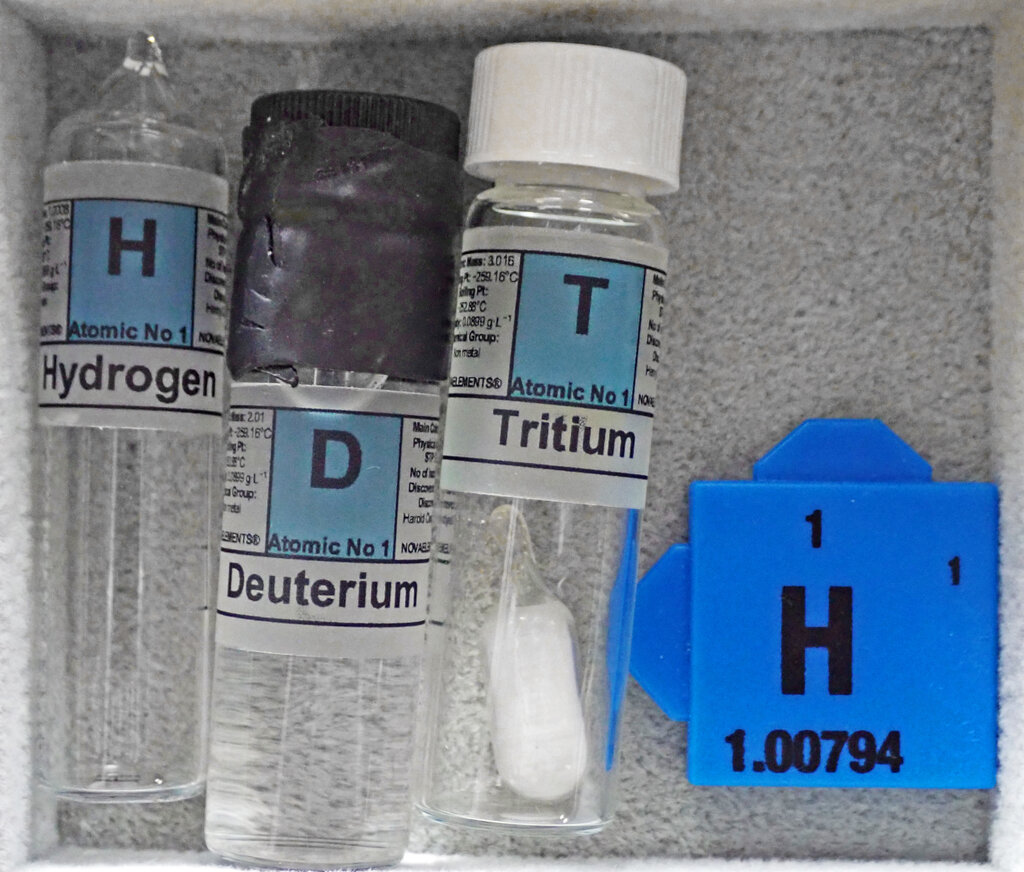
Hydrogen, for example, has an atomic number of 1, meaning it always has one proton. But it can have zero, one, or two neutrons. These variations are all still hydrogen, but they are different isotopes of it.
- Protium (): 1 proton, 0 neutrons
- Deuterium (): 1 proton, 1 neutron
- Tritium (): 1 proton, 2 neutrons
Since isotopes have the same number of protons and electrons, they have nearly identical chemical properties. Their difference in mass, however, can be important in nuclear physics.
Now, let's test your understanding of these atomic building blocks.
What are the three fundamental particles that make up an atom?
Which part of an atom contains almost all of its mass?
With this foundation, you're ready to explore what happens inside the nucleus.