Introduction to Nuclear Physics
Atomic Structure
The Atomic Blueprint
At the heart of everything you can see and touch are atoms. Think of them as the fundamental building blocks of matter. But what are atoms themselves made of? It turns out they have even smaller components called subatomic particles.
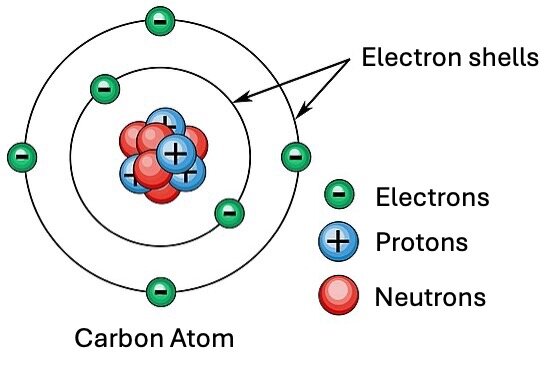
The three key players are protons, neutrons, and electrons. Protons have a positive electric charge, while electrons have a negative charge. Neutrons, as their name suggests, are neutral and have no charge at all.
Protons and neutrons are packed together in a dense, central core called the nucleus. They are the heavyweights of the atom, accounting for almost all of its mass. Orbiting this nucleus are the incredibly lightweight electrons, held in place by their electrical attraction to the positive protons. The space these electrons occupy is vast compared to the tiny size of the nucleus.
An Element's Identity
What makes one element different from another? It's all about the protons.
The number of protons in an atom's nucleus is called its atomic number, and it's what defines an element. Every atom with one proton is hydrogen. Every atom with six protons is carbon. Change the number of protons, and you change the element entirely.
While the atomic number tells you the proton count, the mass number gives you the total count of protons and neutrons in the nucleus. Since electrons are so light, their mass is usually ignored when calculating an atom's mass number.
We can represent an atom's composition with a simple notation:
For example, a common form of carbon has 6 protons and 6 neutrons. Its atomic number is 6, its mass number is 12, and its symbol is .
Sometimes an element can have different versions of itself. These are called isotopes.
Isotopes are atoms of the same element that have the same number of protons but a different number of neutrons. This means they share the same atomic number but have different mass numbers.
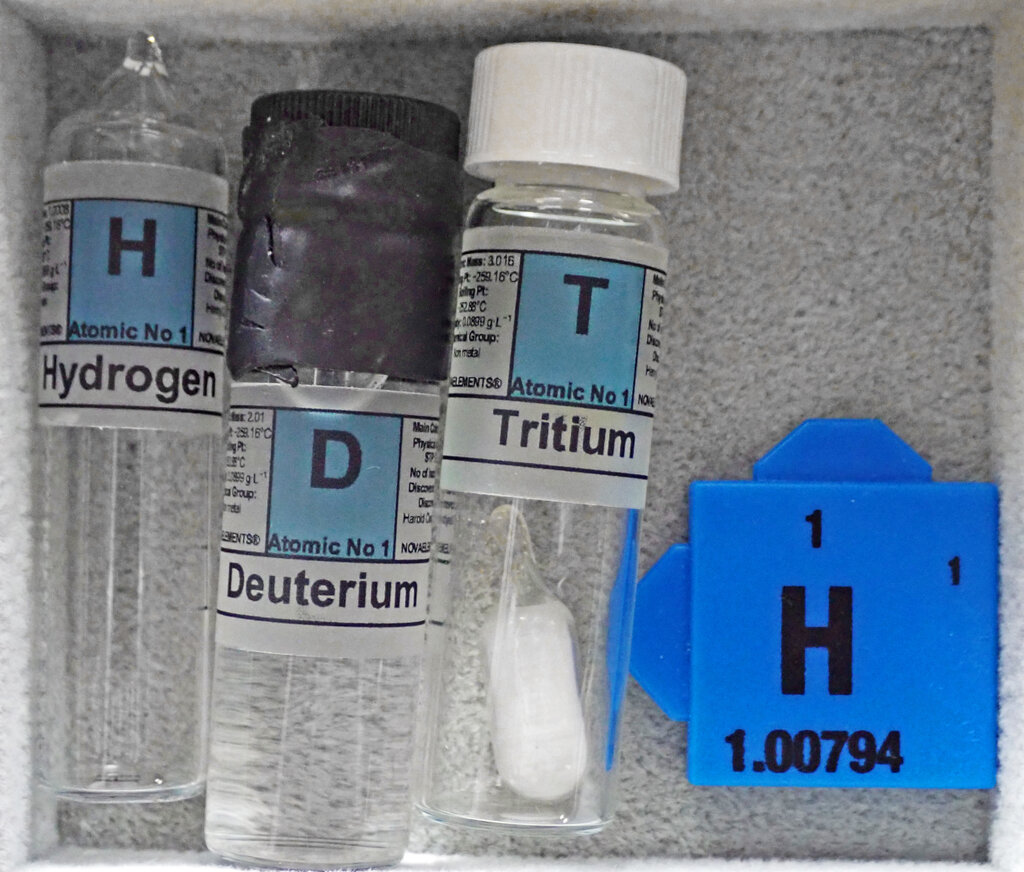
Hydrogen is a great example. Most hydrogen atoms are just a single proton with an electron. But some have a neutron, and a rare few have two. They're all still hydrogen, but they have different masses.
| Name | Protons | Neutrons | Mass Number |
|---|---|---|---|
| Protium (Hydrogen-1) | 1 | 0 | 1 |
| Deuterium (Hydrogen-2) | 1 | 1 | 2 |
| Tritium (Hydrogen-3) | 1 | 2 | 3 |
Because elements exist as a mix of isotopes, the atomic mass you see on the periodic table is a weighted average. It accounts for the natural abundance of each isotope on Earth.
Holding It All Together
If you think about it, the nucleus is a strange place. It's crammed with positively charged protons that should be repelling each other with incredible force. So why doesn't it fly apart?
The answer is the strong nuclear force. This is one of the four fundamental forces of nature, and it acts like a powerful glue, binding protons and neutrons together. It's incredibly strong, but only over extremely short distances, like those found inside a nucleus.
Once protons are far enough apart, the electrical repulsion takes over. But inside the nucleus, the strong force wins.
The energy that holds the nucleus together is called binding energy. It's the amount of energy you would need to supply to break the nucleus apart into its individual protons and neutrons. A higher binding energy per nucleon (proton or neutron) indicates a more stable nucleus.
This balance of forces and the concept of binding energy are crucial for understanding why some isotopes are stable and others are not.
Now, let's test your understanding of these core concepts.
What is the defining characteristic that determines the identity of a chemical element?
An atom has an atomic number of 8 and a mass number of 18. How many neutrons does it have?
With this foundation in atomic structure, you're ready to explore what happens when the nucleus itself changes.