Introduction to Nuclear Physics
Atomic Structure
The Building Blocks of Everything
Everything you see, touch, and breathe is made of atoms. They are the fundamental units of matter. But what are atoms made of? It turns out they have even smaller parts called subatomic particles. There are three key players to know.
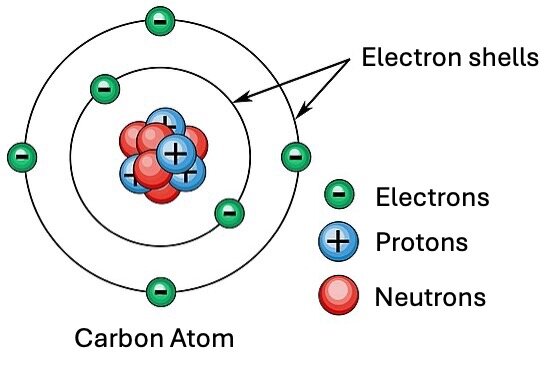
At the center of every atom is the nucleus, a dense core containing two types of particles:
- Protons: These have a positive (+) electrical charge.
- Neutrons: These have no charge; they're neutral.
Orbiting the nucleus are electrons, which have a negative (-) electrical charge. The positive charge of the protons in the nucleus attracts the negative electrons, keeping them bound to the atom. In a neutral atom, the number of electrons equals the number of protons, balancing the charges out to zero.
An Atom's Identity
What makes an atom of gold different from an atom of oxygen? It all comes down to the number of protons.
The atomic number (Z) is the number of protons in an atom's nucleus. This number is unique to each element and defines its identity. For example, every hydrogen atom has exactly one proton (), and every helium atom has exactly two (). Change the number of protons, and you change the element entirely.
isotope
noun
Atoms of the same element that have the same number of protons but a different number of neutrons.
While the number of protons is fixed for an element, the number of neutrons can vary. Atoms of the same element with different numbers of neutrons are called isotopes.
To account for the neutrons, we use the mass number (A), which is the total count of protons and neutrons in the nucleus. For example, the most common form of carbon has 6 protons and 6 neutrons, giving it a mass number of 12. We call it carbon-12. A less common isotope, carbon-14, has 6 protons and 8 neutrons, for a mass number of 14. It's still carbon because it has six protons, but it's heavier.
The Powerful Nucleus
The nucleus is tiny and incredibly dense. It contains positively charged protons packed tightly together. But wait, don't similar charges repel each other? The electromagnetic force should be pushing those protons apart with immense power. So why doesn't the nucleus just fly apart?
The answer is the strong nuclear force, one of the four fundamental forces of nature. It's about 100 times stronger than the electromagnetic force, but it only works over extremely short distances—about the size of a nucleus. This powerful, short-range attraction between protons and neutrons overcomes the electrical repulsion, holding the nucleus together.
The energy that holds the nucleus together is called binding energy. It's the energy you would need to supply to break a nucleus apart into its individual protons and neutrons. A higher binding energy per particle means a more stable nucleus.
Electrons in Motion
Electrons don't circle the nucleus in neat, flat orbits like planets around the sun. Instead, they exist in a cloud of probability around the nucleus. We can't know an electron's exact position and speed at the same time. We can only describe the regions where an electron is most likely to be found.
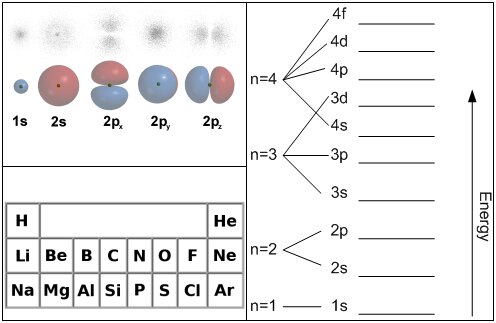
These regions are called orbitals, and they come in different shapes and sizes. Electrons in these orbitals have specific, quantized energy levels. This means they can only exist at certain fixed energy states, like standing on specific rungs of a ladder, not in between.
Each energy level, also called a shell, can hold a certain number of electrons. The lowest energy level is closest to the nucleus. An electron can jump to a higher energy level by absorbing energy or drop to a lower one by releasing energy, often in the form of light.
Now, let's test your understanding of atomic structure.
Which subatomic particle defines an element's chemical identity?
An atom has 8 protons, 8 electrons, and 10 neutrons. What is its mass number (A)?
Understanding these basic components—protons, neutrons, and electrons—and the forces that govern them is the first step to unlocking the secrets of matter itself.