Introduction to Neurotoxins
Neurons
The Brain's Messengers
Your nervous system is a vast communication network, and its fundamental units are specialized cells called neurons. Think of them as the messengers of your body, carrying vital information at incredible speeds. Everything you think, feel, and do is possible because of the coordinated activity of these tiny cells.
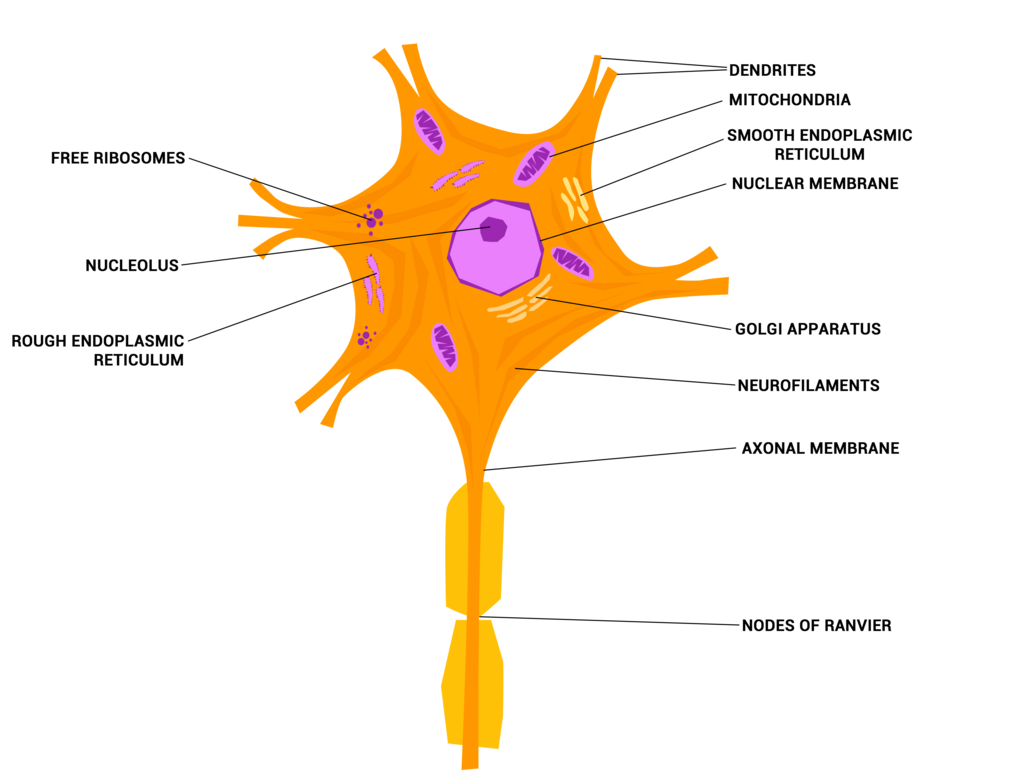
While neurons come in various shapes and sizes, most share a common three-part structure. Understanding these parts is the first step to understanding how the entire nervous system works.
The Control Center
The main part of the neuron is the cell body, also called the soma. Just like other cells in your body, it has a nucleus and other essential components that keep the cell alive and functioning. The cell body acts as the neuron's headquarters. It processes the information it receives and decides whether to pass a signal along.
Soma
noun
The cell body of a neuron, containing the nucleus and other organelles, responsible for the cell's metabolic processes.
Receiving the Signal
Branching out from the cell body are tree-like structures called dendrites. Their name comes from the Greek word dendron, meaning 'tree'. This is a fitting name, as their primary job is to act like antennae, receiving signals from other neurons. A single neuron can have thousands of these dendritic branches, allowing it to communicate with many other cells at once.
Dendrites listen. They are the input channels of the neuron, collecting messages from their neighbors.
Sending the Message
Once the cell body processes the incoming signals from the dendrites, it may decide to send a message of its own. This is the job of the axon, a long, cable-like projection that carries the nerve impulse away from the cell body. Think of it as the output cable. An axon can be very short, or it can be quite long, extending over a meter in humans from the spinal cord to the toes.
At its end, the axon branches out into several axon terminals. These terminals are positioned very close to the dendrites of other neurons, allowing the signal to be passed on, creating a chain of communication.
The flow of information in a neuron is a one-way street: signals are received by the dendrites, processed in the cell body, and sent out through the axon.
Let's check your understanding of the neuron's structure and function.
What is the primary function of a neuron's dendrites?
Which part of the neuron is analogous to an 'output cable,' sending messages onward?
This basic structure allows each neuron to act as a tiny processor, forming the foundation of the nervous system's complex network.