Introduction to Neuroscience
Neuron Structure
The Brain's Building Blocks
Your nervous system is an intricate network that controls everything from your breathing to your thoughts. The fundamental units of this network are specialized cells called neurons. Think of them as the wiring that carries messages throughout your body. There are billions of neurons, and each one is a tiny information processor.
Neurons are fundamental structural and functional building blocks of the brain
While neurons come in various shapes and sizes, they all share a common basic structure that allows them to communicate. Let's break down the anatomy of a typical neuron.
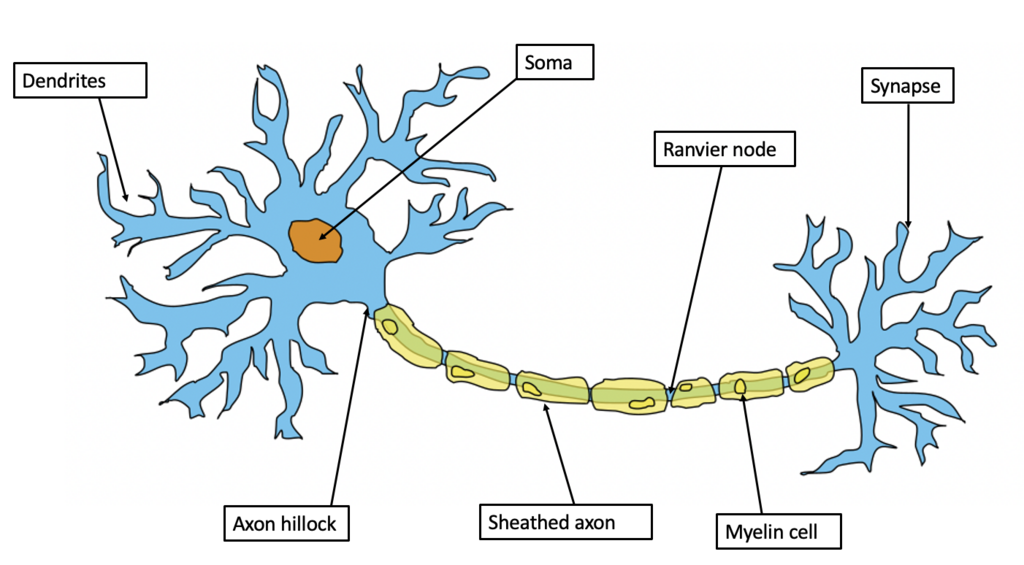
Anatomy of a Neuron
Each part of a neuron has a specific job in the process of sending and receiving signals.
Soma (Cell Body) The soma is the neuron's command center. It contains the nucleus, which holds the cell's genetic material, and other organelles that produce proteins and energy to keep the neuron alive and functioning. You can think of it as the cell's factory and life-support system.
Dendrites Extending from the soma are branch-like structures called dendrites. Their name comes from the Greek word dendron, meaning "tree." These are the neuron's receivers. They collect incoming signals from other neurons and pass them along to the soma.
Axon The axon is a long, slender fiber that extends from the soma. Its job is to transmit the electrical signal, called an action potential, away from the cell body toward other neurons, muscles, or glands. Many axons are covered in a fatty substance called the myelin sheath, which acts like insulation on an electrical wire. This insulation helps the signal travel much faster and more efficiently. Gaps in the myelin sheath are called nodes of Ranvier, and they help regenerate the signal as it moves along the axon.
Synaptic Terminals At the very end of the axon are the synaptic terminals, also known as axon terminals. These small branches are the neuron's transmitters. When the electrical signal reaches these terminals, it triggers the release of chemical messengers to communicate with the next cell in the chain. The tiny gap between the synaptic terminal and the next cell's dendrite is called a synapse.
Information in a neuron flows in one direction: from the dendrites, through the soma, down the axon, and out through the synaptic terminals.
The Unsung Heroes
Neurons don't work alone. They are supported by a cast of other cells called glial cells, or simply glia. The name comes from a Greek word meaning "glue," as early scientists thought they just held the neurons together. We now know they do much more.
| Glial Cell Type | Primary Function |
|---|---|
| Astrocytes | Provide nutrients, maintain ion balance, and clean up debris. |
| Oligodendrocytes & Schwann Cells | Form the myelin sheath around axons (in the brain/spinal cord and peripheral nerves, respectively). |
| Microglia | Act as the immune cells of the brain, protecting against pathogens and injury. |
By understanding the structure of neurons and the crucial support from glial cells, we can begin to see how this incredible network is built. Each component plays a vital role in the complex process of communication that underlies all our actions and thoughts.
Ready to check your understanding?
What is the primary function of a neuron's dendrites?
Which part of the neuron contains the nucleus and is considered the cell's 'command center'?
With this foundation in place, you're ready to explore how these signals actually travel and communicate.