Introduction to Natural Language Processing
Introduction to NLP
Teaching Computers to Talk
Human language is complex. It's filled with sarcasm, slang, and subtle nuances that even we don't always get right. So, how can we teach a computer, which thinks in 1s and 0s, to understand it? That's the central question of Natural Language Processing, or NLP.
NLP is a subfield of artificial intelligence, and it is the ability of a computer to detect and understand human language, through speech and text just the way we humans can.
At its core, NLP is a field that blends computer science, artificial intelligence, and linguistics. It's not just about recognizing words; it's about understanding the meaning, intent, and sentiment behind them. The ultimate goal is to enable computers to understand, interpret, and generate human language in a way that is both meaningful and useful.
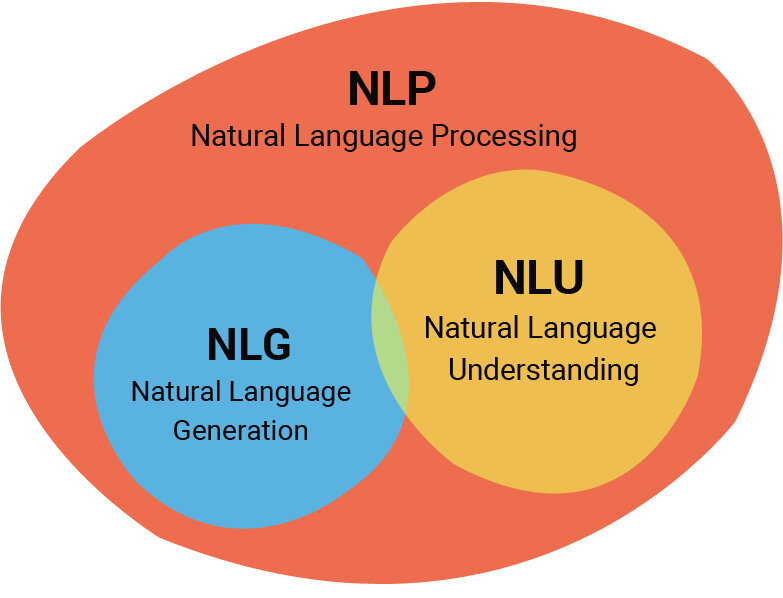
This involves two main tasks. First, there's Natural Language Understanding (NLU), which focuses on a computer's ability to read and comprehend text. Then there's Natural Language Generation (NLG), which is about making the computer produce human-like text on its own. Together, they form the backbone of NLP.
From Simple Rules to Deep Learning
The dream of computers understanding language is almost as old as computers themselves. In 1950, Alan Turing proposed his famous "Turing Test," which challenged a machine to exhibit intelligent behavior indistinguishable from that of a human. A key part of that test was conversing through text.
Early attempts were promising but limited. The 1954 Georgetown-IBM experiment successfully translated over 60 Russian sentences into English. It was a groundbreaking moment, but it relied on a very small vocabulary and a strict set of hand-coded grammatical rules. Scaling this approach proved incredibly difficult.
For decades, progress was slow. Researchers realized that language was far too messy and ambiguous for simple rule-based systems. A single word can have multiple meanings, and context is everything. Think about the word "bank." It could mean a financial institution or the side of a river. Without context, a computer is lost.
Everything changed with the rise of machine learning in the 1980s and 90s. Instead of writing rules by hand, developers began feeding computers massive amounts of text and letting them learn the patterns for themselves. This statistical approach was much more flexible and powerful.
The last decade has seen another leap forward with the advent of deep learning and neural networks, which are loosely modeled on the human brain. These models can process language with a level of sophistication that was once science fiction, leading to the powerful AI tools we see today.
| Year | Milestone |
|---|---|
| 1950 | Alan Turing proposes the Turing Test, a test of a machine's ability to exhibit intelligent behavior. |
| 1954 | The Georgetown-IBM experiment demonstrates automatic translation of Russian to English. |
| 1966 | ELIZA, an early chatbot that simulated conversation with a psychotherapist, is created. |
| 1990s | Statistical models become the dominant approach in NLP, moving away from handwritten rules. |
| 2010s | Deep learning models revolutionize the field, leading to major advances in translation and understanding. |
NLP in Your Daily Life
You probably use NLP every day without even realizing it. It's the technology that powers many of the tools you rely on.
Machine Translation: Services like Google Translate use sophisticated NLP to translate not just words, but entire sentences and their meanings between languages.
Chatbots and Virtual Assistants: When you ask Siri or Alexa for the weather, NLP is what allows the device to understand your spoken request and provide a relevant answer.
Spam Filters: Your email service analyzes the content of incoming messages to determine if they're junk. That's NLP at work, identifying patterns commonly found in spam.
Sentiment Analysis: Companies use NLP to scan social media and reviews to gauge public opinion about their products. It helps them understand if customer feedback is positive, negative, or neutral.
These are just a few examples. From predictive text on your phone to summarizing long articles, NLP is quietly making technology more accessible and intuitive by allowing us to interact with it in our own language.
Let's test your understanding of the basics of Natural Language Processing.
Natural Language Processing (NLP) is a field that primarily blends which three disciplines?
What is the primary function of Natural Language Understanding (NLU)?
NLP is a fascinating and rapidly evolving field. By bridging the gap between human communication and computer computation, it's paving the way for more natural and powerful ways to interact with technology.