Introduction to Music Production
Introduction to Music Production
The Producer's Role
A music producer is like the director of a film. They guide a song from a raw idea to a finished track, making creative and technical decisions along the way. While some producers are musicians who write their own material, others are expert collaborators who help artists shape their sound.
The producer's job isn't just about twisting knobs or making beats. They manage the entire recording process, from scheduling studio time to coaching vocalists. They need a deep understanding of music and technology to translate an artist's vision into a polished recording that connects with listeners.
Ultimately, a music producer wears many hats, acting as a creative visionary, technical expert, collaborator, and project manager.
The Production Journey
Creating a song is a step-by-step process. While every project is different, music production generally follows four key stages.
It begins with Arrangement, which involves deciding how the song will be structured. This is where you map out the verses, choruses, and bridges, and choose which instruments will play which parts.
Next is Recording, the process of capturing the actual sounds. This could involve using microphones for vocals and acoustic instruments, or recording electronic instruments directly into the computer.
Once all the parts are recorded, they are combined in the Mixing stage. The goal of mixing is to balance the volume levels, frequencies, and placement of each track to create a cohesive and clear soundscape.
Finally, Mastering is the last step. It's the final polish that ensures the song sounds good on any playback system, from tiny earbuds to massive club speakers. Mastering makes the track commercially loud and consistent with other songs.
Think of mixing as cooking a meal. Each instrument is an ingredient, and the mix engineer's job is to ensure every flavor is present without any one ingredient overpowering the others.
Tools of the Trade
Modern music production relies on a combination of software and hardware. While you can create amazing music with just a laptop, a typical studio includes a few key pieces of gear.
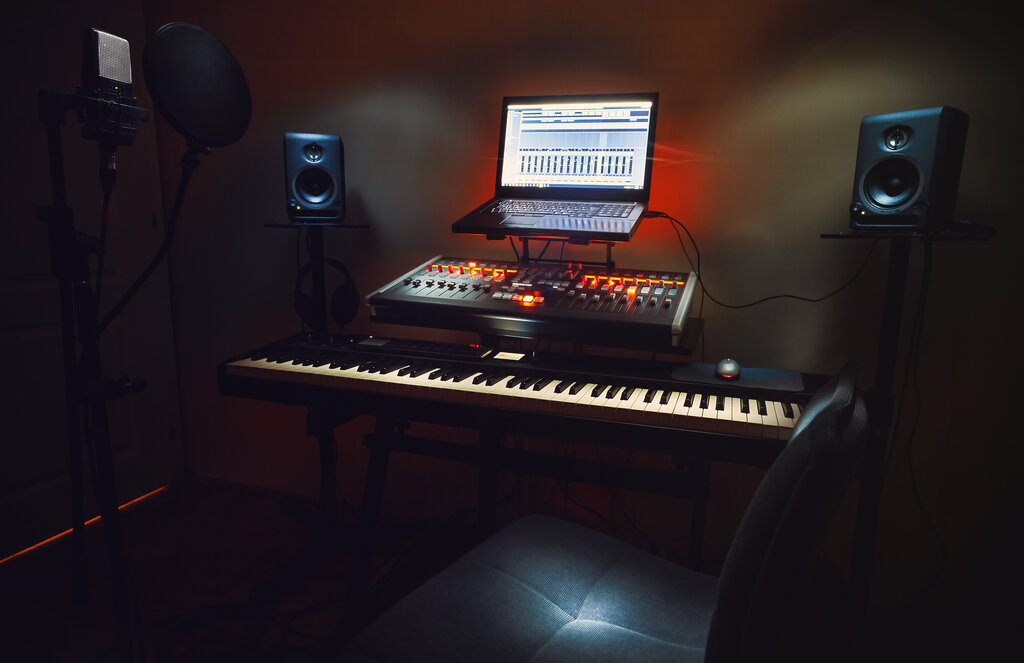
The heart of the studio is the Digital Audio Workstation (DAW). This is the software used to record, edit, and mix music. Popular examples include Ableton Live, Logic Pro X, and FL Studio.
An Audio Interface acts as the bridge between microphones or instruments and the computer, converting analog sound into digital data.
MIDI controllers, often in the form of a keyboard, allow producers to play and record software-based instruments, like synthesizers and drum machines, that live inside the DAW.
To hear everything accurately, producers rely on studio Monitors (specialized speakers) and Headphones. These are designed to provide a flat, uncolored sound, allowing for precise mixing decisions.
Ready to test your knowledge? Let's see what you've learned about the fundamentals of music production.
What is the primary role of a music producer?
Which of the following represents the correct order of the main stages in music production?
These core concepts—the producer's role, the stages of production, and the basic tools—are the foundation of creating music. With this framework in mind, you're ready to explore how each element works in more detail.