Introduction to Motion
Introduction to Motion
What Is Motion?
Motion is all around us. A car driving down the street, a planet orbiting the sun, and even the tiny particles that make up the air are all in motion. Simply put, motion is a change in an object's position over time.
But how do we know something has moved? It’s all about perspective.
Imagine you're on a train, reading a book. As far as you're concerned, the book isn't moving. It's right there in your hands. But to someone standing on a platform watching the train zip by, both you and your book are moving very fast.
This is why we need a reference point—a stationary place or object used for comparison to determine if something is in motion. For the person on the platform, the ground is a reference point. For you on the train, your seat is a reference point. Motion is always described relative to something else.
Distance vs. Displacement
When an object moves, we can describe its journey in two ways: by the distance it traveled or by its displacement. They sound similar, but they mean very different things.
Distance is the total length of the path an object takes. If you walk one mile to a store and one mile back, you've walked a total distance of two miles.
Displacement, on the other hand, is the object's overall change in position. It’s the straight-line path from the starting point to the ending point, and it includes direction.
In the example of walking to the store and back, even though you walked two miles, your journey ended exactly where it began. So, your displacement is zero. Distance tells you how far you went, while displacement tells you how far you are from where you started.
Distance is a scalar quantity (it only has magnitude, like 2 miles), while displacement is a vector quantity (it has both magnitude and direction, like 2 miles east).
Speed, Velocity, and Acceleration
Just like we have distance and displacement, we have two ways to describe how fast an object is moving: speed and velocity.
Speed is how fast an object is moving, or the rate at which it covers distance. When your car's speedometer reads 60 miles per hour, it's telling you your speed. It's a scalar quantity.
Velocity
noun
The rate at which an object changes its position; its speed in a particular direction.
Velocity, like displacement, is a vector. It describes an object's speed and its direction of motion. Two cars can have the same speed (60 mph) but different velocities if they're traveling in different directions, say one east and one west.
But what happens when velocity changes? That's where acceleration comes in.
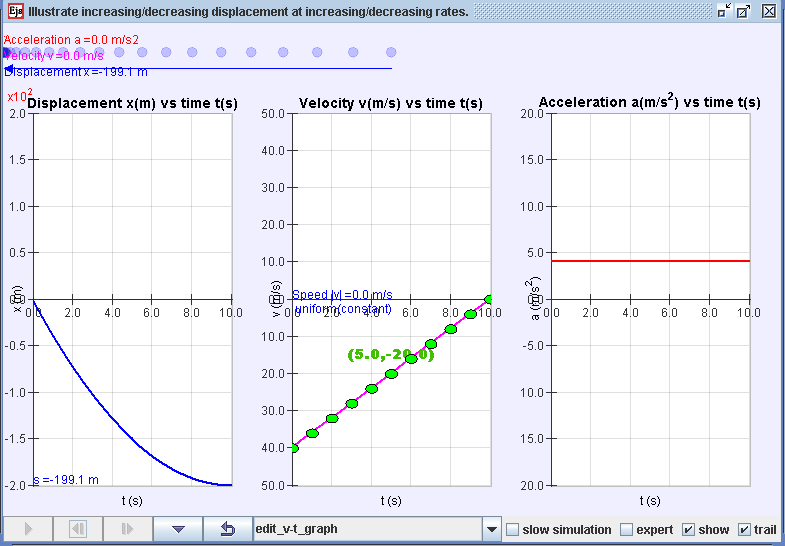
Acceleration is the rate at which an object's velocity changes. Because velocity includes both speed and direction, you are accelerating if you:
- Speed up (like pressing the gas pedal).
- Slow down (like hitting the brakes).
- Change direction (like turning a corner, even if your speed stays the same).
Acceleration is a key concept that helps us understand everything from a thrown ball's arc to the orbit of the moon. It's the link between forces and motion.
Types of Motion
We can categorize motion based on how an object's speed changes.
Uniform motion occurs when an object travels at a constant speed in a straight line. Its velocity does not change, meaning its acceleration is zero. Think of a car on cruise control on a perfectly straight highway.
Non-uniform motion occurs when an object's speed changes over time. A city bus that frequently starts, stops, and turns is a perfect example of non-uniform motion. Most movements we see in everyday life fall into this category.
A runner jogs 2 kilometers east, then turns around and jogs 2 kilometers west, ending up back where they started. What is the runner's total distance traveled and their total displacement?
Two cars are driving on a highway. Car A is traveling at 65 mph north, and Car B is traveling at 65 mph south. Which statement is true?
Understanding these basic ideas—reference points, displacement, velocity, and acceleration—is the first step into the world of physics.