Introduction to Molecular Dynamics
Introduction to Molecular Dynamics
The Dance of Molecules
Imagine trying to understand a complex, fast-paced dance by looking at a single photograph. You might see the dancers' positions at one instant, but you'd miss the flow, the interactions, and the story of the performance. To truly understand it, you need to watch the video.
Molecular Dynamics (MD) is like a video for the world of atoms and molecules. It's a computer simulation that lets us watch how these tiny particles move, interact, and change over time. By simulating this intricate dance, we can understand why materials have certain properties, how proteins fold into complex shapes, or how a drug might interact with a cell.
Molecular Dynamics
noun
A computational method used to simulate the physical movements of atoms and molecules over time.
Tiny Planets, Same Rules
The core idea behind molecular dynamics is surprisingly simple: atoms and molecules, much like planets orbiting the sun, follow the basic laws of motion. The simulation engine is powered by one of the most famous equations in physics, Newton's second law.
This law tells us that the force on an object is equal to its mass times its acceleration (). In an MD simulation, we treat each atom as a point mass. If we can calculate the total force acting on an atom from all its neighbors, we can figure out its acceleration. And if we know its acceleration, we can predict where it will be and how fast it will be moving a moment later.
But where do these forces come from? Unlike planets, which are governed by gravity, the forces between atoms are primarily electromagnetic. They attract and repel each other based on their distance and the nature of the chemical bonds connecting them. Calculating these forces is the next crucial step.
Calculating the Forces
To calculate the forces between atoms, simulations use a set of mathematical functions called a force field. A force field is like a detailed rulebook that describes the potential energy of the system based on the positions of all its atoms. It breaks down the complex interactions into simpler, manageable parts: bonds stretching, angles bending, and atoms pushing and pulling on each other from a distance.
The total potential energy, , of the system is the sum of these different energy terms.
The force on any atom is then calculated by determining how the potential energy changes as that atom moves. Think of it like a ball on a hilly landscape. The force of gravity pulls the ball in the steepest downhill direction. Similarly, the force on an atom pulls it toward a position of lower potential energy. Mathematically, the force is the negative gradient of the potential energy.
Moving Through Time
So, we have the initial positions of our atoms and a way to calculate the forces on them. Now we need to advance the simulation, creating the frames of our molecular movie. This is done through numerical integration.
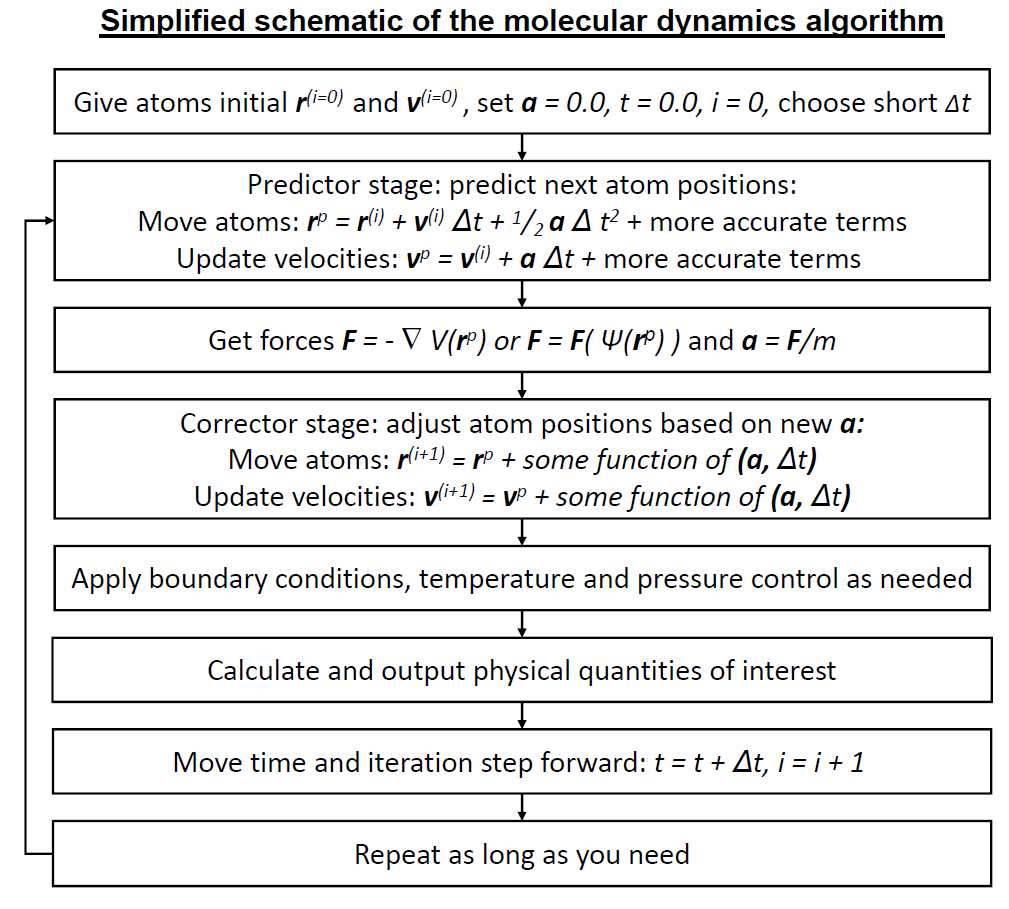
We can't just solve the equations of motion perfectly for a system with thousands of atoms. Instead, we take tiny steps forward in time. A typical time step in MD is a femtosecond—a millionth of a billionth of a second. For each step, we do the following:
- Calculate the forces on all atoms based on their current positions.
- Use these forces to calculate the acceleration of each atom ().
- Use the accelerations to update the velocities and positions of all atoms after one time step.
- Repeat millions of times.
An algorithm, such as the popular Verlet algorithm, is used to update the positions and velocities. This process is repeated over and over, generating a trajectory that shows how the system evolves. The result is a detailed, dynamic view of molecular behavior that can be analyzed to extract valuable information.
Molecular Dynamics Simulations – Understanding the movement and behavior of molecules over time.
The applications are vast. In drug design, MD can show how a potential drug molecule binds to a target protein. In materials science, it can help predict the strength and flexibility of a new polymer. And in biology, it can reveal the intricate mechanisms of molecular machines that keep life going.
By turning complex physics into a step-by-step movie, molecular dynamics gives us a powerful window into a world that's too small and too fast to see directly.
What is the primary analogy used to explain the benefit of Molecular Dynamics (MD) over static observations?
What fundamental physical law is the 'engine' of a Molecular Dynamics simulation, used to calculate the acceleration of atoms?