Introduction to Modular Forms
Complex Analysis Basics
The Complex Plane
To begin our journey, we need a new kind of number. Real numbers are great for measuring things along a line, but they have a limitation: you can't take the square root of a negative number. Mathematicians solved this by defining a new number, , with a special property.
This simple definition opens up an entire new world. Numbers that include are called complex numbers. They have the general form , where is the "real" part and is the "imaginary" part. Don't let the name fool you; these numbers are just as valid as real numbers.
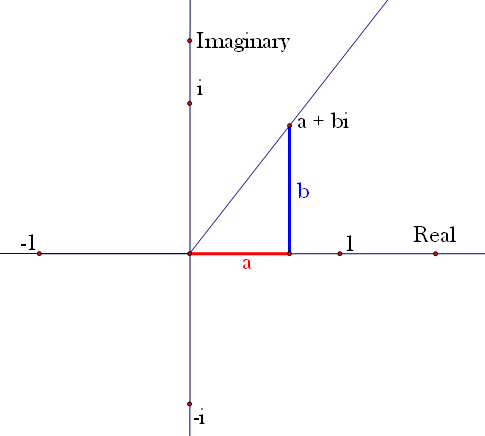
Since a complex number has two parts, we can't place it on a simple number line. Instead, we use a two-dimensional grid called the complex plane. The horizontal axis is the real axis, and the vertical axis is the imaginary axis. Any complex number corresponds to the point on this plane.
One of the most beautiful and useful properties of complex numbers is Euler's formula. It connects the exponential function to trigonometry in a surprising way.
This formula shows that moving in a circle on the complex plane is related to exponential growth in an imaginary direction. It's a cornerstone of complex analysis.
Smooth Functions in a Complex World
In regular calculus, we study functions and their derivatives. We can do the same with complex numbers. A complex function takes a complex number as input and produces another complex number as output.
The most important functions in complex analysis are called analytic or holomorphic. These are functions that are "smooth" in a very strong sense. A function is analytic if it has a derivative at every point in a region of the complex plane. This is a much stricter condition than having a derivative in real calculus.
For a function , where , to be analytic, its real part and imaginary part must satisfy a pair of conditions called the Cauchy-Riemann equations.
You don't need to memorize these, but the key idea is that they connect the rates of change in the real and imaginary directions. If a function satisfies these equations, it behaves in a very predictable and regular way. Polynomials, exponentials, and trigonometric functions are all analytic everywhere on the complex plane.
Journeys Through the Plane
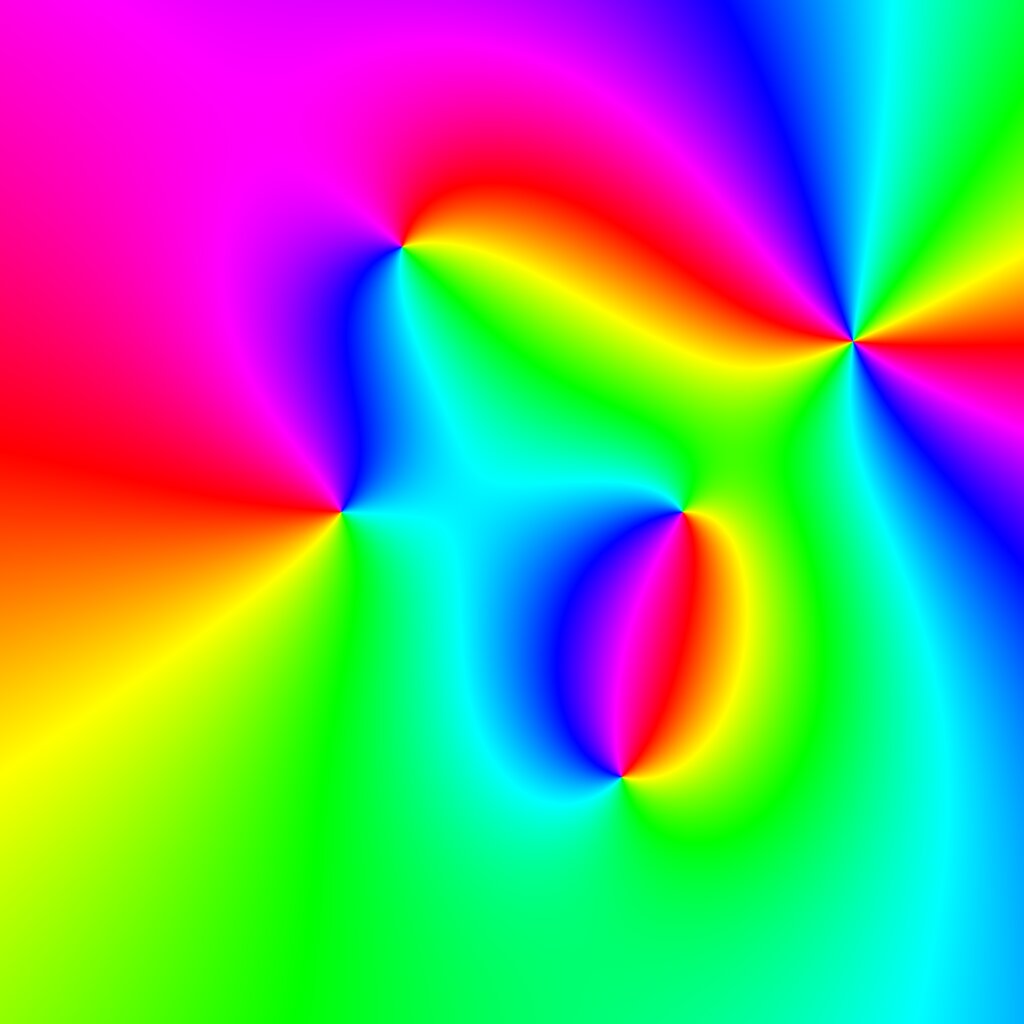
Integration in complex analysis is different from what you see in introductory calculus. Instead of finding the area under a curve, we integrate along a path, or contour, in the complex plane. Imagine the complex plane is a landscape with hills and valleys representing the function's output. A contour integral is like walking along a specific trail and summing up the "heights" you encounter at each step.
These paths can be straight lines, circles, or any other curve. The result of the integral often depends on the path taken, especially if the path goes around a point where the function misbehaves.
Points where a function is not analytic are called singularities. These are like holes or spikes in our landscape. The behavior of an integral changes dramatically depending on whether its path encloses any singularities.
Cauchy's Powerful Shortcuts
The theory of complex integration is dominated by two incredible results from the mathematician Augustin-Louis Cauchy. The first is Cauchy's Integral Theorem. It states that if a function is analytic everywhere inside and on a closed contour, then the integral along that contour is zero.
For an analytic function, a round trip in the complex plane always brings you back to where you started, with a net change of zero.
This is a profound result. It means that for smooth functions, the path of integration between two points doesn't matter, as long as you don't cross any singularities. But what happens if the path does enclose a singularity?
This is where Cauchy's Integral Formula comes in. It's even more powerful. It says that the value of an analytic function at any point inside a contour is completely determined by the function's values on the contour itself.
This formula is like a magic trick. It lets us calculate the value of a function at a point just by integrating along a loop that encloses it. The term in the denominator creates a singularity at exactly the point we're interested in.
These two theorems are the foundation of complex analysis. They simplify calculations enormously and reveal the rigid structure of analytic functions. Understanding them is the key to unlocking the behavior of more advanced objects, like modular forms.
What is the defining property of the imaginary unit, ?
How is a complex number of the form represented graphically?
These concepts form the basic toolkit for working with complex functions. With this foundation, we can begin to explore more specialized and fascinating areas of mathematics.