Introduction to MLOps
Introduction to MLOps
What is MLOps?
A data scientist has just built a fantastic machine learning model. It can predict customer churn with impressive accuracy. The problem? It only exists on their laptop. It's a brilliant piece of work, but it isn't helping the business yet. Getting that model from a research environment into a live product that makes a real impact is a huge challenge. This is the challenge MLOps solves.
MLOps
noun
A set of practices for reliably and efficiently deploying and maintaining machine learning models in production.
MLOps, short for Machine Learning Operations, is the bridge between building a model and using it. It's a discipline that combines machine learning, data engineering, and the principles of DevOps to automate and streamline the entire machine learning lifecycle.
MLOps addresses the entire machine learning lifecycle, from data collection and preparation to model training, deployment, monitoring, and continuous improvement.
The goal is simple: to make the process of getting models into production faster, more reliable, and scalable. Without MLOps, deploying a model can be a slow, manual, and error-prone process. With it, teams can release new models confidently and frequently.
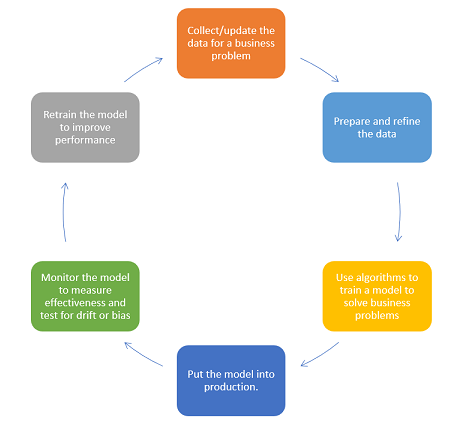
The Three Pillars
A successful ML system isn't just about the model. The model is a crucial component, but it's just one piece of a much larger puzzle. MLOps brings together three distinct fields to build and manage the whole system.
-
Machine Learning: This is the core domain of data scientists. It involves exploring data, running experiments, and training algorithms to create predictive models.
-
DevOps: Borrowed from traditional software engineering, DevOps focuses on automation, infrastructure, and processes to build, test, and release software quickly and reliably. MLOps applies these principles to machine learning.
-
Data Engineering: A model is only as good as the data it's trained on. Data engineering is responsible for creating robust, automated pipelines that collect, clean, and transform data to feed the models.
Core Principles
MLOps is guided by a few key principles that transform the ML lifecycle from a manual research project into an automated, production-ready system.
Automation Automate everything you can, from data pipelines and model training to testing and deployment. This reduces manual errors and frees up the team to focus on building better models, not just managing them.
CI/CD CI/CD stands for Continuous Integration and Continuous Delivery/Deployment. In MLOps, this means automatically testing new code, validating new data, and deploying new models. It creates a seamless pipeline from a data scientist's code to the production environment.
Version Control In software, you version your code. In MLOps, you need to version everything: the code, the dataset used for training, and the resulting model. This creates an audit trail, ensures reproducibility, and allows you to roll back to a previous version if something goes wrong.
| Asset | What It Is | Why It's Versioned |
|---|---|---|
| Code | The scripts used for data processing and model training. | To track changes in logic and algorithms. |
| Data | The specific dataset used to train a model version. | To ensure experiments are reproducible. |
| Model | The trained artifact that is ready for deployment. | To link a specific model to its code and data. |
Monitoring Once a model is deployed, the job isn't done. The real world changes, and a model's performance can degrade over time. Monitoring involves continuously tracking the model's predictions and key performance metrics to catch issues early. When performance drops, it triggers an alert to retrain and redeploy the model.
What is the primary purpose of MLOps?
MLOps integrates Machine Learning and Data Engineering with principles from which other major field?
By embracing these principles, teams can build robust machine learning systems that deliver continuous value to the business.