Introduction to Military English
Basic Military Terminology
The Language of the Military
In the military, clear communication can be a matter of life and death. There's no room for ambiguity. That's why a specialized vocabulary exists, ensuring every order and report is understood instantly and precisely. Learning this terminology is the first step to navigating the military world, whether you're a new recruit or simply trying to understand the context of a news report.
Who's Who: Ranks and Units
The military is built on a strict hierarchy called the chain of command. A person's rank determines their position and level of authority within this structure. Ranks are divided into two main categories: enlisted personnel, who form the backbone of the military, and commissioned officers, who are in leadership and management roles.
| Category | Rank | Abbreviation |
|---|---|---|
| Enlisted | Private | PVT |
| Enlisted | Corporal | CPL |
| Enlisted | Sergeant | SGT |
| Enlisted | Staff Sergeant | SSG |
| Officer | Lieutenant | LT |
| Officer | Captain | CPT |
| Officer | Major | MAJ |
| Officer | Colonel | COL |
These are just a few examples, as each branch of the military has its own detailed rank structure. An individual's rank is a core part of their identity and is always used when addressing them. Knowing the difference between a Sergeant and a Colonel is crucial for understanding who gives orders and who follows them.
Soldiers are organized into units of increasing size. This structure allows for effective command and control over a large number of personnel.
A squad is the smallest and most fundamental unit, often led by a Sergeant. Several squads form a platoon, typically commanded by a Lieutenant. Platoons are grouped into a company, led by a Captain. Finally, companies are organized into a battalion, under the command of a Lieutenant Colonel. This modular structure allows the military to scale its operations effectively.
Gear and Operations
Beyond people, military language includes specific terms for equipment and actions. While the technology is always advancing, the core vocabulary remains consistent.
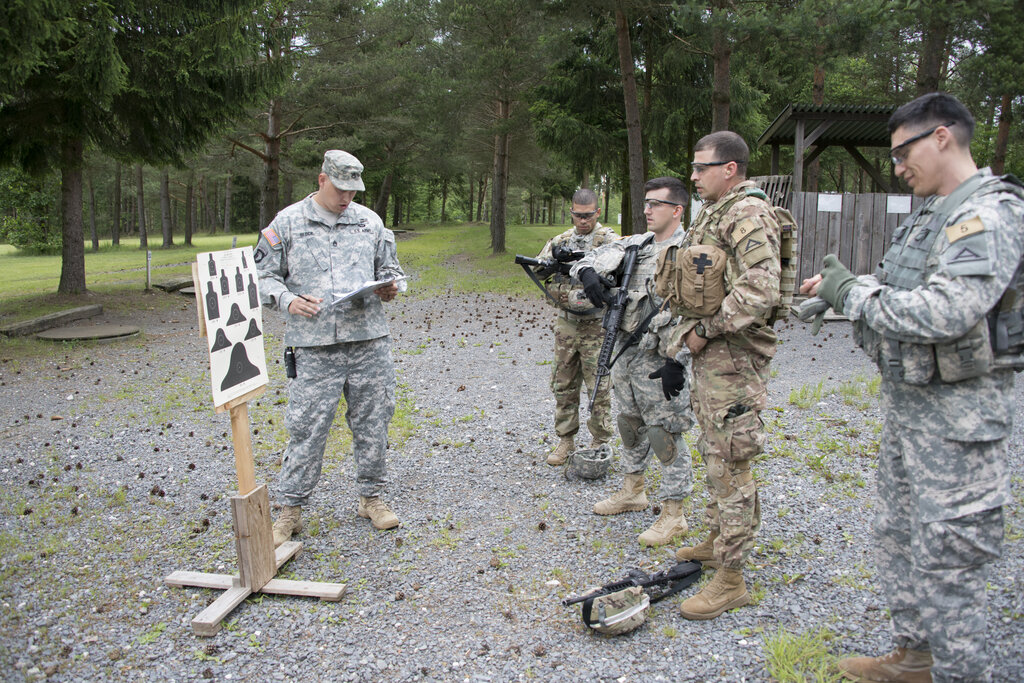
An individual's standard equipment is often referred to as their kit or loadout. This includes their uniform, body armor (often called a plate carrier), helmet, and a rucksack (or ruck) for carrying supplies. Communications equipment, or comms, is vital for coordinating actions with the rest of the unit.
deployment
noun
The movement of troops and equipment to a specific location to accomplish a mission.
Operational terms describe what units are doing. A deployment is the process of sending troops to a foreign country or a different region for an extended period. Once in the area of operations, units may perform a maneuver, which is a coordinated movement of forces to gain an advantage. These terms are used in briefings and reports to describe the mission's status and objectives.
Ready to test your knowledge of these foundational terms?
Military ranks are primarily divided into which two main categories?
Which of the following military units is typically commanded by a Captain?
Mastering this basic vocabulary is the first step toward understanding military culture and communication. Each term has a specific meaning that ensures everyone is on the same page.