Introduction to Measure Theory
Introduction to Measure Theory
Measuring the Unmeasurable
How long is a line? What's the area of a square? These questions are simple enough. But what if we want to measure something more complex, like the size of a jagged, infinite set of points on a line? Our usual tools of length, area, and volume start to fall apart. Measure theory provides a powerful, generalized way to assign a 'size'—called a measure—to subsets of a set.
Think of it like this. You have a big bag of sand (your total set). You can easily measure the volume of a scoop of sand. But what's the 'volume' of only the red grains? Or the volume of all grains that have an odd number of facets? To answer these tricky questions, we first need to define which collections of grains are actually 'measurable'.
Building a Solid Framework
It turns out that trying to assign a measure to every possible subset of a space leads to strange paradoxes. To avoid this, we create a specific collection of subsets that we are allowed to measure. This collection is called a sigma-algebra (or σ-algebra), and it follows a few sensible rules that make our measurements consistent.
sigma-algebra
noun
A collection of subsets of a set X that is closed under complement and countable unions. It provides the family of 'measurable' sets.
A collection of subsets, let's call it , is a σ-algebra on a set if it satisfies three conditions:
- The entire set is in the collection . (We must be able to measure the whole space.)
- If a subset is in , then its complement, , is also in . (If we can measure a set, we can measure what's not in it.)
- If we have a countable sequence of subsets that are all in , their union is also in . (If we can measure individual pieces, we can measure them all put together.)
A set paired with a σ-algebra, written as , is called a measurable space. It's the foundation upon which we can build a measure.
Defining the Measure
Once we have a measurable space, we can define a measure. A measure is a function that takes a set from our σ-algebra and assigns it a non-negative number, which we think of as its size. This function, let's call it (the Greek letter mu), also has to follow a couple of important rules.
First, the measure of the empty set must be zero. This makes sense; a set with nothing in it should have a size of zero.
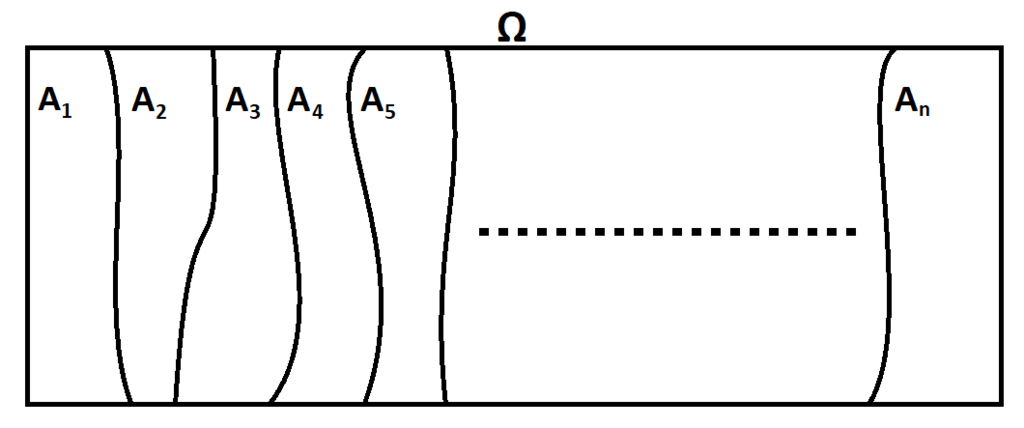
Second, and most importantly, it must have a property called countable additivity. This means that if you take a countable collection of sets from your σ-algebra that don't overlap (they are pairwise disjoint), the measure of their union is simply the sum of their individual measures.
This formula is the heart of measure theory. It ensures that our concept of 'size' behaves intuitively, even when dealing with infinitely many pieces.
Functions That Play by the Rules
Now that we have measurable spaces, we need a way to talk about functions between them that respect their structure. This brings us to the idea of a measurable function.
Imagine we have two measurable spaces, and . A function is called measurable if it 'maps' measurable sets in the output space back to measurable sets in the input space. More formally, for any measurable set in the codomain's σ-algebra , its preimage must be a measurable set in the domain's σ-algebra .
preimage
noun
For a function f from X to Y, the preimage of a subset B of Y is the set of all elements in X that f maps to B. It is denoted f⁻¹(B).
So, a function is measurable if for every set , the set is in .
This property is essential. It guarantees that we can ask meaningful questions about the measure of sets defined by the function's output. For example, in probability theory, we can ask for the probability that a random variable (a measurable function) takes a value within a certain range. This is only possible if the set of outcomes that produce that range is itself measurable.
These three concepts—sigma-algebras, measures, and measurable functions—form the bedrock of modern analysis and probability. They provide a rigorous way to handle the idea of size for a vast range of mathematical objects.