Introduction to Matrices
Matrix Basics
Grids of Numbers
At its heart, a matrix is just a way to organize numbers. Think of a spreadsheet, a calendar, or a tic-tac-toe board. They're all grids that hold information in a structured way. A matrix is simply a rectangular arrangement of numbers, symbols, or expressions, organized into rows and columns.
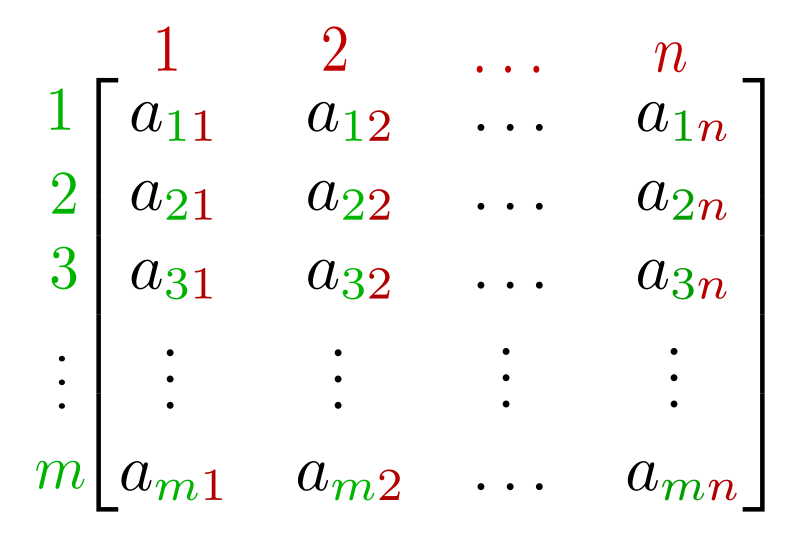
We describe the size of a matrix by its dimensions: the number of rows and columns it has. The convention is always rows by columns. A matrix with 2 rows and 3 columns is called a "2 by 3" matrix, written as . The numbers that run horizontally form the rows, and the numbers that run vertically form the columns.
A matrix with 5 rows and 2 columns has dimensions , not . The order matters!
Notation and Elements
We typically use a capital letter, like , to name a matrix and use square or round brackets to enclose its numbers. Each number inside the matrix is called an element. Here is an example of a matrix named .
To talk about a specific element, we use the matrix's name (as a lowercase letter) with a subscript that gives the element's address: first the row number, then the column number. So, refers to the element in the i-th row and j-th column.
In the matrix we saw earlier, the element is 1 (first row, first column). The element is 7 (second row, third column). And is -5. This simple address system is crucial for performing calculations with matrices.
Let's check your understanding of these basic terms.
What are the dimensions of the following matrix?
Consider the matrix . What is the value of the element ?
That's the basic anatomy of a matrix. It's a powerful tool for organizing data, which is the first step toward doing interesting things with it.