Introduction to Mathematics
Arithmetic
The Building Blocks of Math
At its heart, math is about understanding numbers. The simplest numbers we use are whole numbers: 0, 1, 2, 3, and so on. They're the numbers we use to count things in the real world. With these numbers, we can perform four basic actions, or operations: addition, subtraction, multiplication, and division. Think of them as the fundamental tools in your mathematical toolkit.
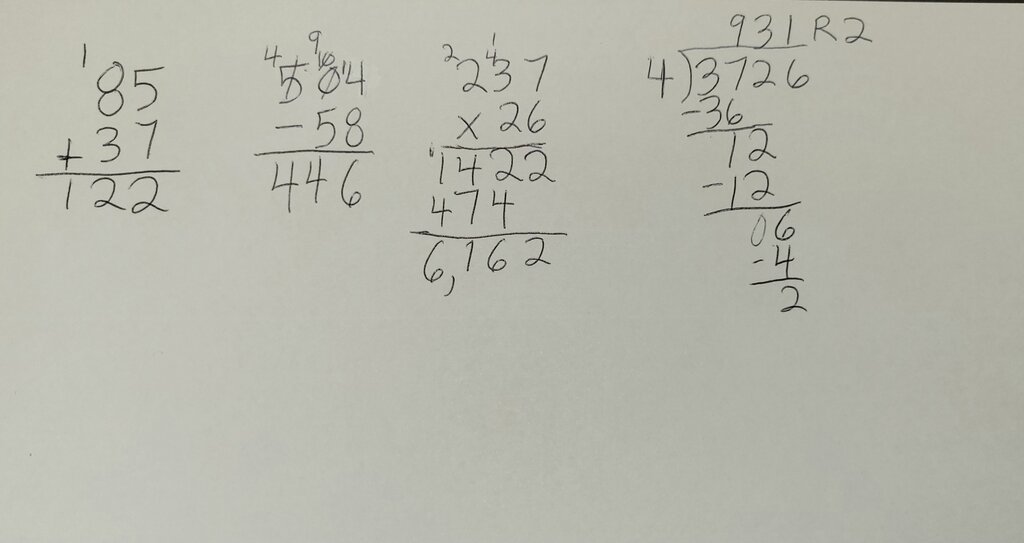
Addition is about combining things. If you have 3 apples and you get 2 more, you add them together to find the total: apples.
Subtraction is the opposite; it's about taking things away. If you start with 5 apples and eat 2, you subtract to see what's left: apples.
Multiplication is just a shortcut for repeated addition. Instead of adding , you can simply multiply: . It's much faster.
Division is about splitting things into equal groups. If you have 12 apples and want to share them equally among 3 friends, you divide: . Each friend gets 4 apples.
Working with Parts of a Whole
Sometimes we need to work with numbers that aren't whole. That's where fractions come in. A fraction represents a part of a whole, like a slice of a pizza or a piece of a pie. A fraction has two parts: a numerator (the top number) and a denominator (the bottom number).
The denominator tells you how many equal pieces the whole is divided into. The numerator tells you how many of those pieces you have.
For example, in the fraction 3/8, the whole is split into 8 equal parts, and we are considering 3 of them.
Fractions can often be written in a simpler form. This is called simplifying. For instance, if you have 4/8 of a pizza, you really have half of it. So, 4/8 is the same as 1/2. To simplify a fraction, you find the largest number that divides evenly into both the numerator and the denominator and divide both by it.
To add or subtract fractions, they must have the same denominator, called a common denominator. If you want to add 1/3 and 1/4, you first need to find a denominator that both 3 and 4 go into, like 12. You convert 1/3 to 4/12 and 1/4 to 3/12. Now you can add them: $4/12 + 3/12 = 7/12$.
Multiplying fractions is more straightforward. You just multiply the numerators together and the denominators together. For example, to multiply 1/2 by 3/4, you calculate , which equals 3/8.
Dividing fractions is almost as simple. To divide by a fraction, you flip the second fraction over (this is called finding the reciprocal) and then multiply. So, to divide 1/2 by 3/4, you calculate 1/2 multiplied by 4/3, which gives you 4/6. This can then be simplified to 2/3.
Decimals and Percentages
Decimals are another way to write fractions. They are based on the number 10 and its multiples. The position of a digit after the decimal point tells you its value. For example, 0.5 is the same as 5/10, or 1/2. The number 0.75 is the same as 75/100, or 3/4.
To convert a fraction to a decimal, you divide the numerator by the denominator. For example, 3 divided by 4 is 0.75. To convert a decimal to a fraction, you write the decimal as a fraction over a power of 10 (like 10, 100, 1000) and then simplify. For example, 0.6 is 6/10, which simplifies to 3/5.
When you add or subtract decimals, the most important thing is to line up the decimal points. For multiplication, you multiply the numbers as if they were whole numbers, and then you place the decimal point in the answer. The number of decimal places in the result is the sum of the decimal places in the numbers you multiplied.
Finally, we have percentages. The word "percent" literally means "per hundred." So, 50% means 50 out of 100, which is the fraction 50/100 or the decimal 0.5. Percentages are useful for talking about proportions, like a discount at a store or the interest rate on a loan.
To find a percentage of a number, you convert the percentage to a decimal or a fraction and then multiply. To find 25% of 80, you can multiply 80 by 0.25, which gives you 20. Another way is to know that 25% is 1/4, and 1/4 of 80 is also 20.
Understanding how to calculate percentage increase or decrease is also a handy skill. If a 💲10 item increases in price by 20%, the increase is 20% of 💲10, which is 💲2. The new price is 💲12.
Which of the following expressions is equivalent to ?
When adding or subtracting fractions, they must have the same denominator.