Introduction to Material Science
Atomic Structure
The Building Blocks of Materials
Everything you see and touch is made of atoms. From the water you drink to the screen you're reading this on, it's all collections of these tiny particles. But what makes steel strong and rubber stretchy? The answer lies not just in which atoms are present, but how they're connected and arranged.
Atoms are like social creatures. They rarely exist alone. Instead, they link up with other atoms through chemical bonds, driven by the interactions of their outermost electrons. These bonds are the fundamental glue of the universe, and the type of bond determines many of a material's properties.
How Atoms Stick Together
There are three main ways atoms bond with each other: by giving and taking electrons, by sharing them, or by pooling them in a collective sea. Each method creates a unique type of bond with distinct characteristics.
An ionic bond is a give-and-take relationship. One atom transfers one or more electrons to another. This creates ions, which are atoms with a net positive or negative charge.
The classic example is table salt, or sodium chloride (). A sodium atom () gives up its single outer electron to a chlorine atom (), which needs one to complete its outer shell. The sodium becomes a positive ion (), and the chlorine becomes a negative ion (). Just like tiny magnets, these opposite charges attract, forming a strong ionic bond.
Next up is the covalent bond, which is all about sharing. Instead of a transfer, two atoms share electrons to complete their outer shells. This sharing creates a very strong and stable link between the atoms.
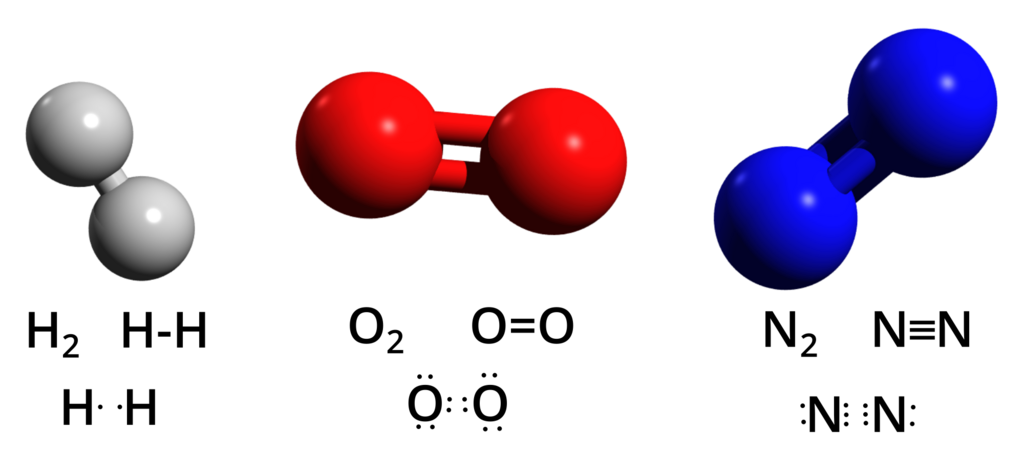
Think of water (). The oxygen atom shares electrons with two hydrogen atoms. This arrangement gives all three atoms the stability they seek. Diamond is another great example. Each carbon atom forms four strong covalent bonds with its neighbors, creating an incredibly hard and rigid structure.
Finally, there's the metallic bond. This is unique to metals. In a metallic solid, the atoms release their outer electrons, which then form a mobile "sea" of electrons that surrounds a grid of positive metal ions.
This electron sea is what makes metals special. It holds the positive ions together, but it's not rigid. The ions can slide past one another, which is why metals can be bent and shaped without breaking (they are malleable and ductile). The freely moving electrons are also why metals are excellent conductors of heat and electricity.
Order in the Atomic World
When atoms bond to form a solid, they often don't just clump together randomly. In many materials, especially metals and ceramics, they organize themselves into a highly ordered, repeating three-dimensional pattern. This pattern is called a crystal structure or a crystal lattice.
When matter crystallizes, its atoms spontaneously organize themselves into the rows, columns and stacks of a three-dimensional lattice.
To understand a crystal lattice, we can look at its smallest repeating component, called the unit cell. Imagine building a wall with identical bricks. The single brick is the unit cell. By stacking it over and over, you create the entire wall. In the same way, the unit cell is the fundamental building block of the crystal.
There are many types of unit cells, but three common cubic structures are particularly important for metals:
| Structure | Abbreviation | Description |
|---|---|---|
| Body-Centered Cubic | BCC | Atoms are at each corner of a cube and one is in the very center. |
| Face-Centered Cubic | FCC | Atoms are at each corner and in the center of each of the six faces. |
| Hexagonal Close-Packed | HCP | Atoms are arranged in a hexagonal pattern, forming tightly packed layers. |
The way these atoms are packed has a direct impact on the material's properties. For instance, the FCC structure is more densely packed with atoms than the BCC structure. This difference in packing affects density, strength, and how the material deforms under stress. A material's crystal structure is a key piece of information that helps engineers predict its behavior.
Understanding these fundamental bonds and structures is the first step in understanding why materials behave the way they do. It’s the atomic-level architecture that dictates the macroscopic world we interact with every day.
What is the primary mechanism that forms an ionic bond?
A material is an excellent conductor of electricity and can be easily bent into a new shape without breaking. Which type of chemical bond is most likely responsible for these properties?