Introduction to Marine Biology
Introduction to Oceanography
The Ocean's Physical Nature
Oceans are constantly in motion, shaped by physical forces and properties. Three of the most important are temperature, density, and pressure. Ocean temperature varies dramatically with location and depth. Water near the equator is much warmer than at the poles. But temperature also changes as you go deeper. The sun only warms the top layer of water. Below this, there's a transition zone called the thermocline, where the temperature drops rapidly. In the deep ocean, it's perpetually cold and dark, just a few degrees above freezing.
Density is a measure of how much mass is packed into a certain volume. In the ocean, density depends on two things: temperature and salinity (how salty the water is). Cold water is denser than warm water, and salty water is denser than fresh water. This might seem like a small detail, but these density differences are a major driving force behind the ocean's massive circulation patterns.
Finally, pressure increases tremendously with depth. At sea level, we experience about 14.7 pounds of pressure per square inch from the atmosphere. For every 10 meters you descend into the ocean, the pressure increases by one whole atmosphere. In the deepest parts of the ocean, like the Mariana Trench, the pressure is over 1,000 times greater than at the surface. It’s like having the weight of 50 jumbo jets stacked on top of you.
The sharp drop in temperature in the thermocline creates a barrier that separates the upper ocean from the colder, deeper water below. This layering, or stratification, has a huge impact on marine life and the distribution of nutrients.
A Salty Chemical Mix
Seawater isn't just water. It’s a complex solution of dissolved mineral salts and gases. The total amount of dissolved salt is called salinity. On average, about 3.5% of the weight of seawater comes from these salts. While that sounds small, it means that if you evaporated all the water from the oceans, you'd be left with a layer of salt about 60 meters thick covering the entire Earth.
The most abundant salt is sodium chloride, or common table salt. But many other ions are present. A remarkable feature of ocean chemistry is that while total salinity can vary from place to place, the relative proportion of the major ions is almost always the same. This principle of constant proportions means that ocean water is chemically well-mixed over long timescales.
| Ion | Symbol | Concentration (g/kg) | Percent of Total |
|---|---|---|---|
| Chloride | Cl⁻ | 19.35 | 55.0% |
| Sodium | Na⁺ | 10.77 | 30.6% |
| Sulfate | SO₄²⁻ | 2.71 | 7.7% |
| Magnesium | Mg²⁺ | 1.29 | 3.7% |
| Calcium | Ca²⁺ | 0.41 | 1.2% |
| Potassium | K⁺ | 0.40 | 1.1% |
Besides salts, gases from the atmosphere dissolve in seawater. Oxygen is crucial for marine animals to breathe. Carbon dioxide is also a key player. The ocean absorbs enormous amounts of CO₂, which has profound effects on both marine chemistry and the global climate.
Global Currents and Tides
The ocean is never still. Its movements are driven by currents and tides. Tides are the daily rise and fall of sea level, caused primarily by the gravitational pull of the Moon and, to a lesser extent, the Sun. As Earth rotates, different parts of the planet are pulled by the Moon's gravity, creating two high tides and two low tides each day in most places.
Ocean currents are like massive rivers flowing within the ocean, moving water over vast distances. They can be split into two main types.
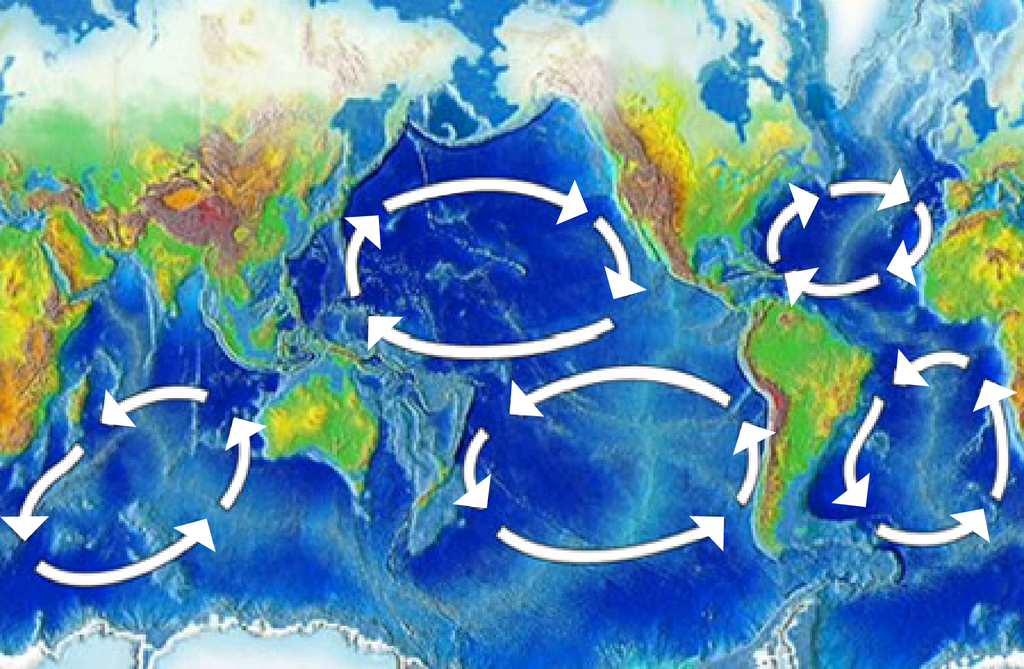
Surface currents are found in the upper 400 meters of the ocean and are driven mainly by wind. As wind blows across the ocean's surface, it drags the water along. Because the Earth is spinning, these currents are deflected—to the right in the Northern Hemisphere and to the left in the Southern Hemisphere. This is known as the Coriolis effect, and it organizes surface currents into large circular patterns called gyres.
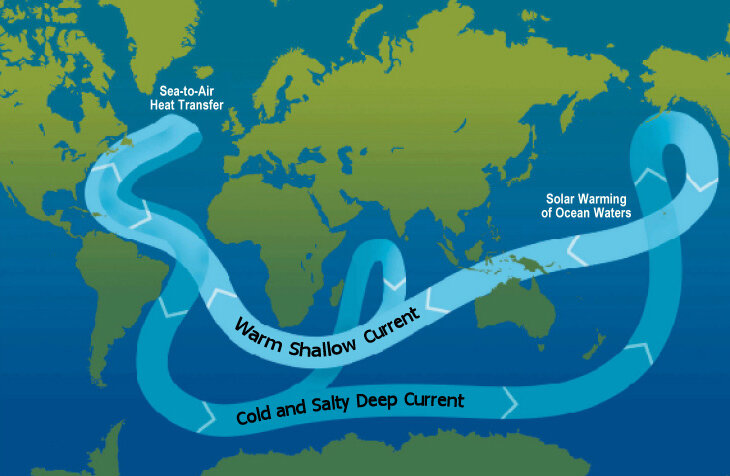
Deep currents are driven by differences in water density. This process, known as thermohaline circulation, is a global conveyor belt powered by heat (thermo) and salt (haline). In polar regions, seawater gets very cold and salty as sea ice forms. This makes the water dense, causing it to sink to the deep ocean floor. This sinking water pushes deep water along, creating a slow-moving but powerful current that travels across the entire globe. One full cycle can take about 1,000 years.
The Climate Connection
The ocean is a key regulator of Earth's climate. Because water has a high heat capacity, it can absorb and store huge amounts of solar energy without its own temperature increasing dramatically. Ocean currents then transport this heat around the world. For example, the Gulf Stream brings warm water from the tropics to the North Atlantic, giving Western Europe a much milder climate than it would otherwise have.
The ocean also plays a critical role in the global carbon cycle. It has absorbed about a quarter of all the carbon dioxide humans have released into the atmosphere. This has slowed the pace of climate change, but it's also changing the ocean's chemistry, a process known as ocean acidification.
By absorbing heat and carbon dioxide, circulating nutrients, and driving weather patterns, the ocean helps make our planet habitable. Its physical and chemical properties are the foundation for the rich web of life it supports and the stable climate we depend on.
What are the two primary factors that determine the density of seawater?
The thermocline is a layer in the ocean where...