Introduction to Mandarin Chinese
Chinese Phonetics
Sounds You Can See
How do you learn to pronounce a language that uses characters instead of an alphabet? You start with Pinyin. Pinyin is the official system for transcribing Mandarin sounds using the Roman alphabet—the same one used for English. It's a bridge that lets you see how a word is spoken before you learn its character.
"Pinyin", the official Chinese phonetic system, is a way to learn to pronounce Chinese characters correctly using Roman alphabet and "tones".
Think of it as a set of pronunciation instructions. By learning Pinyin, you build a strong foundation for speaking and listening correctly from day one.
Building Blocks of Sound
Every syllable in Mandarin is made of two parts: an initial and a final.
An initial is the consonant sound that starts the syllable. A final is the vowel sound (or combination of vowel sounds) that follows. Put them together, and you have a complete syllable. For example, in the Pinyin syllable bāo, the b is the initial and the āo is the final.
| Type | Pinyin Components |
|---|---|
| Initials | b, p, m, f, d, t, n, l, g, k, h, j, q, x, zh, ch, sh, r, z, c, s |
| Finals | a, o, e, i, u, ü, ai, ei, ao, ou, an, en, ang, eng, ong, er... and more |
Some syllables don't have an initial and are just a final sound, like ài (love). But the basic structure—initial plus final—is the key to pronouncing almost any word in Mandarin.
The Music of Mandarin
Now for the most important part: tones. Mandarin is a tonal language, which means the pitch you use to say a syllable changes its meaning. The same sound can mean completely different things depending on whether your voice goes up, down, or stays flat. There are four main tones, plus a fifth neutral tone.
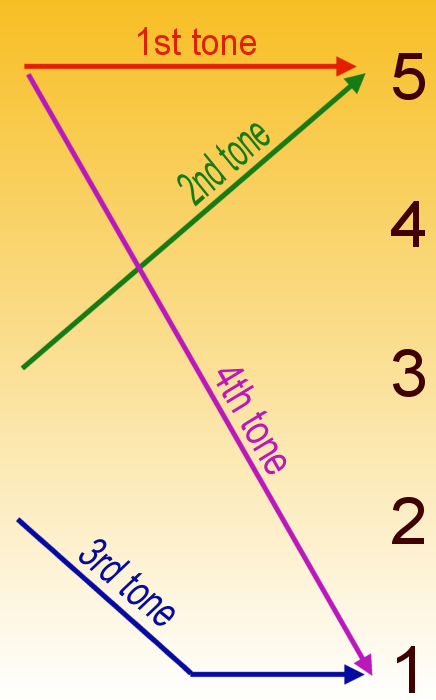
Here’s a breakdown of the tones:
- First Tone (mā): A high, flat pitch. Imagine a singer holding a high note. It's written with a straight line above the vowel: mā.
- Second Tone (má): A rising pitch. It sounds like you're asking a question, like "What?" The tone mark slants up: má.
- Third Tone (mǎ): A dipping pitch. Your voice falls and then rises. It's the most complex tone. The tone mark is a small checkmark: mǎ.
- Fourth Tone (mà): A sharp, falling pitch. It's like giving a command, such as "Go!" The tone mark slants down: mà.
- Neutral Tone (ma): This tone is light, short, and has no tone mark. It's often used for grammatical particles or the second syllable of some words.
The classic example to show the power of tones is the syllable ma.
| Pinyin | Tone | Meaning |
|---|---|---|
| mā | First | mother (妈) |
| má | Second | hemp (麻) |
| mǎ | Third | horse (马) |
| mà | Fourth | to scold (骂) |
| ma | Neutral | (question particle) (吗) |
Combining Tones
When you speak, you'll be stringing syllables—and tones—together. The way tones interact can be tricky, but there are patterns. For example, a common rule involves two third tones in a row.
If you have two third-tone syllables back-to-back, like in the greeting nǐ hǎo, the first third tone changes to a second tone. So, even though it's written as nǐ hǎo (both third tones), you actually pronounce it as ní hǎo (second tone + third tone). This makes it flow more smoothly.
Hello
Don't worry about memorizing all the rules right now. The most important thing is to listen carefully to native speakers and practice mimicking the sounds you hear. Your ear will gradually get used to the rhythm and flow of Mandarin tones.
Ready to test your knowledge of Pinyin and tones?
What is Pinyin?
A Mandarin syllable is typically composed of an initial (a consonant sound) and a ____ (a vowel sound).
Mastering Pinyin and tones is the first big step on your journey. It gives you the tools to pronounce any word you see and to be understood when you speak.