Introduction to Machine Learning
Introduction to Machine Learning
What is Machine Learning?
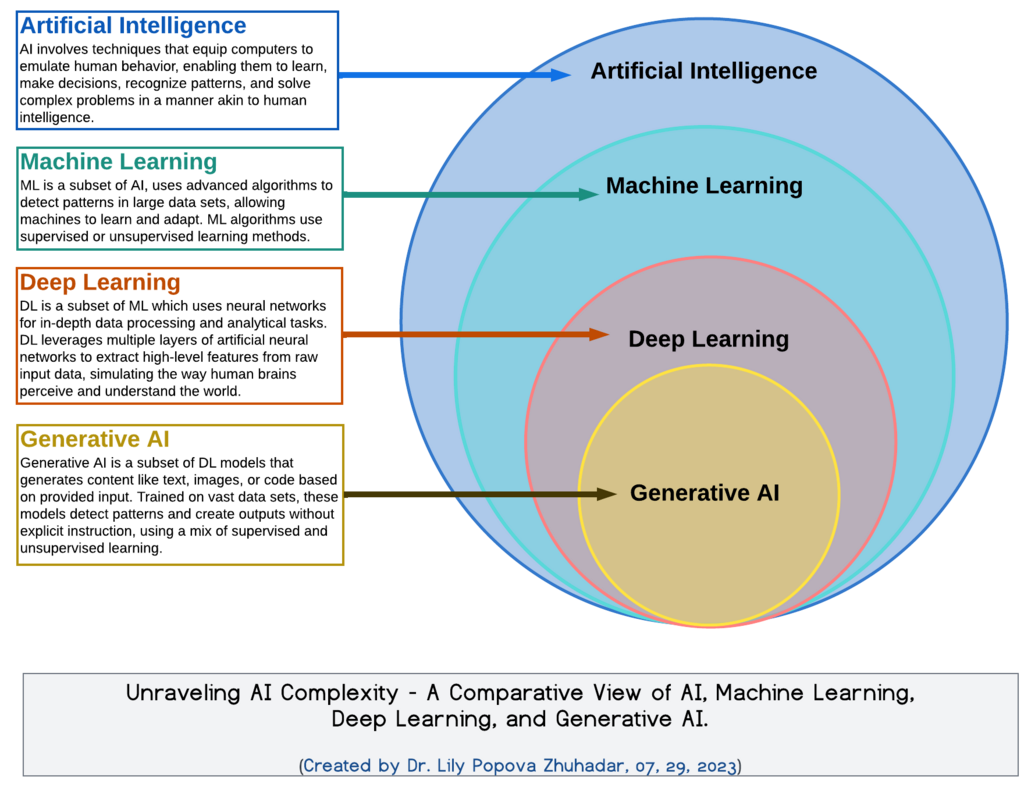
Think about how you learned to identify a cat. No one gave you a long list of rules like "if it has pointy ears, whiskers, and says 'meow,' it's a cat." Instead, you saw many examples of cats over time. Your brain learned to recognize the pattern on its own. Machine learning (ML) works in a similar way. It's a field of artificial intelligence where computers learn from data and experience, rather than being explicitly programmed for every task.
Instead of writing step-by-step instructions, developers create algorithms that allow a computer to learn from examples and improve its performance over time.
This ability to learn from data is what makes ML so powerful. It's the engine behind many things you use every day, from the spam filter in your email to the movie recommendations on your favorite streaming service. By finding patterns in vast amounts of information, machine learning helps us solve complex problems, make better predictions, and automate tasks that would be impossible for humans to do at scale.
Three Flavors of Learning
Machine learning isn't a single technique but a collection of approaches. These can be grouped into three main categories based on how the machine learns.
Supervised Learning
adjective
The machine learns from data that is already labeled. It's like studying with an answer key. The algorithm is given a set of inputs and the corresponding correct outputs, and its job is to learn the mapping function between them.
The goal is to get good enough at this mapping so that when you give it new, unlabeled data, it can accurately predict the output.
Unsupervised Learning
adjective
Here, the machine is given unlabeled data and must find patterns or structures on its own. There's no answer key. The algorithm explores the data to find inherent groupings or relationships.
This method is fantastic for exploring data and discovering insights you didn't know existed.
Reinforcement Learning
noun
This type of learning is based on trial and error. An 'agent' (the algorithm) learns to make decisions by performing actions in an environment to achieve a goal. For each action, it receives feedback in the form of a reward or a penalty.
The goal of the agent is to learn a policy—a strategy for choosing actions—that maximizes its cumulative reward over time.
| Learning Type | How it Learns | Real-World Example |
|---|---|---|
| Supervised | From labeled data (with answers) | Predicting house prices based on historical sales data. |
| Unsupervised | Finding patterns in unlabeled data | Grouping news articles by topic automatically. |
| Reinforcement | Through trial and error (rewards/penalties) | A robot learning how to navigate a maze. |
A Brief History
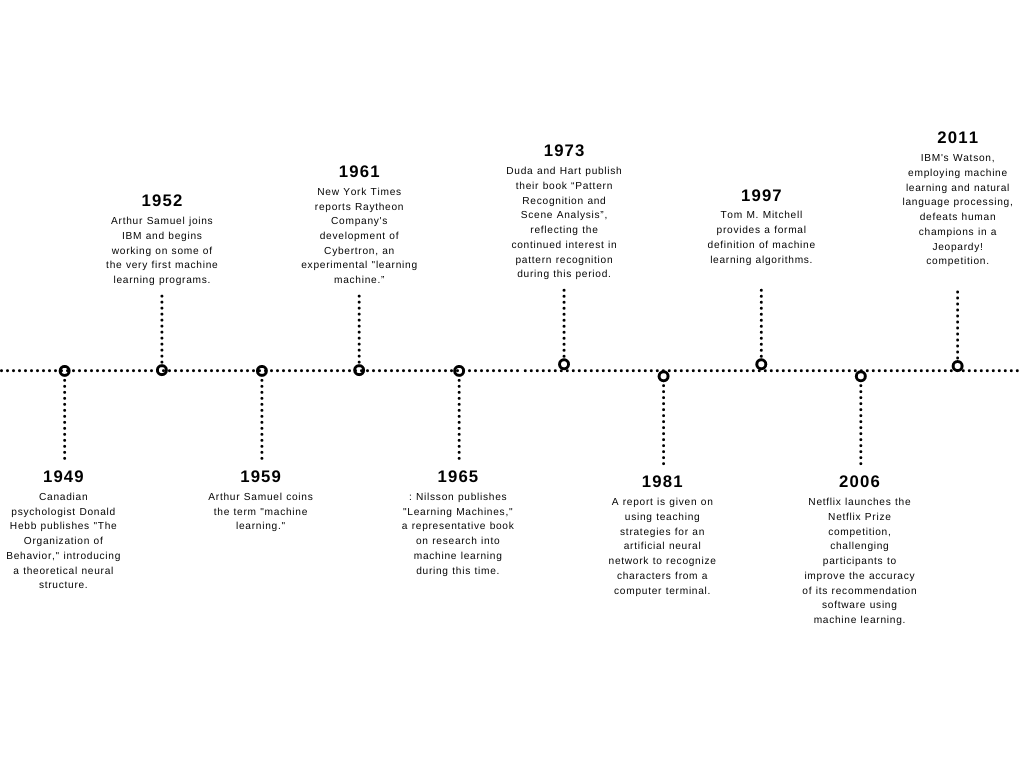
The idea of a machine that could learn is not new. The term "machine learning" was coined back in 1959 by Arthur Samuel, an IBM pioneer who created a checkers-playing program. His program learned from playing against itself and eventually became better than its creator. For decades, however, progress was slow due to a lack of data and the high cost of computing power.
In the last couple of decades, that has changed dramatically. The rise of the internet created massive datasets, and advancements in computing made it cheaper and faster to process that data. This combination of big data and powerful computers has fueled a golden age for machine learning, taking it from a niche academic field to a technology that powers global industries.
Today, machine learning is at the heart of countless applications. In healthcare, it helps diagnose diseases from medical images. In finance, it detects fraudulent transactions. In retail, it powers recommendation engines that personalize your shopping experience. And in transportation, it is the key technology behind self-driving cars. Its ability to turn raw data into actionable insights is transforming nearly every field it touches.
Let's check your understanding of these core concepts.
What is the primary way machine learning models learn?
An AI is trained to play a chess game by receiving a 'reward' for good moves and a 'penalty' for bad ones. Its goal is to maximize its total score over many games. This approach is focused on learning a strategy, or 'policy', to achieve the best outcome. Which learning method does this describe?
You now have a solid foundation in what machine learning is, its main types, and why it's become such a vital technology. As you continue, you'll build on these fundamentals to explore how these learning systems are built and applied.