Introduction to Machine Learning
Introduction to Machine Learning
What is Machine Learning?
Machine learning is a way to make computers learn from data and experience, much like humans do. Instead of writing explicit, step-by-step instructions for every possible scenario, we create algorithms that allow a computer to find patterns and make decisions on its own. The core idea is simple: feed the machine data, and it figures out the rules.
Think about how you learned to recognize a cat. No one gave you a strict set of rules like "if it has pointy ears, whiskers, and a long tail, it's a cat." You just saw many examples of cats, and eventually, your brain learned to identify them. Machine learning works similarly. By analyzing thousands of cat photos, a computer can learn to identify a cat in a new picture it has never seen before.
Machine learning enables a system to learn from data, identify patterns, and make decisions with minimal human intervention.
This ability is transformative. It's the engine behind spam filters that protect your inbox, recommendation systems that suggest movies you might like, and medical tools that can help doctors spot diseases earlier. It's about creating smarter, more adaptive systems that improve over time as they are exposed to more data.
AI, ML, and Deep Learning
You'll often hear the terms Artificial Intelligence (AI), Machine Learning (ML), and Deep Learning (DL) used together. They are related, but not interchangeable. The easiest way to understand them is as a set of Russian nesting dolls, one inside the other.
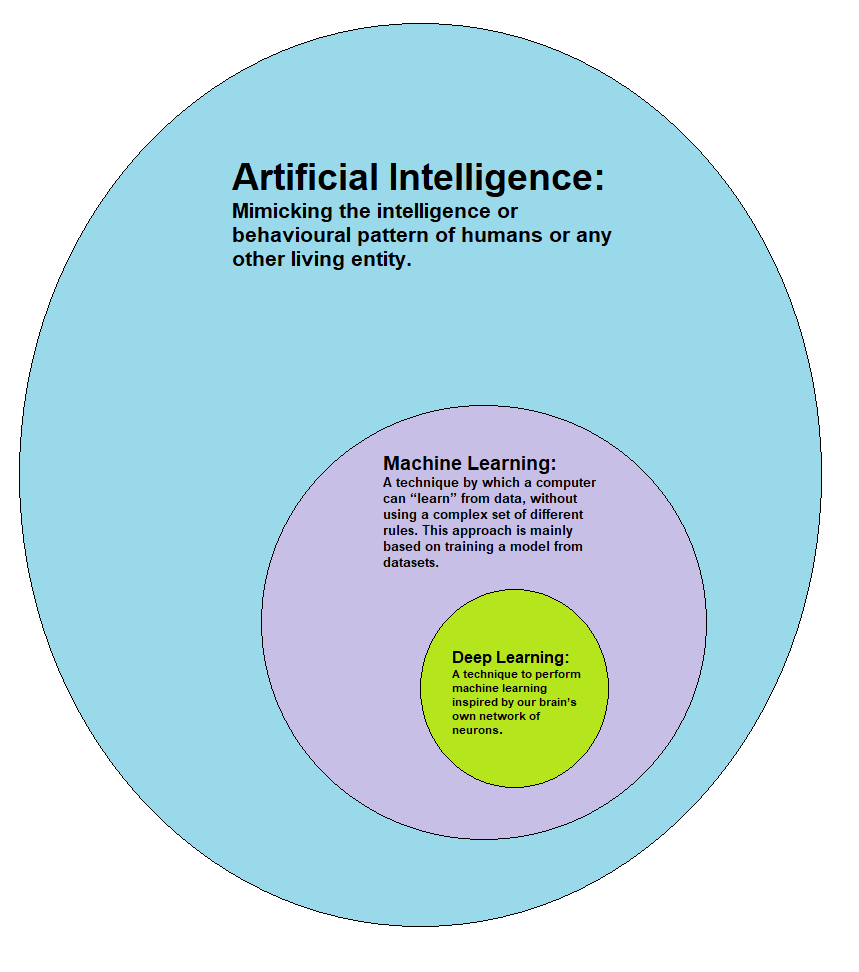
Artificial Intelligence (AI) is the broadest concept. It's the overall field of making machines intelligent, capable of mimicking human thought and behavior in any way.
Machine Learning (ML) is a subset of AI. It’s one of the most common and powerful ways to achieve AI. Instead of programming intelligence, we let the machine learn from data.
Deep Learning (DL) is a subset of ML. It uses complex, multi-layered neural networks (inspired by the human brain) to solve problems. Deep learning is especially good at finding intricate patterns in very large datasets, like images, sound, and text. Most of the recent breakthroughs you hear about, like advanced image recognition and sophisticated language models, are powered by deep learning.
Types of Machine Learning
Machine learning isn't a single approach; it's a collection of methods that can be grouped into a few main types. The best type to use depends on the problem you're trying to solve and the kind of data you have.
Supervised Learning
noun
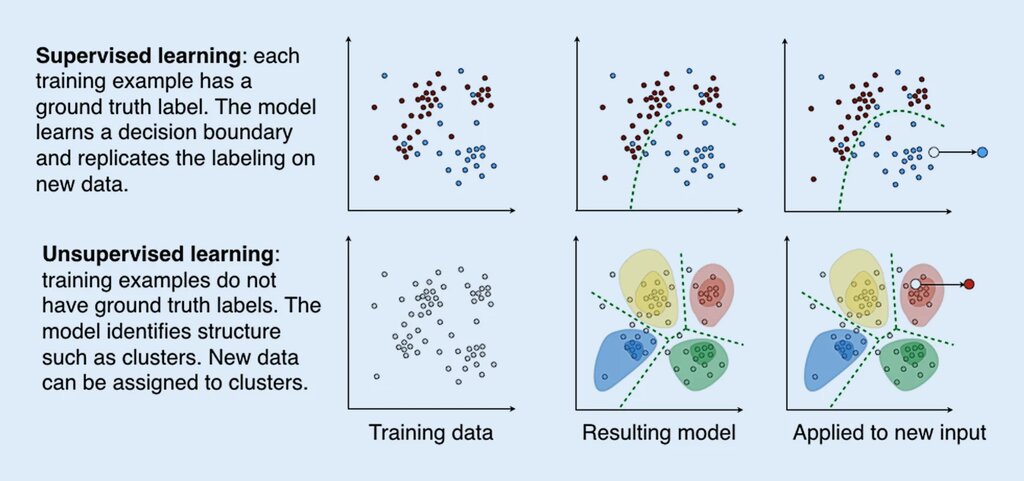
The machine learns from data that is already labeled with the correct answers. It's like studying with a set of flashcards that have both the question and the answer.
The goal in supervised learning is to learn a mapping function that can predict the output for new, unseen data. It's used for two main kinds of problems:
- Classification: Predicting a category, like whether an email is spam or not spam.
- Regression: Predicting a continuous value, like the price of a house based on its features (square footage, number of bedrooms, location).
Unsupervised Learning
noun
The machine learns from unlabeled data, finding hidden patterns and structures on its own without any answer key. It's like being given a box of mixed-up puzzle pieces and asked to sort them into logical groups.
Common tasks for unsupervised learning include:
- Clustering: Grouping similar data points together. For example, grouping customers by their purchasing habits.
- Association: Discovering rules that describe large portions of your data, such as "customers who buy bread also tend to buy milk."
Semi-Supervised Learning This is a hybrid approach. It uses a small amount of labeled data along with a large amount of unlabeled data. This is useful when labeling data is expensive or time-consuming. For instance, a photo app might have you label a few pictures of a person, and then it uses that information to find that person in all your other unlabeled photos.
Reinforcement Learning This type of learning is inspired by behavioral psychology. An algorithm, called an "agent," learns to make decisions by performing actions in an environment to achieve a goal. It learns from the consequences of its actions, receiving rewards for good decisions and penalties for bad ones. It’s a process of trial and error.
Reinforcement learning is the technology behind game-playing AI that can beat human champions in games like chess or Go. It's also used in robotics, for teaching robots how to perform tasks, and in training self-driving cars to navigate roads safely.
What is the fundamental principle of machine learning?
Which statement accurately describes the relationship between Artificial Intelligence (AI), Machine Learning (ML), and Deep Learning (DL)?
Understanding these core concepts gives you a map of the machine learning landscape. You can see how the different pieces fit together and which paths lead to solving different kinds of real-world problems.