Introduction to Machine Learning
Introduction to Machine Learning
What Is Machine Learning?
At its core, machine learning is a way to teach computers to find patterns. Instead of writing explicit, step-by-step instructions for every possible scenario, we give a computer a large amount of data and let it figure out the rules for itself. The computer builds a model, which is essentially its own understanding of the patterns in the data.
Think of it like this: you can either give someone a detailed recipe to bake a cake (traditional programming), or you can let them taste a hundred different cakes and have them figure out the recipe on their own (machine learning).
This ability to learn from experience is what makes machine learning so powerful. It's the engine behind email spam filters, movie recommendation systems, and voice assistants. In traditional programming, a developer writes rules. For a spam filter, a rule might be: "If an email contains the phrase 'free money', mark it as spam." But what if spammers change their tactics? The developer would have to write new rules endlessly.
A machine learning approach is different. We show the model thousands of examples of spam and non-spam emails. The model then learns the subtle characteristics that distinguish one from the other, far beyond what a human could manually program. It creates its own "rules" and can adapt as new spam techniques emerge.
How Machines Learn
Just as humans learn in different ways, machines have several methods for learning from data. These methods are called learning paradigms, and the three most common are supervised, unsupervised, and reinforcement learning.
Supervised Learning
other
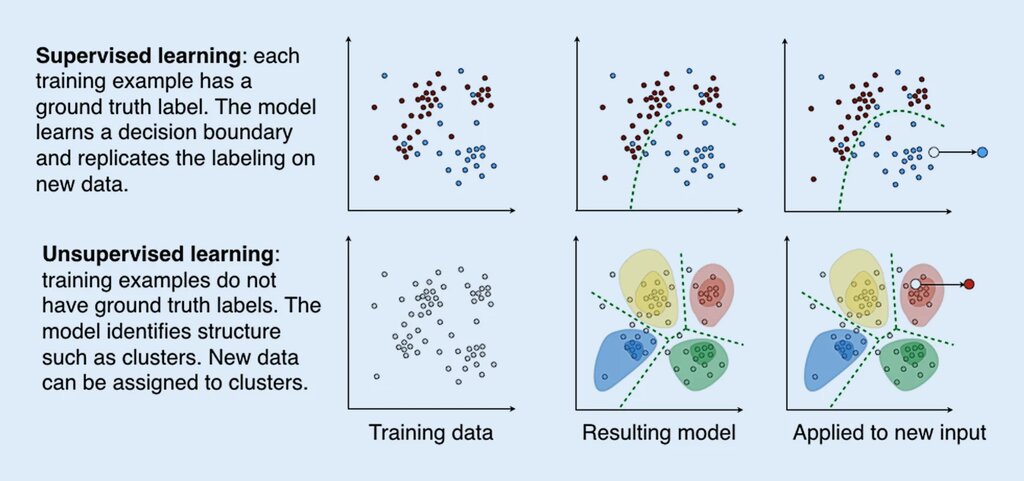
The machine learns from data that is already labeled with the correct answers. The goal is to learn a mapping function that can predict the output for new, unlabeled data.
Imagine teaching a child to identify different fruits. You show them a picture of an apple and say "apple." You show them a picture of a banana and say "banana." After many examples, the child learns to identify fruits they've never seen before. In this analogy, you are the "supervisor" providing the labeled data (pictures of fruit with their names). The machine learns the relationship between the input (the image) and the output (the label).
Unsupervised Learning
other
The machine learns from data that has not been labeled or categorized. The goal is to find hidden patterns or intrinsic structures in the input data.
Now imagine giving that same child a box of mixed fruit and asking them to sort it. Without knowing the names, they might group the fruits by color, shape, or size. They are finding patterns on their own. Unsupervised learning works the same way. The algorithm sifts through unlabeled data to discover natural groupings or clusters. This is useful for tasks like identifying customer segments or finding anomalies in a system.
The key difference: Supervised learning predicts an outcome based on labeled examples. Unsupervised learning discovers patterns within the data itself.
Finally, there's Reinforcement Learning. This is about learning through trial and error. An algorithm, called an agent, learns to make decisions by performing actions in an environment to achieve a goal. For correct actions, it receives a reward; for incorrect ones, it gets a penalty. The agent's objective is to maximize its total reward over time. This is the same way you might train a pet with treats. It's commonly used to teach machines how to play games or control robotic systems.
The Machine Learning Workflow
No matter which learning paradigm you use, developing a machine learning model follows a general, iterative process. It's not a linear path but a cycle of refinement.
Developing a machine learning model is an iterative process that consists of several phases: starting with requirements engineering, data gathering, preprocessing, and feature engineering; moving on to model training and tuning; and ending with model evaluation, deployment, and monitoring.
The journey always starts with data. Data is the fuel for machine learning. Without high-quality, relevant data, even the most advanced algorithm will fail. This is why a significant portion of any machine learning project is spent on gathering, cleaning, and preparing data.
Once the data is ready, the core steps include:
- Choosing a Model: Selecting an appropriate algorithm for the task (e.g., one for classification, one for clustering).
- Training the Model: Feeding the prepared data into the chosen model so it can learn the patterns.
- Evaluating the Model: Testing the model on new, unseen data to see how well it performs. Is it accurate? Does it make good predictions?
- Tuning: Adjusting the model's parameters to improve its performance. This is often repeated many times.
- Deployment: Putting the trained model into a real-world application to start making decisions or predictions.
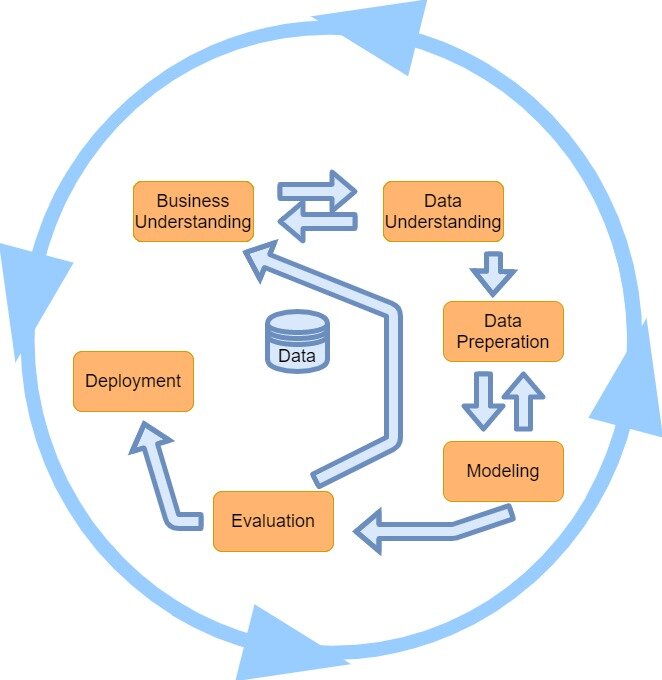
This cycle highlights a fundamental truth: data is not just an input; it's the foundation of the entire process. The quality of your data directly determines the quality of your model.
Now that we've covered the basic ideas, let's test your understanding.
What is the core difference between a machine learning approach and a traditional programming approach to solving a problem?
You are tasked with building an email filter. You train a model by feeding it thousands of emails that have already been labeled as 'spam' or 'not spam'. What type of machine learning paradigm is this?