Introduction to Machine Learning
Introduction to Machine Learning
What is Machine Learning?
Machine learning is a way of teaching computers to find patterns. Instead of giving a computer a detailed set of instructions for every single task, you give it a lot of data. The computer then learns from that data to make predictions or decisions on its own.
Think about how you learned to recognize a cat. No one gave you a list of rules like, "If it has pointy ears, whiskers, and a long tail, it's a cat." You just saw many examples of cats, and eventually, your brain learned to identify them. Machine learning works in a similar way. We show a computer thousands of cat photos, and it figures out the features that define a cat.
This ability to learn from experience is what makes machine learning so powerful. It's the engine behind personalized recommendations on streaming services, spam filters in your email, and even medical systems that can help doctors detect diseases earlier.
Machine learning enables a computer to learn from data rather than being explicitly programmed.
Learning vs Programming
Traditional programming is all about rules. A programmer writes explicit, step-by-step instructions that tell the computer exactly what to do. To build a calculator app, a programmer writes the code for how to add, subtract, and multiply. The computer follows these rules perfectly, but it can't do anything the programmer didn't anticipate.
Machine learning flips this around. Instead of starting with rules, you start with data and the answers you want. You provide the machine learning model with lots of examples, and it learns the rules that connect the inputs to the outputs. For a spam filter, you don't write rules like "if an email contains the word 'free', it's spam." Instead, you feed it thousands of emails that have already been labeled as 'spam' or 'not spam', and the model discovers the patterns that are common in spam messages.
This fundamental difference allows machine learning to solve problems that are too complex or change too often for traditional programming, like recognizing speech or predicting stock prices.
The Machine Learning Workflow
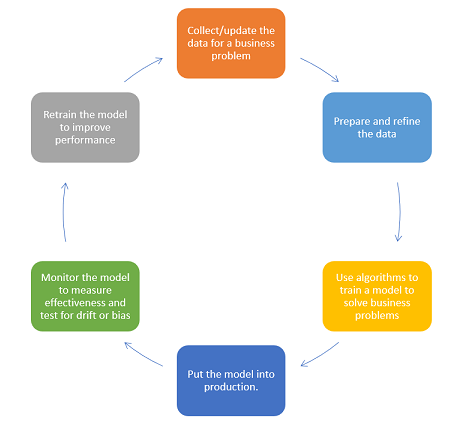
While every project is different, most machine learning applications follow a similar high-level process. It all starts with data.
- Data Collection: The first step is to gather the data that the model will learn from. This could be images, text, numbers in a spreadsheet, or sensor readings. The quality and quantity of this data are critical.
- Data Preparation: Raw data is often messy. This step involves cleaning the data, handling missing values, and formatting it in a way the model can understand.
- Model Training: This is where the learning happens. The prepared data is fed into a chosen algorithm, which adjusts its internal parameters to find patterns. This process is often called "fitting" a model to the data.
- Model Evaluation: After training, you need to check how well the model learned. This is done by testing it on a separate set of data it has never seen before. This tells you how well the model is likely to perform on new, real-world data.
- Deployment: Once you have a model that performs well, you can deploy it for its intended use, like making recommendations in a web app or identifying fraudulent transactions.
Types of Machine Learning
Machine learning isn't a single technique but a broad field with several distinct approaches. The best approach depends on the problem you're trying to solve and the kind of data you have. The main types are supervised, unsupervised, semi-supervised, and reinforcement learning.
Supervised Learning
other
The model learns from data that is already labeled with the correct answers. The goal is to learn a mapping function that can predict the output for new, unlabeled data.
Supervised learning is like learning with a teacher. The 'teacher' provides labeled examples, and the model's job is to figure out the general rule that connects the examples to their labels.
Unsupervised Learning
other
The model works with unlabeled data and tries to find hidden patterns or structures on its own, without any pre-existing outcomes to guide it.
With unsupervised learning, there is no teacher and no 'correct' answers. The goal is exploration. The model sifts through the data and groups similar items together, a process called clustering.
Between these two is semi-supervised learning, which uses a small amount of labeled data and a large amount of unlabeled data. This is useful when labeling data is expensive or time-consuming.
Finally, there's reinforcement learning. This type of learning is about taking actions in an environment to maximize a reward. The model learns through trial and error, much like training a pet. It receives rewards for good actions and penalties for bad ones. This is the approach used to train computers to play complex games like chess or Go.
Understanding these fundamental concepts is the first step into the world of machine learning. Each type has its own strengths and is suited for different kinds of real-world challenges.